FDA Orange Book: Where to Find Patent Expiration Dates for Generic Drugs
 Dec, 30 2025
If you're trying to figure out when a brand-name drug will lose patent protection and generics can hit the market, the FDA Orange Book is your most reliable starting point. It’s not a marketing brochure or a drug guide-it’s the official federal database that tracks every patent and exclusivity period tied to approved small-molecule drugs in the U.S. For pharmacists, generic manufacturers, investors, or even curious patients, knowing how to read this resource can mean the difference between guessing and planning with confidence.
What the FDA Orange Book Actually Is
The FDA Orange Book, officially called Approved Drug Products with Therapeutic Equivalence Evaluations, has been around since 1985. It was created under the Hatch-Waxman Act to balance innovation and access. The goal? Let brand-name companies protect their patents but also give generic makers a clear path to enter the market once those protections expire. It doesn’t list every drug ever approved. It only includes non-biological (small-molecule) drugs. Biologics like insulin or monoclonal antibodies are tracked separately. Each entry shows the drug’s brand name, active ingredient, manufacturer, approval date, and-most importantly-the patents and exclusivity periods that block generics. The Orange Book isn’t just a static list. It’s updated daily. If a patent is invalidated, expires, or gets delisted by the manufacturer, the FDA removes it. But here’s the catch: if a patent expires early because the owner didn’t pay maintenance fees, the Orange Book doesn’t always catch it right away. That’s something you need to watch for.Where to Find Patent Expiration Dates
The easiest way to find patent expiration dates is through the Electronic Orange Book on the FDA’s website. You don’t need an account. Just go there and search by:- Brand name (like "Brilinta")
- Generic name (like "ticagrelor")
- Application number (like "NDA 022295")
- Manufacturer name
- Patent number
- Expiration date (in MMM DD, YYYY format)
- Patent use code (like U-892)
- Whether the patent covers the drug substance, formulation, or method of use
- If the sponsor has requested to delist the patent
What the Patent Use Code Means
Patent use codes look like random letters and numbers-U-123, U-456-but they’re actually a key to understanding what the patent protects. A patent might cover the drug’s chemical structure, how it’s made, or how it’s used to treat a specific condition. For example, a drug like metformin might have multiple patents:- One patent covers the active ingredient (drug substance)
- Another covers the 500mg tablet formulation
- A third covers using it to treat prediabetes
Exclusivity vs. Patents: Don’t Confuse Them
Many people think patent expiration is the only thing that blocks generics. It’s not. The FDA also grants regulatory exclusivity-time periods where no generic can be approved, even if the patent is gone. There are different types:- New Chemical Entity (NCE) exclusivity: 5 years of market exclusivity from approval
- Orphan drug exclusivity: 7 years for drugs treating rare diseases
- Pediatric exclusivity: 6 months added to all existing patents and exclusivities
- Patent No. 9,123,456 - Exp. 06/15/2026
- Patent No. 9,123,456 - Exp. 12/15/2026 (with pediatric exclusivity)
When the Orange Book Gets It Wrong
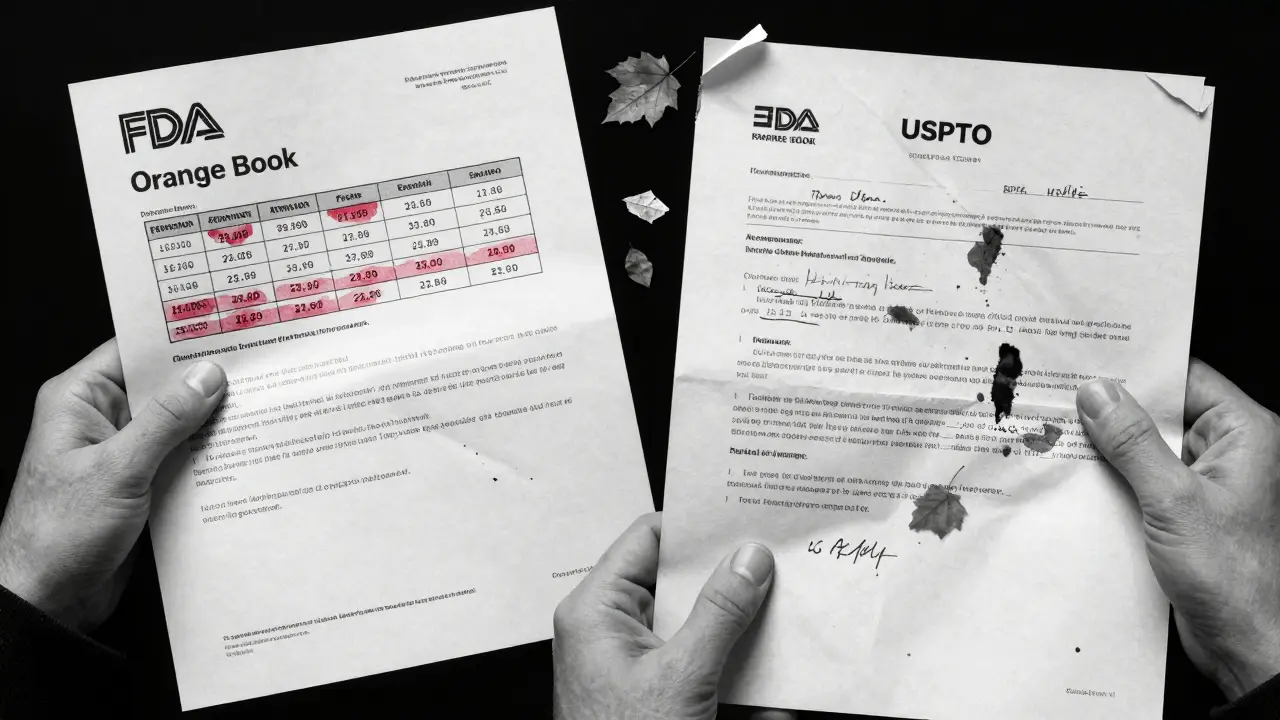
The FDA Orange Book is authoritative-but not perfect. A 2023 study from the National Bureau of Economic Research found that about 46% of patents listed in the Orange Book expire early due to missed maintenance fees. The FDA doesn’t automatically remove these patents from the database, even after they’re no longer enforceable. Also, about 10% of patent expiration dates in the Orange Book don’t match the USPTO’s official records. In most cases, the USPTO is correct. That means if you’re planning a generic launch, you should cross-check the Orange Book with the USPTO Patent Center database. Another issue: the Orange Book doesn’t include patents filed after a drug’s approval unless the sponsor submits them within 30 days. Some companies delay filing to extend market control. That’s legal, but it means the Orange Book might not show the full picture until months later.
How to Get the Data in Bulk
If you’re a researcher, developer, or generic drug company, you don’t want to click through hundreds of drug pages. The FDA offers downloadable data files updated daily at Orange Book Data Files. These files are in CSV and XML formats. Each row contains:- Product Number
- Patent Number
- Patent Expiration Date
- Drug Substance Flag (Y/N)
- Drug Product Flag (Y/N)
- Patent Use Code
- Delist Request Flag (Y/null)
- Submission Date (only for patents filed after 2013)
What to Do Next
If you’re trying to predict when a generic will become available:- Go to the Electronic Orange Book and find the drug.
- Look at all patent expiration dates and exclusivity periods.
- Check if pediatric exclusivity is attached.
- Compare the Orange Book dates with the USPTO Patent Center to catch early expirations.
- Monitor the "Delist Requested" column-if it’s marked "Y," the patent may be invalid.
- Use the Patent Use Code tool to confirm what the patent actually covers.
Why This Matters
By 2025, nearly 78% of brand-name drug revenue will face generic competition. That’s billions of dollars in savings for patients and insurers. But none of that happens unless someone knows exactly when the legal barriers drop. The FDA Orange Book doesn’t give you predictions. It gives you facts. And if you know how to read those facts, you can anticipate market shifts, plan investments, or even help patients access cheaper meds sooner.Is the FDA Orange Book free to use?
Yes. The Electronic Orange Book and all downloadable data files are completely free and publicly accessible through the FDA’s website. No registration, login, or subscription is required.
Can I trust the patent expiration dates in the Orange Book?
Mostly, but not always. The FDA updates the Orange Book based on what drug companies report. However, about 46% of patents expire early due to unpaid maintenance fees, and the Orange Book doesn’t always remove those right away. Always cross-check with the USPTO Patent Center for the most accurate expiration dates.
What’s the difference between a patent and exclusivity?
A patent is a legal right granted by the USPTO to protect an invention, like a drug formula or method of use. Exclusivity is a regulatory period granted by the FDA that blocks generic approval, even if the patent has expired. A drug can have both, only one, or neither. Exclusivity runs independently of patents and can extend the time before generics enter the market.
Why does the Orange Book list the same patent twice?
That’s usually because pediatric exclusivity has been added. When a drug maker completes required pediatric studies, the FDA grants an extra six months of protection. This doesn’t create a new patent-it extends the existing one. So the Orange Book shows the original expiration date and a second line with the extended date, both under the same patent number.
How often is the Orange Book updated?
The Electronic Orange Book is updated daily. The downloadable data files are also refreshed every day, so you’re always working with the most current information. However, changes made by drug companies take time to process, so there can be a slight delay between when a patent is delisted and when it disappears from the public database.
What if a patent is delisted from the Orange Book?
If a patent is marked as "delisted," it means the drug company has asked the FDA to remove it from the database. This often happens when a patent is challenged in court and found invalid, or when the company decides it’s no longer worth enforcing. A delisting can be a strong signal that generic competition is imminent.
Harriet Hollingsworth
December 31, 2025 AT 14:26This is why people can't trust the government. The FDA Orange Book is full of errors, and they don't even fix them when they're caught. Patents expire, but the database still lists them like they're holy scripture. It's not just lazy-it's dangerous. People rely on this to make life-or-death decisions about meds, and the system is broken.
I've seen it myself. My dad's prescription was delayed for months because the Orange Book said the patent was active, but the USPTO said it expired two years ago. No one at the FDA even responded when we called. This isn't transparency-it's negligence.
Martin Viau
January 1, 2026 AT 14:20Look, I get it, the Orange Book is the official source-but it's a glorified Excel sheet run by interns. The real intel comes from patent litigation trackers, PTO filings, and the dark web forums where generics brokers share insider intel. If you're not cross-referencing with USPTO Patent Center and LexisNexis, you're playing Russian roulette with your supply chain.
And don't even get me started on delisting flags. That's the only real signal. Everything else is theater.
Marilyn Ferrera
January 3, 2026 AT 00:44Patents ≠ exclusivity. This distinction is critical. One is a legal right; the other is a regulatory delay. Confusing them leads to flawed forecasts, wasted capital, and delayed access to affordable medicine.
Also: pediatric exclusivity extensions are not new patents. They are statutory additions. The Orange Book reflects this correctly-but only if you know how to read the formatting. Two rows, same number, different date. That’s the clue.
Deepika D
January 4, 2026 AT 02:17Hey everyone, I just want to say how amazing it is that this resource exists for free! 🌟 Seriously, in countries like India, we dream of having this kind of transparency. I’ve been using the Orange Book to help my local pharmacy predict when generics will drop-so many people in rural areas finally get access to life-saving meds without bankruptcy.
And yes, I double-check with USPTO too. I even made a little Google Sheet that auto-updates from the FDA’s CSV feed. It’s not perfect, but it’s helping. If you’re a student, a pharmacist, or just someone who cares about health equity-this is your superpower. Use it. Share it. Don’t let corporate greed silence this tool.
Also, if you’re a generic manufacturer reading this: please don’t game the system. We’re all in this together. 💪
Bennett Ryynanen
January 5, 2026 AT 13:17Bro, the Orange Book is the only thing keeping Big Pharma in check. If you think they’re not gaming the system, you’re naive. I’ve seen patents get filed for the color of the pill. The fact that this database even exists means someone’s fighting back.
And yeah, it’s not perfect-but it’s the best we got. Stop complaining and learn how to use it. I’ve built a whole SaaS tool around scraping this data. If you can’t figure it out, maybe you shouldn’t be in pharma.
Chandreson Chandreas
January 5, 2026 AT 14:23Been using the Orange Book for my research for 3 years now. 🤓
Biggest tip? Always check the delist flag. If it says "Y," that’s your green light. Most people miss that. Also, the CSV downloads are gold. I automated my whole pipeline with Python-no more manual clicking.
And hey, if you’re stressed about deadlines, just remember: this isn’t magic. It’s data. You got this. 💯
Darren Pearson
January 5, 2026 AT 22:07The notion that the FDA Orange Book constitutes a definitive source for patent expiration dates is, frankly, an oversimplification bordering on intellectual negligence. One must recognize that the database is a self-reported, non-audited repository, subject to the fiduciary discretion of proprietary pharmaceutical entities. The conflation of regulatory exclusivity with statutory patent rights further undermines its utility as a predictive instrument. A rigorous analytical framework necessitates triangulation with the United States Patent and Trademark Office’s official registry, as well as litigation databases such as PACER. To rely upon the Orange Book in isolation is to engage in what may be termed, in legal parlance, a material misrepresentation of risk.
Urvi Patel
January 7, 2026 AT 00:18anggit marga
January 8, 2026 AT 09:45Joy Nickles
January 9, 2026 AT 11:55Emma Hooper
January 9, 2026 AT 20:28