The Danger of Counterfeit Meds: Why Unlicensed Online Pharmacies Are a Risk
 Apr, 6 2026
Imagine ordering a pill to help with anxiety or pain, only to find out it contains a lethal dose of a synthetic opioid. It sounds like a nightmare, but for many people buying from unlicensed websites, this is a terrifying reality. The convenience of a "no-prescription-needed" pharmacy is often a trap set by global criminal networks. When you bypass a licensed pharmacist, you aren't just saving a few bucks or avoiding a doctor's visit-you're gambling with your life.
Buying counterfeit meds online is essentially a game of Russian roulette. You have no way of knowing if the pill in your hand is a diluted version of the real thing, a completely different chemical, or a toxic cocktail of fillers. The risk isn't just a "bad batch"; it's the total absence of oversight in a market where profit matters more than your pulse.
| Feature | Licensed Pharmacy | Unlicensed / Rogue Site |
|---|---|---|
| Prescription Requirement | Always required for Rx drugs | Often "optional" or skipped |
| Regulatory Oversight | FDA, State Boards, Pharmacists | None; often based overseas |
| Ingredient Quality | Strict purity and potency standards | Random; can contain fentanyl or chalk |
| Financial Safety | Secure, transparent billing | High risk of identity theft/fraud |
The Hidden Ingredients in Fake Pills
When a medication is produced in a regulated lab, every milligram is accounted for. In a clandestine lab, the goal is simply to make the pill look like the real thing. This often leads to three dangerous scenarios. First, there are inert fillers. Some victims have reported pills that dissolve instantly in water, suggesting they lack the binding agents needed for slow release, or worse, contain only flour or sugar.
Second, there is the risk of incorrect dosages. A pill might have too much of an active ingredient, leading to an overdose, or too little, meaning your condition goes untreated. For someone taking medication for a heart condition or diabetes, this "therapeutic failure" can lead to a stroke or coma.
The most lethal scenario, however, is the inclusion of dangerous substitutes. The U.S. Drug Enforcement Administration (DEA) has issued urgent warnings about counterfeit pills laced with Fentanyl and methamphetamine. Criminals often lace fake versions of Oxycodone, Adderall, and Xanax with these potent opioids because they are cheap and addictive. In one documented case from Operation Press Your Luck, a woman died from acute fentanyl poisoning after taking a single pill she believed was a standard prescription painkiller.
How Criminals Trick You into Buying
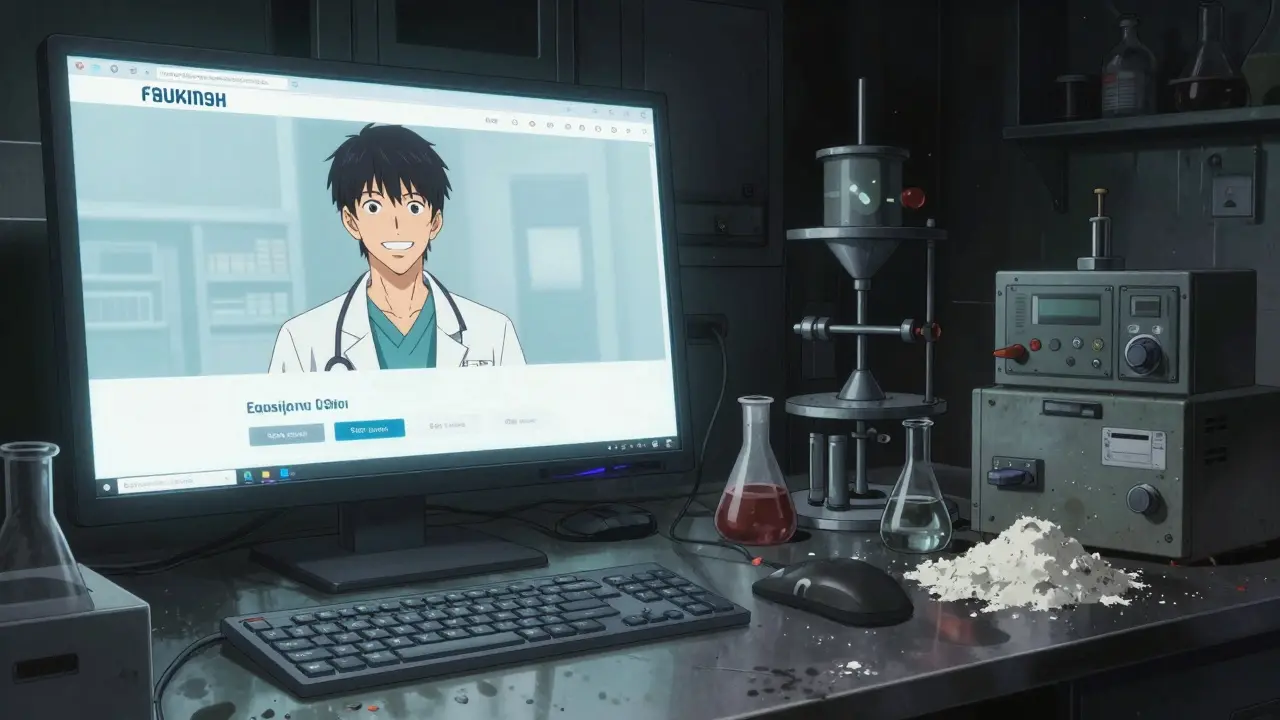
Modern rogue pharmacies don't look like "dark web" sites; they look like professional healthcare portals. They use clean designs, stock photos of smiling doctors, and even fake customer testimonials to build trust. Many use .com or .us web addresses to make it seem like they are operating domestically, while the actual shipments are coming from countries like India or the Dominican Republic.
They also leverage social media. Have you seen ads for weight loss "miracle pens" or peptides? With the surge in demand for Semaglutide, criminal groups have pivoted quickly. They promote these drugs on TikTok and Instagram, targeting people who want to lose weight without a clinical consultation. Because these biologics are complex to manufacture, the versions sold online are frequently contaminated or completely fake, yet they sell for hundreds of dollars on the secondary market.
The scale of this is staggering. The National Association of Boards of Pharmacy has noted that nearly 95% of websites offering prescription drugs without a valid prescription are operating illegally. With roughly 20 new illicit pharmacy sites popping up every single day, the digital landscape is a minefield for unsuspecting patients.
The Global Scale of the Pharmaceutical Black Market
This isn't just a few bad actors; it's a multi-billion dollar industry. According to the OECD, global trade in counterfeit goods has reached 467 billion USD. While fake handbags and shoes are common, the shift toward hazardous fakes-like medicines-is the most concerning trend.
Law enforcement is fighting back, but the criminals are evolving. Interpol recently conducted Operation Pangea XVI, a massive coordinated effort involving 90 countries. They shut down 13,000 websites and social media pages and seized over 50 million doses of unapproved medicines. Despite these wins, the Pharmaceutical Security Institute (PSI) continues to track thousands of incidents across 136 countries, showing that as soon as one site is shut down, three more take its place.
A major strategy used by these networks is "localisation." Instead of shipping finished fake pills, which are easier for customs to detect, they ship unassembled components to be put together closer to the final customer. This bypasses many of the traditional security checks at international borders.
Why People Take the Risk
If the dangers are so clear, why do people still buy from these sites? The World Health Organization (WHO) points to three main drivers. First, there's a lack of access to affordable medicine. When a life-saving drug is too expensive, people turn to cheaper, unregulated alternatives out of desperation.
Second, weak regulatory systems in low- and middle-income countries make it easier for fakes to enter the legal supply chain. In some regions, 1 in 10 medicines is estimated to be substandard or falsified. This creates a culture where patients aren't sure if their local pharmacy is even selling the real thing.
Finally, there is the "convenience gap." The desire to avoid a doctor's appointment, a long wait at a clinic, or the stigma associated with certain medications (like those for ADHD or erectile dysfunction) makes the "click-and-buy" model of rogue pharmacies incredibly tempting. But that convenience comes at a price that can be measured in human lives.
Red Flags: How to Spot a Rogue Pharmacy
You don't need to be a forensic chemist to spot a fake pharmacy. There are several glaring red flags that should make you close the tab immediately:
- No Prescription Required: If a site offers to sell you a drug that legally requires a prescription (like antibiotics, strong painkillers, or blood pressure meds) without asking for one, it is 100% illegal.
- Too Good to Be True Pricing: If a medication costs $300 at a local pharmacy but is listed for $40 online, you are likely buying chalk or a dangerous substitute.
- Generic Contact Info: Look for a physical address and a working phone number. If the only way to contact them is a generic web form or a WhatsApp number, be wary.
- Pressure Tactics: Be suspicious of sites that use countdown timers or "limited stock" warnings to rush you into a purchase.
- Strange Payment Methods: Legitimate pharmacies don't ask you to pay via cryptocurrency, wire transfers, or gift cards.

The Ripple Effect of Pharmaceutical Fraud
The damage doesn't stop at your health. When you buy from an unlicensed source, you are funding organized crime. These networks often overlap with those smuggling other illegal goods and weapons. Furthermore, there is a massive risk of financial fraud. Many users report spending anywhere from $50 to $500 only to receive nothing, or to find their credit card information stolen and sold on the dark web shortly after the transaction.
From a public health perspective, counterfeit drugs fuel the crisis of antibiotic resistance. When people take fake antibiotics that contain only a fraction of the necessary active ingredient, the bacteria in their body aren't fully killed. Instead, they adapt, creating "superbugs" that are harder to treat, making everyone in the community less safe.
Can I tell if a pill is fake just by looking at it?
Not always. Modern counterfeiters are very good at mimicking the color, shape, and imprint of legitimate pills. However, some signs include inconsistent coloring, pills that crumble easily, or packaging with spelling errors and missing batch numbers. If the pill dissolves instantly in water or smells unusual, it is a major red flag.
What should I do if I suspect I took a counterfeit medication?
Stop taking the medication immediately and contact a healthcare provider or go to the emergency room if you feel unwell. Be honest with your doctor about where the medication came from so they can test for specific toxins like fentanyl. You should also report the website to the FDA or your local health authority to help prevent others from being harmed.
Are all pharmacies that ship online illegal?
No. Many legitimate, licensed pharmacies offer mail-order services. The difference is that a legal pharmacy will always require a valid prescription from a licensed healthcare provider, will be registered with the appropriate state or national boards, and will provide clear contact and licensing information.
Why do counterfeiters add fentanyl to fake pills?
Fentanyl is an extremely potent synthetic opioid that is cheap to produce. By adding it to fake painkillers or anti-anxiety meds, criminals can mimic the "high" or sedative effect of the real drug, making the user believe the medication is working while simultaneously creating a powerful, lethal addiction.
Is it safer to buy medications from social media sellers?
Absolutely not. Social media platforms have become primary hubs for the distribution of unapproved and fake medications, especially for weight loss and performance enhancement. These sellers have zero regulation and no accountability, making them some of the highest-risk sources for counterfeit drugs.
Next Steps for Staying Safe
If you are struggling with the cost of your medications, don't turn to the internet. Instead, talk to your doctor about generic alternatives or patient assistance programs offered by pharmaceutical companies. Many clinics also have social workers who can help you find legal ways to afford your treatment.
Always verify your online pharmacy through official channels. In the U.S., check for the VIPPS (Verified Internet Pharmacy Practice Sites) seal or similar certifications that prove the site adheres to safety and privacy standards. Remember, if a deal seems too good to be true, it probably is-and in the case of medicine, the cost of a "bargain" can be your life.
Jay Vernon
April 7, 2026 AT 18:36This is so scary 😱 hope everyone stays safe! 👍
Danielle Kelley
April 9, 2026 AT 00:53Give me a break. This is just another way for the government to scare us into only using their approved corporate pharmacies so they can track every single pill we take.
They want total control over our health and who gets what medicine. These "warnings" are just propaganda to keep the big pharma monopolies in place while they hike up the prices anyway. Wake up people! The system is rigged and they're just using fear to keep us compliant and dependent on their licensed doctors who are just salesmen in white coats.
dwight koyner
April 9, 2026 AT 11:13It is imperative to understand that the biological complexity of drugs like Semaglutide makes them particularly susceptible to degradation when not stored in climate-controlled environments, which is a common failure in illicit supply chains.
Furthermore, the absence of a sterile environment during the compounding process in rogue labs introduces a significant risk of bacterial contamination, which can lead to severe systemic infections or abscesses at the injection site.
Patients should be aware that many of these rogue sites use "mirror" domains to evade law enforcement, meaning a site that looks legitimate today could be a shell for a criminal enterprise tomorrow.
The role of the pharmacist extends far beyond dispensing; it includes critical drug-interaction screening that prevents lethal combinations of medications.
When a patient bypasses this step, they are essentially ignoring the safety net designed to prevent adverse drug reactions.
The mentioned "localisation" strategy is particularly insidious as it allows the final product to be branded as "domestic," further deceiving the consumer.
I strongly encourage anyone struggling with medication costs to investigate the 340B Drug Pricing Program or look for federally qualified health centers (FQHCs) that offer sliding-scale fees.
These programs provide a legal and safe pathway to affordability without compromising patient safety.
The issue of antibiotic resistance mentioned is a global crisis, and substandard dosing is a primary driver of the evolution of multi-drug resistant organisms.
Public health depends on the integrity of the pharmaceutical supply chain.
It is also worth noting that the financial fraud associated with these sites often involves "skimming," where your card details are stolen the moment you enter them.
Once the data is on the dark web, it is nearly impossible to recover.
The DEA's Operation Press Your Luck highlighted just how pervasive fentanyl is in the counterfeit market.
The potency of fentanyl is such that a microscopic amount can be fatal, making the manufacturing process in clandestine labs incredibly dangerous for the user.
Safety must always take precedence over convenience in medical care.
Toby Sirois
April 10, 2026 AT 14:38People only do this because they are weak and want a quick fix. If you actually focused on your holistic health and didn't rely on chemicals, you wouldn't be in this mess. It's basic stuff. Stop complaining about the cost and start fixing your lifestyle. You're just paying for your own laziness at this point.
Stephen Luce
April 11, 2026 AT 08:17It's really heartbreaking to think about people being so desperate for affordable care that they're forced to take these kinds of risks. No one should have to gamble with their life just to manage their health.
Darius Prorok
April 12, 2026 AT 05:58The thing about the .com and .us addresses is that anyone can buy those for a few bucks. It doesn't mean they are in the US. Just because a site looks fancy doesn't mean it's real. It's just a basic website template they bought online.
Jitesh Mohun
April 13, 2026 AT 20:59this is exactly why we need better education and cheaper healthcare globally stop blaming the victims when they have no choice but to look for alternatives just be smart and check the sources before buying anything
Sarabjeet Singh
April 14, 2026 AT 19:24Stay focused and keep searching for the right paths to health. We can all support each other in finding the safe and legal ways to get the help we need.