Provider Education: Understanding Biosimilar Differences
 Jan, 26 2026
Most doctors and pharmacists know what a generic drug is. You swap out the brand-name pill for a cheaper version, and it works the same. But when it comes to biosimilars, that simple logic falls apart. They’re not generics. They’re not copies. And if you don’t understand why, you’re not just confusing patients-you’re risking trust, compliance, and even outcomes.
What Exactly Is a Biosimilar?
A biosimilar is a biological product that’s highly similar to an already-approved biologic-called the reference product-but it’s not identical. Biologics aren’t made in a lab like chemical pills. They come from living cells: yeast, bacteria, or mammalian cells grown in controlled environments. Think insulin, rheumatoid arthritis drugs like Humira, or cancer treatments like Herceptin. These are complex molecules. Even tiny changes in the manufacturing process can affect how they behave in the body.
The FDA requires biosimilars to show no clinically meaningful difference in safety, purity, or potency compared to the original. That means: same effect, same risks, same benefits. But to prove that, manufacturers run dozens of tests-analytical studies, animal trials, and at least one clinical trial in humans. That’s not something you do for a generic aspirin. Generics just need to show they’re absorbed the same way. Biosimilars? They need to prove they work the same way in real patients.
Biosimilars vs. Generics: The Real Difference
Let’s clear this up once and for all. A generic drug is chemically identical to its brand-name counterpart. It’s the same molecule, made with the same ingredients, in the same way. You can swap them without thinking twice.
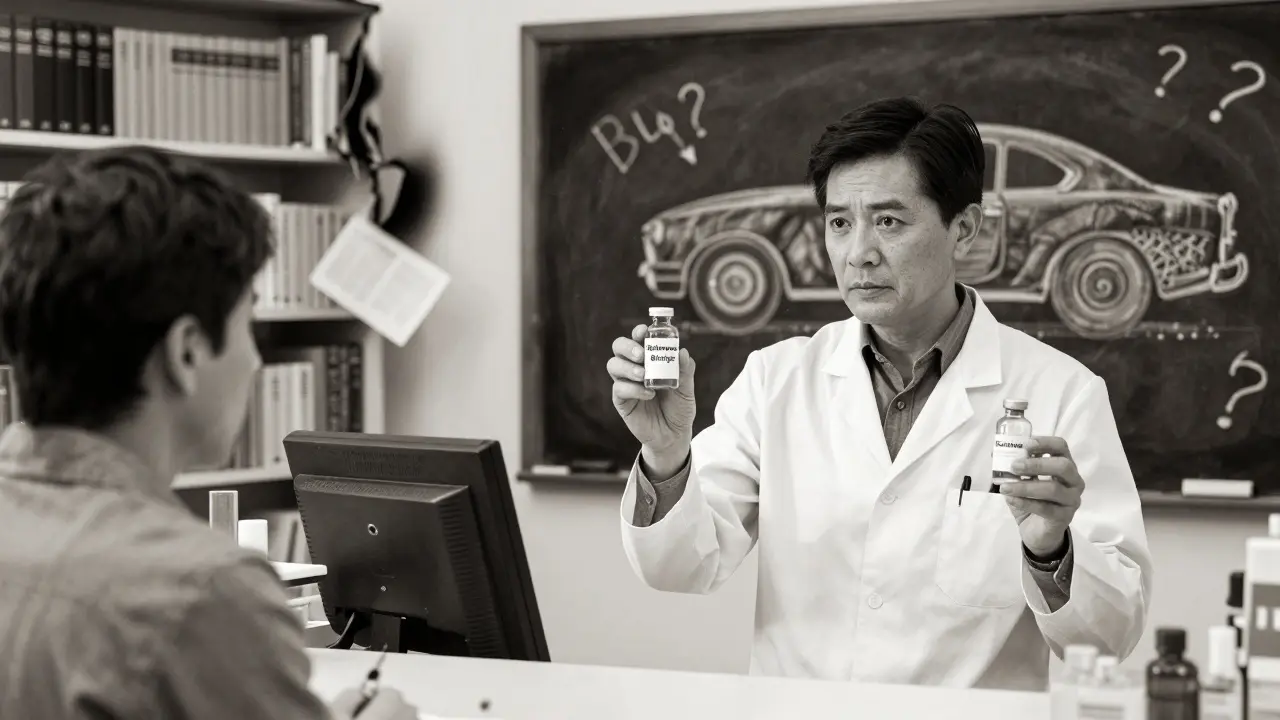
A biosimilar? It’s like a handcrafted replica of a vintage car. Same engine, same shape, same performance-but the paint might have a slightly different sheen, the seats are made from a different leather, and the radio is from a different manufacturer. The car drives the same. But if you’re a mechanic who’s worked on the original for 20 years, you notice the differences. And you want to know: does it matter?
Here’s the data: In a 2016 survey of 102 U.S. physicians, only 38% could correctly define a biosimilar. And 63% couldn’t tell the difference between biosimilars and generics. That’s not just a knowledge gap-it’s a safety risk. Patients switching from a reference biologic to a biosimilar need to know it’s not a random substitution. It’s a scientifically validated alternative.
Why Do Providers Struggle to Understand Biosimilars?
It’s not that providers are lazy. It’s that the system doesn’t make it easy. Biologics are expensive-sometimes over $100,000 a year. Biosimilars cost 15-30% less. That’s huge for patients and payers. But the education? It’s scattered. Some hospitals have full training programs. Others? A one-page handout from a sales rep.
Studies show hospital pharmacists know more about biosimilars than community pharmacists. Oncologists use them more than endocrinologists. Why? Because they’ve had the training. At UCSF Medical Center, pharmacist-led education cut provider hesitation from 58% to 12% in six months. At the University of Pittsburgh, a three-phase program-foundational knowledge, specialty application, ongoing support-boosted provider confidence to 89% within six months.
Meanwhile, 78% of U.S. hospitals say their electronic health records (EHRs) can’t properly track biosimilars. If your system doesn’t distinguish between Humira and its biosimilar, how do you know what the patient actually got? How do you report adverse events? How do you audit outcomes?
Interchangeable vs. Biosimilar: What’s the Big Deal?
Not all biosimilars are created equal. There’s a special category: interchangeable. This means the FDA has confirmed that switching back and forth between the reference product and the biosimilar won’t increase risk or reduce effectiveness. It’s not automatic. The manufacturer must prove it through multiple switches in clinical trials.
Only a handful of biosimilars in the U.S. have this designation. But when they do, pharmacies can substitute them without asking the prescriber-just like generics. But here’s the catch: 42 U.S. states have laws allowing substitution, but rules vary. Some require the prescriber to be notified immediately. Others give 7 days. Six states don’t require any notice at all.
If you’re a rheumatologist and your patient walks in with a new prescription for a biosimilar they picked up at the pharmacy without telling you, you need to know what it is. And you need to know whether it’s interchangeable. Because if it’s not, and they’ve switched multiple times, you might be seeing a reaction that’s not from the drug-but from the switching itself.
Extrapolation: Using a Drug for Conditions It Wasn’t Directly Tested For
This is where things get tricky. A biosimilar might be tested in one condition-say, rheumatoid arthritis-but approved for five others because the science shows the mechanism of action is the same. That’s called extrapolation.
For example, a biosimilar approved for Crohn’s disease might also be approved for ulcerative colitis, even if it was never tested on colitis patients. The FDA allows this if the data supports it. But 57% of providers are still worried about it. They don’t feel comfortable prescribing it for an indication they didn’t see in the trial data.
That’s where education matters. The American College of Rheumatology’s 2021 guidelines strongly support biosimilar use in rheumatoid arthritis based on 37 clinical trials involving over 12,000 patients. But if you’re an endocrinologist prescribing an insulin biosimilar for the first time, and you’ve never seen data on its use in type 1 diabetes, you’re going to hesitate. And that hesitation? It slows adoption. And patients pay the price in higher costs and delayed care.
Immunogenicity: The Silent Risk
Biologics can trigger immune reactions. That’s why some patients develop antibodies and stop responding. Biosimilars might have slightly different impurities or structures. Could that make them more likely to cause an immune response?
The answer: not meaningfully. Studies show immunogenicity rates between biosimilars and reference products are within the same range. But the perception? It’s real. Patients worry. Providers worry. And if you don’t explain it clearly, they’ll assume the worst.
One nurse in a 2017 study said her patient refused a biosimilar because she’d heard it could cause “more side effects.” The nurse had never been trained to explain immunogenicity in plain language. So she didn’t. The patient stayed on the expensive reference product.
Education isn’t about memorizing FDA guidelines. It’s about translating science into trust. You need to say: “This drug works the same. The tiny differences are monitored. No one’s seen more side effects. Here’s the data.”

Who’s Leading the Way in Education?
The FDA has released 37 educational resources-free, in nine languages, and compliant with accessibility standards. They cover everything from manufacturing to billing. But are providers using them? Not enough.
Pharmacists are stepping in. In 76% of U.S. hospitals, pharmacists now lead biosimilar education. They run lunch-and-learns. They update EHR templates. They answer questions on the floor. At the University of Pittsburgh, pharmacists created a biosimilar checklist for prescribers: “Is this interchangeable? Has the patient been on this before? Is the EHR coded right?” Simple. Practical. Effective.
Specialty societies are helping too. The Arthritis Foundation launched a provider campaign in January 2023. Over 12,500 healthcare professionals accessed their materials in six months. The American Society of Clinical Oncology now includes biosimilar training in its continuing education modules.
What Happens When You Don’t Educate?
Patients don’t get cheaper drugs. Providers stay confused. Hospitals lose money. And the system stays stuck.
In 2022, Medicare Part B biosimilars saved 28% compared to reference products. That’s billions in potential savings. But adoption in the U.S. is only 32% for eligible biologics. In Europe? It’s 65%. Why? Because they invested in education early. They trained doctors, pharmacists, nurses, and patients together.
And the cost of inaction? Patients delay treatment because they can’t afford the original. Providers avoid biosimilars out of fear. EHRs miscode prescriptions. Claims get denied. And the cycle continues.
Where Do We Go From Here?
The good news? Change is coming. The Association of American Medical Colleges plans to include biosimilar education in 95% of medical school curricula by 2025. The FDA is updating its teaching guide in 2024 to include real-world evidence-because providers keep asking for it.
But you don’t have to wait. Start now. Ask your pharmacy department for training materials. Watch the FDA’s free modules. Talk to your pharmacist. Ask: “What do we need to fix in our EHR?”
And if you’re a provider, don’t assume your patient understands. Ask: “Have you heard of biosimilars?” Then explain it like you’re talking to a neighbor-not a colleague. Use analogies. Compare it to a different brand of insulin pen. Say: “It’s not the same box, but it does the same job. And it’s been tested just as hard.”
The savings are real. The science is solid. The only thing holding us back is the gap between knowledge and action. Close that gap-and you don’t just save money. You save lives.
Angie Thompson
January 26, 2026 AT 09:15Okay but imagine your insulin pen is like a Nike sneaker vs. a generic brand-same laces, same sole, same cushioning, but the logo’s different and your foot just… knows. That’s biosimilars. No one’s dying from the switch, but we’re all weirdly nervous about it. 🤷♀️
Skye Kooyman
January 26, 2026 AT 16:41My pharmacist switched my Humira without telling me. Now I’m scared to go back. Not because it didn’t work-because no one explained it.
Conor Flannelly
January 27, 2026 AT 06:02It’s not about whether biosimilars work-it’s about whether we trust the system enough to let them. We’ve been trained to equate price with quality, and now we’re being asked to unlearn that for molecules grown in yeast. That’s not a pharmacology problem. That’s a cultural one.
Think about it: we’ll pay $100K for a biologic because we believe the brand is sacred. But the science says the difference is negligible. So why does it feel like betrayal when we swap? Because we’ve turned medicine into a religion, and now someone’s trying to change the liturgy.
And the EHRs? They’re still stuck in the 2000s. How can we track what a patient got if the system can’t tell Humira from its clone? It’s like trying to audit a magic trick without knowing how the illusion works.
Meanwhile, in Europe, they trained everyone-doctors, nurses, patients-and now biosimilars are just… medicine. No drama. No fear. Just savings and outcomes.
We’re not behind because we’re dumb. We’re behind because we’re scared of change disguised as cost-cutting. And until we address the emotional weight of substitution, no amount of FDA guidelines will help.
Conor Murphy
January 28, 2026 AT 07:07I’ve seen patients cry because they thought switching to a biosimilar meant they were being ‘downgraded.’ Like their illness wasn’t important enough for the ‘real’ drug.
We need to stop treating biosimilars like second-class citizens. They’re not cheaper because they’re worse-they’re cheaper because we stopped letting corporations charge $100K for a vial of living cells.
Teach patients like they’re people, not billing codes. Say: ‘This isn’t a downgrade. It’s an upgrade in access.’
Ryan W
January 29, 2026 AT 21:27USA still can't get this right while Europe just rolls out biosimilars like they're toilet paper. We're losing billions because doctors are too lazy to read a 10-page FDA handout. Fix the EHR. Train the pharmacists. Stop letting fear drive policy. This isn't rocket science-it's basic healthcare logistics. We're embarrassing ourselves.
Simran Kaur
January 31, 2026 AT 04:00My aunt in Mumbai got her biosimilar insulin last month. She didn’t know the difference between ‘generic’ and ‘biosimilar’-but she knew her bill dropped by 60%. She said, ‘If it keeps me alive, it’s the right one.’
Why are we overcomplicating this? Science says it’s safe. Patients just want to live. Maybe we need to stop talking to each other and start listening to them.
Marian Gilan
January 31, 2026 AT 20:28Wait… so you’re telling me the FDA approved a drug made by a company that probably uses the same factory as the original, but just changed the label? And now we’re supposed to believe it’s ‘equivalent’?
What if the original manufacturer is just letting the biosimilar company use their old recipe? What if the ‘clinical trials’ were cherry-picked? What if this is just Big Pharma’s way of keeping profits alive under a new name?
I’ve seen this before. Remember the Vioxx scandal? They said it was safe too.
And don’t get me started on the EHRs. They’re probably coded by interns who think ‘Humira’ and ‘Hulira’ are the same thing. This whole system is a house of cards.
Someone’s making money off this. And it’s not you. It’s not me. It’s the shareholders.
Rakesh Kakkad
February 2, 2026 AT 19:37Respected colleagues, I must express my profound concern regarding the systemic underutilization of biosimilar therapeutics in the United States. The disparity between U.S. adoption rates (32%) and European benchmarks (65%) is not merely a statistical anomaly-it is a moral imperative. The economic burden borne by patients, particularly in low-resource settings, is exacerbated by the absence of comprehensive educational frameworks. It is imperative that institutional leadership prioritize interdisciplinary training modules, standardized electronic health record nomenclature, and transparent communication protocols to mitigate therapeutic inertia. The FDA's resources are commendable, yet their dissemination remains fragmented. We must act with urgency, not only for fiscal prudence but for the sanctity of patient autonomy.
Patrick Merrell
February 4, 2026 AT 02:16People don’t get it because they’re being lied to. Biosimilars are just rebranded generics with a fancy name so Big Pharma can keep raking in cash. You think they care about your health? They care about stock prices. The FDA? They’re just the PR department. And don’t even get me started on how they let pharmacies swap them without telling you. This is how you lose trust in medicine. 😡