Proton Pump Inhibitors and Antifungals: Why Acid Blockers Kill Drug Absorption
 Jul, 29 2026
Imagine swallowing a pill to fight a serious fungal infection, only for another routine medication you take daily to silently neutralize its effect. This isn't science fiction; it is a common clinical reality for millions of patients taking Proton Pump Inhibitors (PPIs), which are medications that reduce stomach acid production by blocking the enzyme in the wall of the stomach that produces acid. When combined with certain antifungal drugs, specifically azoles like itraconazole, PPIs can slash drug absorption by up to 60%. The result? Treatment failure, resistant infections, and unnecessary healthcare costs.
The Chemistry Behind the Clash
To understand why this happens, we have to look at how your stomach works. Your stomach is naturally acidic, with a pH level between 1 and 2. This acidity is crucial for breaking down food, but it also plays a key role in dissolving certain medications. Many azole antifungals are "weak bases." Think of them like sugar cubes that need hot water to dissolve quickly. In an acidic environment (low pH), these drugs dissolve rapidly and get absorbed into your bloodstream efficiently.
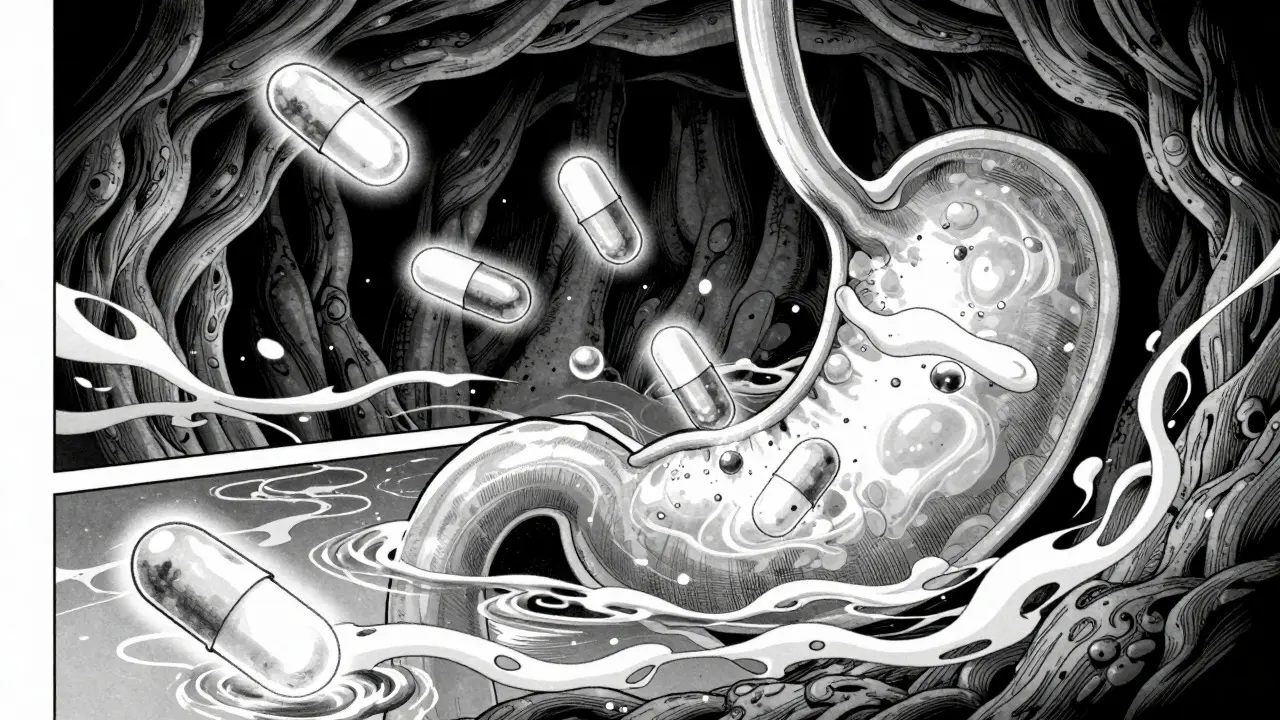
PPIs change the game entirely. By inhibiting the H+/K+-ATPase enzyme in gastric parietal cells, they raise the stomach's pH to between 4 and 6. Suddenly, that "hot water" becomes lukewarm tea. For drugs like encapsulated itraconazole, which require a pH below 3 for optimal dissolution, this shift is catastrophic. Studies published in JAMA Network Open (2023) show that PPIs can reduce the area under the concentration-time curve (AUC) of itraconazole by 60%. If the drug doesn't dissolve, it passes right through you without ever fighting the infection.
| Antifungal Agent | Formulation | Absorption Reduction with PPIs | Clinical Significance |
|---|---|---|---|
| Itraconazole | Capsules | 50-60% AUC decrease | High Risk of Failure |
| Itraconazole | Solution | 10-15% AUC decrease | Low Risk |
| Voriconazole | Tablets | 22-35% AUC decrease | Moderate Risk |
| Posaconazole | Delayed-Release Tablets | 40% lower exposure | High Risk |
| Fluconazole | All Forms | Minimal to None | Safe to Combine |
Not All Antifungals Are Created Equal
If you are prescribed fluconazole, you can likely breathe a sigh of relief. Fluconazole is highly water-soluble, meaning it dissolves easily regardless of stomach acidity. Multiple studies confirm its absorption remains stable even when taken with omeprazole or lansoprazole. However, for itraconazole, voriconazole, and posaconazole, the formulation matters immensely.
Itraconazole capsules are the most vulnerable. They rely heavily on low pH to break open and release the active ingredient. In contrast, itraconazole solution contains pre-dissolved molecules. Since the drug is already dissolved, it bypasses the need for stomach acid to do the heavy lifting. This is why Medicare data shows a growing awareness among clinicians: while 38.7% of patients on itraconazole capsules were also on PPIs, only 12.3% of those on the solution form were co-prescribed acid blockers. The market is slowly adapting to the chemistry.
Voriconazole sits in the middle ground. It shows moderate sensitivity, with a 22% reduction in absorption when paired with omeprazole. While not as drastic as itraconazole capsules, this drop can still push trough levels below the therapeutic window for severe infections like invasive aspergillosis. Posaconazole delayed-release tablets also suffer significant exposure loss (40%) when gastric pH is elevated, whereas its oral suspension is less dependent on acidity.
Beyond Absorption: The Synergy Surprise
Here is where things get counterintuitive. While PPIs kill the absorption of systemic antifungals, recent research suggests they might actually help fight fungi in other ways. A 2025 study in Frontiers in Pharmacology revealed that combining omeprazole with itraconazole showed synergistic effects against 77.6% of pathogenic fungal strains, including azole-resistant Aspergillus fumigatus. How does this work if the drug isn't being absorbed?
The mechanism appears to be local and cellular rather than systemic. PPIs may disrupt fungal cell membranes or interfere with ergosterol synthesis pathways directly in the gut or tissue, making the fungus more susceptible to whatever small amount of antifungal does get absorbed. This has sparked Phase I clinical trials at the NIH (NCT05678901) testing low-dose omeprazole with subtherapeutic itraconazole. However, until these trials conclude, clinicians treat the absorption issue as the primary danger. You cannot rely on synergy if the drug never reaches the bloodstream in the first place.

Practical Solutions for Patients and Clinicians
So, what should you do if you need both medications? The Infectious Diseases Society of America (IDSA) guidelines offer clear paths forward, but they require coordination.
- Switch Formulations: If possible, switch from itraconazole capsules to the solution. Or, consider the newer Tolsura formulation approved in 2023, which shows only an 8% AUC reduction with PPIs compared to 50% for conventional capsules.
- Change Acid Suppressors: H2-receptor antagonists like famotidine raise gastric pH less profoundly and for shorter durations (4-10 hours vs. 12-24 hours for PPIs). Dosing famotidine 10 hours after itraconazole can maintain therapeutic levels.
- Timing Matters: For itraconazole solution, separate administration by at least 2 hours. For posaconazole tablets, taking them with an acidic beverage like cola can increase absorption by 35%, partially offsetting PPI effects.
- Monitor Levels: Therapeutic drug monitoring is non-negotiable for high-risk cases. Target trough levels for itraconazole in invasive aspergillosis should be 0.5-1.0 mcg/mL. One pharmacist reported a patient’s levels jumping from 0.3 mcg/mL to 1.7 mcg/mL simply by switching from omeprazole to famotidine.
The Hidden Cost of Ignoring Interactions
This isn't just a theoretical problem. Approximately 15% of US adults use PPIs chronically, and 5-7% of hospitalized patients receive systemic antifungals. The overlap is massive. An economic analysis in JAMA Internal Medicine estimated that unnecessary PPI co-prescription costs the US healthcare system $287 million annually due to wasted doses and treatment failures. On a personal level, it means prolonged illness, hospital readmissions, and potentially life-threatening complications.
Electronic health records now flag this as a "high-severity" interaction, yet many alerts are ignored or overridden. Pharmacists play a critical role here. Studies show that when pharmacists intervene, adherence to management strategies jumps to 82%. If you are on long-term acid suppression and start an antifungal course, ask your pharmacist to review your regimen. It could save your treatment plan.
Can I take fluconazole with omeprazole?
Yes. Fluconazole is highly water-soluble and its absorption is not significantly affected by changes in gastric pH caused by proton pump inhibitors. It is generally considered safe to take concurrently.
Why does itraconazole capsule absorption fail with PPIs?
Itraconazole capsules are weak bases that require a highly acidic environment (pH < 3) to dissolve properly. PPIs raise stomach pH to 4-6, preventing the capsule shell from breaking down and the drug from entering the bloodstream effectively.
Is there a safer alternative to PPIs for patients on antifungals?
H2-receptor antagonists like famotidine are often preferred because they cause less profound and shorter-lasting increases in gastric pH. Taking famotidine 10 hours apart from the antifungal can minimize interaction risks.
Does voriconazole interact with acid reducers?
Yes, voriconazole shows moderate pH-dependent absorption. Co-administration with PPIs can reduce its AUC by 22-35%. Timing separation or dose adjustment may be necessary to maintain therapeutic levels.
What is the new Tolsura formulation?
Tolsura is a newer itraconazole formulation approved in 2023 designed for pH-independent absorption. It shows only an 8% reduction in absorption when taken with PPIs, compared to 50% for traditional capsules, making it a better option for patients requiring acid suppression.