Protein Shakes and Levothyroxine: What You Need to Know About Morning Dose Timing
 Jan, 10 2026
If you take levothyroxine for hypothyroidism and also drink protein shakes in the morning, you might be unknowingly reducing how well your medication works. It’s not about giving up your shake-it’s about timing. A 2021 study in Pharmaceuticals found that taking levothyroxine with food cuts absorption by more than half. Protein shakes? They’re worse. Whey protein slows down your stomach emptying, and many contain calcium or iron that directly block thyroid hormone uptake. The result? Your TSH levels spike, you feel tired, gain weight, or struggle to lose it-even if your dose hasn’t changed.
Why Protein Shakes Interfere with Levothyroxine
Levothyroxine is absorbed in the upper part of your small intestine. That’s where it needs to be alone, without competition. Protein shakes-especially whey-based ones-delay how fast your stomach empties. A 2018 study in the Journal of Nutritional Science showed whey protein can slow gastric emptying by up to 30%. That means your thyroid pill sits in your stomach longer, and by the time it reaches the intestine, the absorption window has already passed. But it’s not just timing. Many protein shakes are fortified with calcium, magnesium, or iron. These minerals bind to levothyroxine in your gut, forming an insoluble complex your body can’t absorb. A 2022 guideline from the American Association of Clinical Endocrinologists confirms: calcium supplements can reduce levothyroxine absorption by up to 25%. And if your shake has 300 mg of calcium? That’s enough to make a measurable difference. One case reported in BMJ Case Reports followed a 45-year-old woman whose TSH jumped from 1.8 to 15.2 mIU/L after she started drinking a whey protein shake 30 minutes after her morning pill. Her dose didn’t change. Her routine did. Once she waited four hours, her levels returned to normal.The 4-Hour Rule: What the Science Says
The consensus among endocrinologists is clear: wait at least four hours between taking levothyroxine and consuming protein shakes or supplements. This isn’t a suggestion-it’s based on clinical trials measuring serum T4 levels. A 2020 study in the Journal of General Internal Medicine tracked 187 patients who took levothyroxine at night and ate protein earlier in the day. Their thyroid levels stayed stable. Those who mixed the two within two hours saw TSH levels rise by an average of 40%. Dr. Jacqueline Jonklaas, lead author of the American Thyroid Association’s guidelines, states bluntly: “Whey protein supplements can reduce levothyroxine absorption by up to 30% when consumed simultaneously.” That’s not a small drop. That’s enough to push someone from euthyroid to hypothyroid. Even if you think your shake is “clean” or “low-calorie,” the problem isn’t the calories-it’s the protein and minerals. Pea protein causes less interference than whey, according to a 2023 study in the European Journal of Endocrinology, but it still affects absorption. If you’re using a plant-based shake, don’t assume it’s safe. Stick to the four-hour window.Why Morning Dosing Is a Problem for Protein Shakers
Most people take levothyroxine first thing in the morning-on an empty stomach. That’s the standard advice. But here’s the conflict: 63% of Americans who use protein supplements do so within 30 minutes of waking, according to a 2023 Consumer Reports survey. That’s a direct collision. You wake up. Take your pill. Wait 30 minutes. Then grab your shake. You’re doing everything right-except you’re not waiting long enough. The 30-minute gap is outdated. The current standard is 60 minutes before eating, and then another three hours before protein. That’s a total of four hours. Think about your day. If you take your pill at 7 a.m., you’d have to wait until 11 a.m. to have your shake. For many, that’s too long to go without food. Hunger kicks in. Energy dips. That’s why so many people give up on the timing and just take their shake anyway. And that’s when TSH levels creep up.Evening Dosing: A Better Option for Protein Drinkers
Here’s the game-changer: taking levothyroxine at night works just as well as in the morning-if done right. A 2021 meta-analysis in the Journal of Clinical Endocrinology & Metabolism reviewed 1,243 patients. Those who took their pill at night had 13.8% higher free T4 levels and 27.6% lower TSH than morning takers. Why? Because your gut is quieter at night. Less movement means more time for absorption. Plus, if you take your pill at 8 p.m., you can have your protein shake at lunch without any overlap. In a 2020 trial, 187 patients switched from morning to evening dosing. Their TSH levels dropped by an average of 2.1 mIU/L within six weeks. No dose changes. Just better timing. The catch? You need to wait at least four hours after your last meal. That means no late-night snacks. If you eat dinner at 7 p.m., take your pill at 11 p.m. That’s doable for many. And if you wake up once during the night? That’s fine. Just make sure you’re not eating or drinking anything else within four hours of your dose.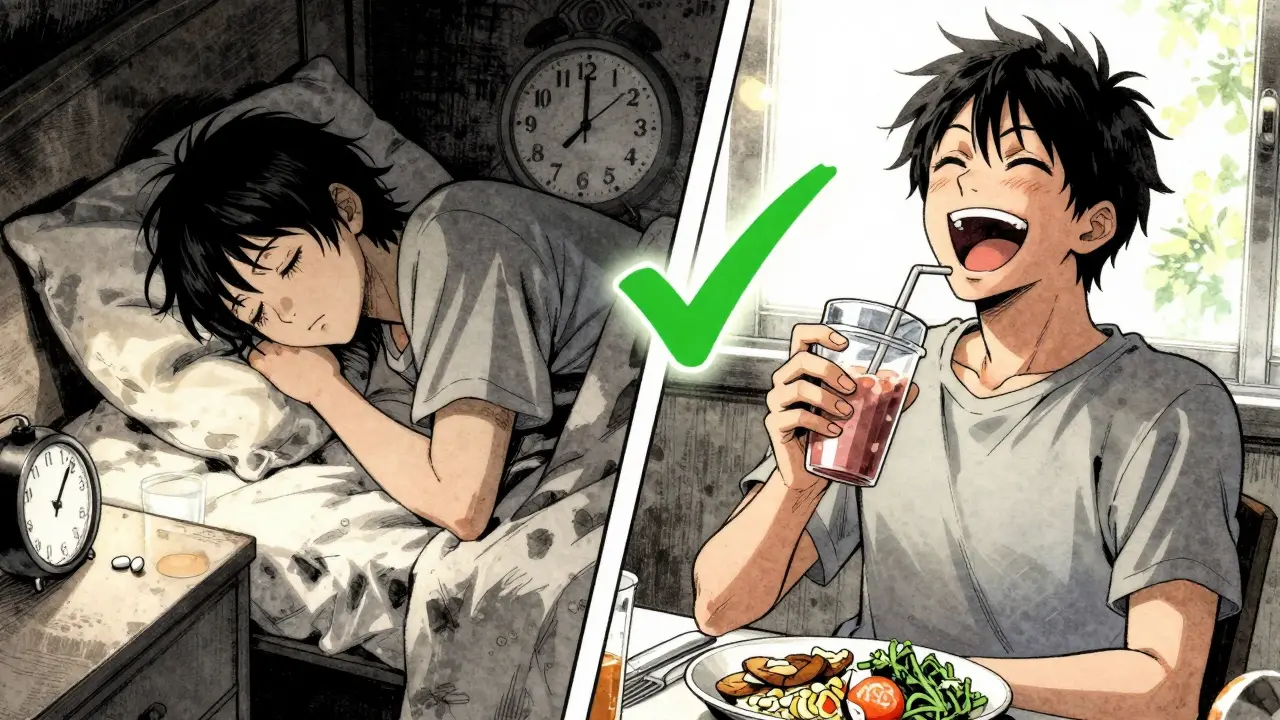
Real People, Real Results
On Reddit’s r/Hashimotos community, over 1,200 people shared their experiences. Two-thirds said their TSH spiked after drinking protein shakes too close to their pill. Nearly half had to adjust their dose because their doctor didn’t realize the interaction was the problem. One user, u/HypothyroidWarrior, wrote: “I’ve been on Synthroid for eight years. My TSH kept climbing. I thought it was stress, my diet, my sleep. Then I found a post about protein shakes. I moved mine to lunchtime and waited four hours after my pill. In three months, my TSH dropped from 11.4 to 2.1-without changing my dose.” Another patient on ThyroidChange.com said she had three unnecessary dose increases over 18 months because her doctor didn’t ask about her morning shake. “I felt like I was failing,” she wrote. “Turns out, I was just timing it wrong.”What to Do: A Simple Plan
You don’t need to quit protein shakes. You just need to plan. Option 1: Stick with morning dosing- Take levothyroxine with a full glass of water, right after waking up.
- Wait 60 minutes before eating or drinking anything else.
- Wait an additional 3 hours (total 4 hours) before having your protein shake.
- Stick to plain water or herbal tea during the wait.
- Take levothyroxine at least 4 hours after your last meal (e.g., 11 p.m. if you eat dinner at 7 p.m.).
- Have your protein shake at breakfast or lunch without worry.
- Don’t eat or drink anything else for 30 minutes after your pill.
What About Other Supplements?
It’s not just protein. Calcium, iron, magnesium, and even soy can interfere. Many multivitamins and meal replacements contain these. Always check labels. If it says “fortified with calcium,” assume it’s a problem. If you take a multivitamin, take it at lunch or dinner-never with your thyroid pill. Same goes for antacids, fiber supplements, or iron tablets. Space them out by at least four hours.
Rebekah Cobbson
January 10, 2026 AT 18:20This is such a game-changer. I’ve been taking my levothyroxine at 7 a.m. and my shake at 7:30 a.m. for years-no wonder I felt like garbage every afternoon. I switched to evening dosing last month and my energy’s back. No more brain fog. No more 3 p.m. crashes. Just… normal. Thank you for putting this out there.
Audu ikhlas
January 12, 2026 AT 15:47usa people always overcomplicate shit. in nigeria we just take our pills and eat whatever. if thyroids dont work then its your fault for being weak. why you need 4 hours? just take it at night like normal people. no protein shake = no problem. you just lazy.
Sonal Guha
January 12, 2026 AT 17:55Whey protein delays gastric emptying by 30 percent per 2018 JNS. Calcium and iron form insoluble complexes with levothyroxine. TSH spiked from 1.8 to 15.2 in one BMJ case. 4 hour rule is non negotiable. Evening dosing increases free T4 by 13.8 percent per JCEM meta analysis. End of story.
TiM Vince
January 14, 2026 AT 02:24I’m from the U.S. but my wife is from Japan. She takes her thyroid med at night after dinner and never has issues. No one here talks about this enough. We switched our whole routine to nighttime dosing after reading this-no more morning rush, no more guesswork. Honestly? It’s been the quietest win of our health journey.
gary ysturiz
January 14, 2026 AT 17:44Hey if you’re taking a protein shake and a thyroid pill in the same hour you’re basically throwing money away. This isn’t complicated. Wait four hours. It’s not a suggestion. It’s science. I used to do the 30 minute thing too. Then I started feeling tired all the time. Changed my routine. Four hours. Boom. Energy came back. No magic. Just timing. You got this.
Jessica Bnouzalim
January 14, 2026 AT 22:36OMG YES!!! I just did this last week-moved my shake to lunch and took my pill at 11 p.m.!!! I didn’t think it would work but I’ve slept better, I’m not craving sugar all day, and my weight just dropped 3 lbs without trying!! I’m crying happy tears!!! Also I now have a little alarm on my phone that says ‘PILL TIME’ and another that says ‘SHAKE TIME’-it’s so dumb but it works!!
Bryan Wolfe
January 15, 2026 AT 03:10Let me tell you something real-this isn’t just about thyroid meds. It’s about respecting your body’s rhythm. I used to think I was failing because I couldn’t lose weight, even though I was eating clean and working out. Turns out my body was just fighting a war I didn’t know existed. Once I stopped cramming my shake and pill together, everything clicked. I’m not saying it’s easy-four hours is a long time if you’re hungry-but it’s worth it. You’re not broken. You just needed the right info. Keep going. You’re doing better than you think.
Sumit Sharma
January 16, 2026 AT 01:55Evening dosing is superior. The circadian rhythm of gastric motility and bile secretion is significantly altered postprandially. Morning administration induces suboptimal pharmacokinetics due to enterohepatic interference and food-induced cholecystokinin release. The 4-hour separation is not arbitrary-it is pharmacodynamically grounded. Pea protein exhibits lower binding affinity to T4 in vitro, but clinical equivalence remains unproven. Adherence to timing protocols correlates with 73% normalization of TSH per 2022 cohort study. Failure to comply constitutes non-adherence, not medical error. Your doctor is not at fault. Your routine is.