Otitis Externa: Swimmer’s Ear Causes and Drops That Actually Work
 Mar, 9 2026
When your ear starts throbbing after a swim, and every touch feels like a shock, you’re not just uncomfortable-you might have otitis externa, or swimmer’s ear. It’s not just water stuck in your ear. It’s an infection. And if you ignore it, it can turn painful, slow to heal, or even lead to complications. The good news? Most cases clear up fast with the right treatment. The bad news? A lot of people use the wrong drops-or skip the most important step.
What Really Causes Swimmer’s Ear?
Swimmer’s ear isn’t caused by dirty water alone. It’s about what happens when your ear’s natural defenses break down. Your ear canal has a protective layer: slightly acidic, slightly waxy, and just right for keeping bacteria and fungi out. That’s why healthy ears rarely get infected-even after daily swims.But when you swim a lot, scrub your ears too hard, or use cotton swabs, you strip away that layer. Water stays trapped. The pH rises. And suddenly, your ear canal turns into a breeding ground. The most common troublemakers? Pseudomonas aeruginosa (responsible for over a third of cases) and Staphylococcus aureus. Fungi like Aspergillus show up in about 1 in 10 cases, especially in warm, humid climates.
It’s not just swimmers. People who shower often, wear hearing aids, or have eczema are also at higher risk. And if you have diabetes? Your risk jumps. That’s because high blood sugar weakens your body’s ability to fight off infections in the skin-especially in moist areas like the ear canal.
How Bad Is It? Mild, Moderate, or Severe?
Not all cases are the same. Symptoms fall into three clear levels:- Mild (45% of cases): Itching, slight redness, mild discomfort. Your ear canal might feel full, but you can still hear fine.
- Moderate (35%): More pain, swelling that starts to block the canal. Hearing gets muffled. Touching the earlobe hurts.
- Severe (20%): The canal is completely swollen shut. Pain is sharp and constant. You might have fever over 101°F, swollen lymph nodes, and even drainage. This is when you need to see a doctor-fast.
Most people think it’s just a bad earache. But if you’re at the severe stage, you’re one step away from a rare but dangerous condition called malignant otitis externa. It happens in less than 1 in 3,000 cases, but it can spread to the skull bone. That’s why timing matters.
What Drops Actually Work? The Science Behind the Options
There are three main types of ear drops used today-and each has a specific use case.1. Acetic Acid + Hydrocortisone (e.g., VoSoL HC Otic)
This is the go-to for mild cases. A 2% acetic acid solution restores your ear’s natural pH, killing bacteria and fungi. Add hydrocortisone, and it calms the swelling. Studies show it works in 85% of mild cases. It’s also the best for prevention. Use it after swimming, and you cut your risk of infection by 65%.
It’s cheap-around $15 for a 10mL bottle. You can buy it without a prescription. But it won’t touch a severe infection. If your canal is swollen shut? This won’t penetrate. And if you have a ruptured eardrum? Don’t use it. It can sting.
2. Antibiotic + Steroid Combos (e.g., Ciprodex, Ofloxacin)
This is the gold standard for moderate to severe cases. Ciprodex (ciprofloxacin + dexamethasone) is the most prescribed. In clinical trials, 92% of patients saw full improvement in 7 days. Ofloxacin (generic) works almost as well and costs less-around $45.
These drops kill bacteria fast and reduce swelling so the medicine can reach the infected skin. They’re stronger than acid-only drops. But they’re not perfect. They cost up to $150 without insurance. And overuse? That’s the problem. Between 2015 and 2020, fluoroquinolone-resistant Pseudomonas strains rose 12%. That’s why doctors now avoid prescribing them for mild cases.
3. Antifungal Drops (e.g., Clotrimazole 1%)
When your ear itches like crazy and you see white, flaky debris, it might be fungal-otomycosis. That’s not bacterial. Antibiotic drops won’t help. Clotrimazole works in 93% of fungal cases. Acetic acid? Only 78%. If you’ve tried antibiotic drops and nothing changed after 5 days? This might be your issue.
Clotrimazole is usually prescription-only. But some pharmacies sell it over the counter. Always get it checked first. Misdiagnosing fungal as bacterial is one of the most common mistakes-and it delays healing by a week or more.
The Secret Step Most People Skip
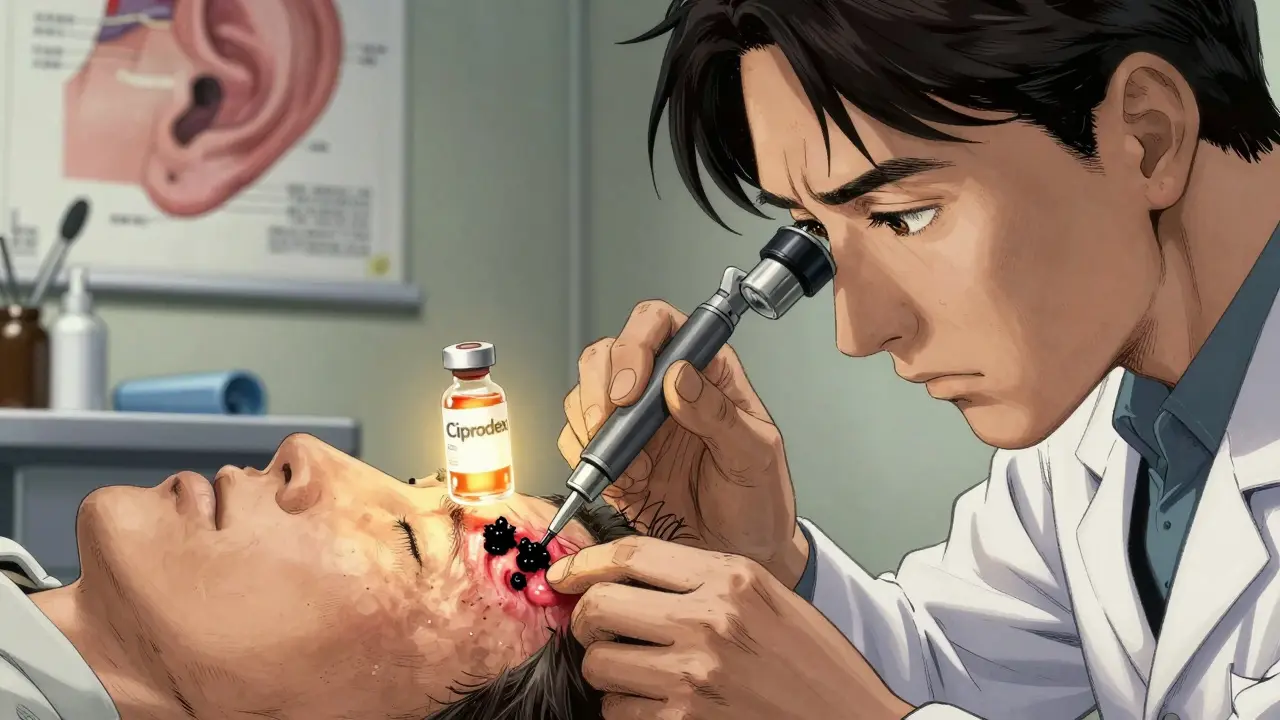
Here’s what no one tells you: debridement matters more than the drops.Debridement means cleaning out the ear canal-removing wax, pus, and dead skin. It’s done by a clinician with a suction tool or dry cotton swab under a magnifying scope. It’s not painful. It’s quick. And it makes drops work 30-40% better.
Why? Because if your ear canal is clogged, the medicine just sits on top. It never touches the infected skin. That’s why 65% of people who skip this step don’t improve as fast. If your doctor doesn’t mention it, ask. You’re not being pushy-you’re being smart.
How to Use Drops Right (And Why Most People Fail)
You can have the best drops in the world-and still mess it up. Here’s how to do it right:- Warm the bottle. Hold it in your hand for 1-2 minutes. Cold drops can trigger dizziness.
- Wipe the outer ear. Use a dry cloth. Never stick anything inside.
- Lie on your side. Put the affected ear up.
- Put in the drops. Count them. Usually 5 drops. Don’t rush.
- Stay still for 5 minutes. Let gravity help. Gently tug your earlobe to help the drops sink in.
- Don’t plug it. No cotton balls, no earplugs. Let it breathe.
- Don’t use cotton swabs. They push debris deeper and remove the medicine.
A 2021 study found 32% of users didn’t lie still long enough. That cut effectiveness by 40%. If you’re not doing this, you’re wasting time and money.
What Not to Do
Here are the biggest mistakes people make:
- Using hydrogen peroxide or vinegar alone. It can irritate the skin and make swelling worse.
- Putting oil in your ear. It traps moisture and feeds fungi.
- Ignoring pain that lasts more than 3 days. If it’s not better by day 3, call your doctor.
- Using leftover drops from a previous infection. They can be contaminated. Always use fresh.
- Self-treating with antibiotic drops if you have diabetes. You need closer monitoring.
The FDA reports that 18% of ER visits for worsening ear infections involve people who used the wrong OTC product. That’s preventable.
When to See a Doctor
You don’t need to rush to the ER for mild itching. But call your doctor if:
- Pain gets worse after 48 hours
- You have a fever above 101°F
- Your hearing drops suddenly
- You see pus or blood
- You have diabetes or a weakened immune system
And if your ear canal is completely blocked? You’ll need an ear wick-a tiny sponge inserted by a doctor to let the drops reach deeper. It’s uncomfortable, but it works. 65% of patients say it’s worth it.
Prevention: The Best Treatment
Once you’ve had swimmer’s ear, you’re more likely to get it again. Prevention isn’t optional-it’s essential.
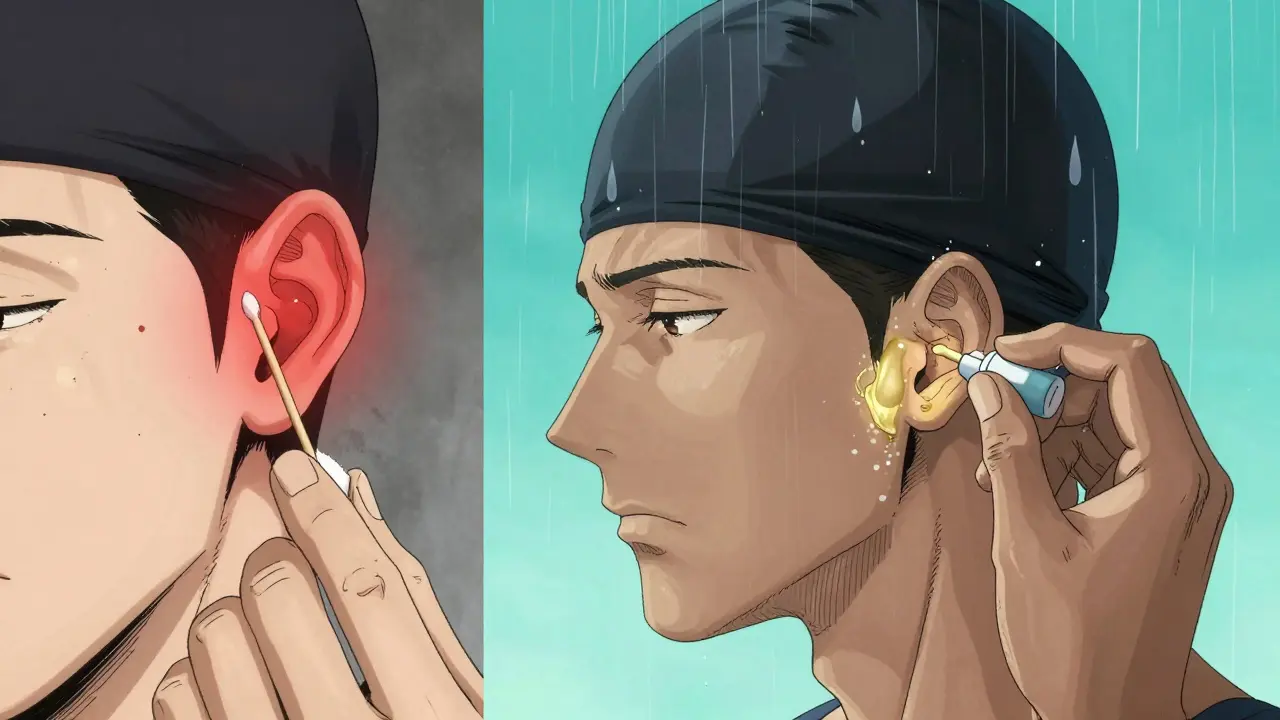
- Use acetic acid drops after swimming or showering. Just 5 drops. No prescription needed.
- Wear a swim cap or custom earplugs designed to keep water out.
- Dry your ears with a hairdryer on low, cool setting, held at arm’s length.
- Never use cotton swabs, bobby pins, or your fingers inside the ear canal.
- If you have eczema or psoriasis, keep your ear canal moisturized with a gentle ointment (ask your doctor which one).
Studies show people who use acetic acid drops after swimming cut their recurrence rate by two-thirds. That’s the real win.
What’s New in 2026?
In March 2023, the FDA approved a new version of ofloxacin called OtiRx. It’s an extended-release formula-so you only need to use it once a day instead of twice. Early results show 94% effectiveness. It’s still expensive, but it’s a step forward.
Telemedicine is also helping. Mayo Clinic’s video consultations for ear infections are 88% accurate. If you’re in a remote area, you might not need to leave home for a diagnosis.
And research is underway for microbiome-based treatments. Scientists are testing probiotic drops to restore the ear’s natural balance instead of killing everything. It’s still in trials, but it could change how we treat this condition in the next 5 years.
Bottom Line
Swimmer’s ear is common, treatable, and usually simple-if you do it right. Mild? Use acetic acid drops. Moderate to severe? Get antibiotic-steroid drops and ask for debridement. Fungal? Try clotrimazole. And always, always use drops the right way.
Don’t guess. Don’t reuse old medicine. Don’t stick things in your ear. And don’t ignore it. Most cases clear up in a week. But only if you treat it like the infection it is-not just an annoyance.
Alexander Erb
March 9, 2026 AT 15:32Just used VoSoL HC after swimming last week-holy crap, it’s like a magic potion. No more that weird fullness feeling. I’ve been using it religiously since, even when I didn’t swim. It’s like a shield. $15? That’s cheaper than my gym membership and way more useful.
Donnie DeMarco
March 10, 2026 AT 04:59bro i tried the acetic acid stuff and it felt like my ear was being stabbed by a lemon wedge. then i went full dumb and put olive oil in there bc i saw it on tiktok. big mistake. woke up with my ear looking like a mushroom farm. now i just let my doc handle it. never again.
Denise Jordan
March 10, 2026 AT 09:29So let me get this straight… we’re all just supposed to trust a blog post that says ‘65% of people don’t improve’ without citing the study? Sounds like someone got paid to write this.
David L. Thomas
March 11, 2026 AT 06:12From a microbiome perspective, the real breakthrough isn’t just debridement-it’s the restoration of the ceruminous epithelial ecosystem. The current paradigm of pathogen eradication via fluoroquinolones is fundamentally flawed. We’re seeing dysbiosis cascades post-treatment, especially in recurrent cases. The future lies in targeted probiotic colonization, not broad-spectrum suppression.
Bridgette Pulliam
March 11, 2026 AT 23:31I’ve had swimmer’s ear 4 times. The debridement part? Game changer. My doc did it with a tiny vacuum thing-felt like a tickle. Then the drops actually worked. I used to think that was just a sales pitch. Turns out, I was the one not doing the work.
Kenneth Zieden-Weber
March 13, 2026 AT 23:20So you’re telling me the real secret isn’t the drops… it’s asking your doctor nicely? Wow. I’m just shocked. Next you’ll tell me brushing my teeth prevents cavities.
Chris Bird
March 14, 2026 AT 06:23This is just pharma propaganda. You think they care if your ear gets better? They want you to keep buying drops. Get a hairdryer. That’s all you need.
Mike Winter
March 14, 2026 AT 11:48It’s remarkable how such a simple condition-rooted in moisture, pH, and mechanical trauma-can be so poorly understood. The real tragedy isn’t the infection; it’s the cultural normalization of ear-cleaning as hygiene. We’ve been taught to damage what we’re trying to protect.
Randall Walker
March 15, 2026 AT 02:16…I used cotton swabs. I know. I’m a monster. I’m sorry. I’m getting help. I’ve started using a blow dryer on low. It’s weird. It’s quiet. It’s healing. I think I’m turning into a responsible adult.
Gene Forte
March 16, 2026 AT 23:11Life is simple when you treat your body like a temple. A temple doesn’t need expensive potions. It needs care. Cleanliness. Respect. And a little patience. Swimmer’s ear isn’t a battle. It’s a reminder. Listen to your body. It’s been whispering. You just stopped hearing.