Nail Disorders: How to Tell Fungal Infections Apart from Psoriatic Changes
 Jan, 4 2026
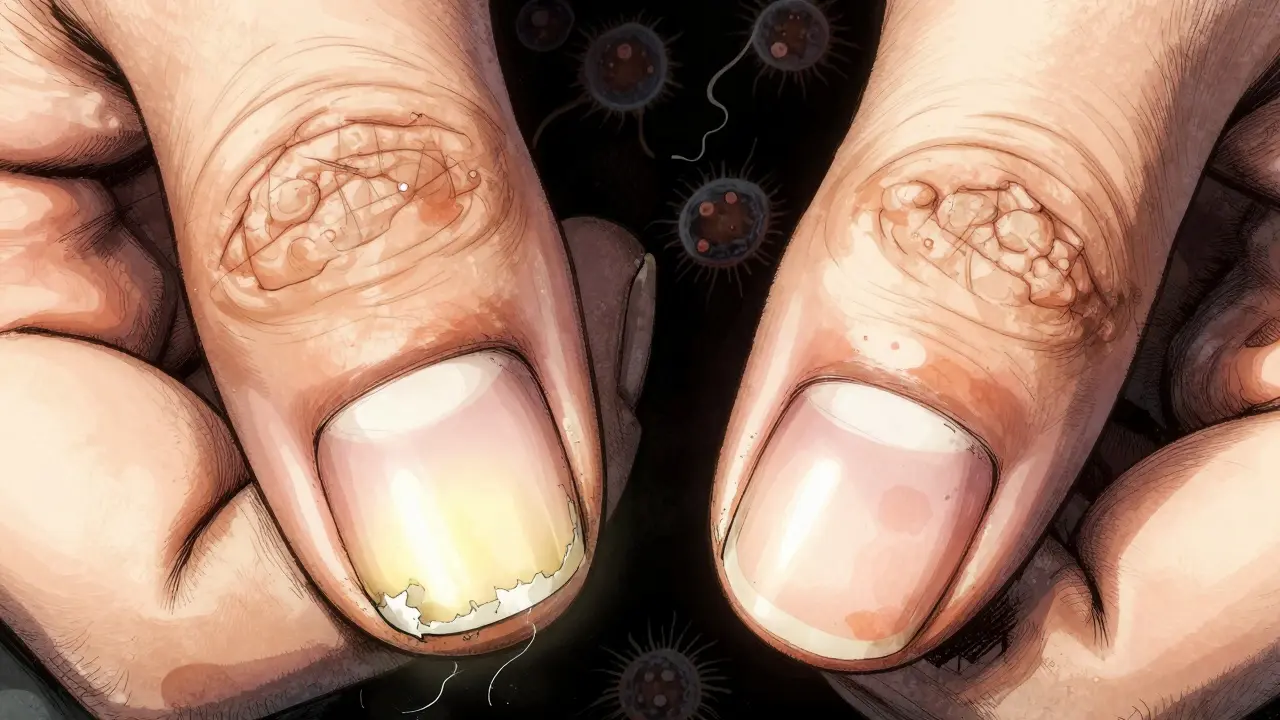
Most people think a yellow, thickened nail is just a fungal infection. But what if it’s not? What if it’s something deeper-something your body’s own immune system is causing? Nail disorders like fungal infections and psoriatic changes look almost identical at first glance. Both can turn your nails yellow, make them crumble, or even cause them to lift off the nail bed. But treating them the same way? That’s where things go wrong.
Why You Can’t Guess by Looking
You’ve probably seen it: someone with a discolored nail, maybe a little thick, maybe a bit brittle. They buy antifungal cream online. They soak it in vinegar. They try tea tree oil. Months pass. Nothing changes. And then it gets worse. That’s because fungal nail infection and nail psoriasis are completely different diseases. One is an invasion-fungus sneaking in from outside. The other is an internal rebellion-your immune system attacking your own nail tissue. And the treatments? Opposite. Fungal infections need antifungals. Psoriasis needs immune modulators. Give a psoriasis patient antifungals? It won’t help. Give a fungal patient steroids? It might make the fungus grow faster. And here’s the scary part: 30 to 40% of the time, doctors misdiagnose these two. That’s not rare. That’s common.What Fungal Nail Infections Actually Look Like
Fungal nail infections, or onychomycosis, start small. Usually, it’s a tiny white or yellow spot under the tip of the nail. From there, it creeps backward like a slow tide. It doesn’t hit all your nails at once. It picks one or two-often the big toe or the thumb-and takes its time. The nail gets thick. Really thick. Sometimes 3 to 5 millimeters. That’s like stacking three pennies under your nail. It becomes brittle. It cracks. It separates from the bed. And in about 40% of cases, it smells. Not just a little odor-something sour, almost cheesy. That smell? That’s a red flag. Psoriasis doesn’t do that. The fungus behind this? Usually Trichophyton rubrum. It’s everywhere-showers, gyms, sweaty shoes. It doesn’t care if you’re healthy or not. It just needs warmth and moisture. That’s why older adults are more at risk. As we age, nails grow slower, circulation drops, and the immune system weakens. By age 60, one in five people has it.What Nail Psoriasis Really Is
Nail psoriasis isn’t caused by germs. It’s caused by your body. If you have psoriasis on your skin-those red, scaly patches on your elbows or knees-chances are, you’ll get it on your nails too. In fact, 80 to 90% of people with psoriasis will develop nail changes at some point. But here’s what makes it different: it doesn’t creep in. It shows up suddenly. And it doesn’t pick one nail. It hits several at once. Fingernails more than toenails. And it leaves behind patterns you won’t see in fungal infections. The most telling sign? Nail pitting. Tiny dents, like someone tapped the nail with a pin. About 70% of nail psoriasis cases have this. Then there’s the salmon patch-a translucent red-yellow stain under the nail. Or oil-drop lesions, dark brown or yellow spots that look like a drop of oil on glass. And subungual hyperkeratosis-that chalky, crumbly buildup under the nail. It’s not dirt. It’s excess skin cells. The thickness? It’s there, but it’s milder-usually 2 to 3 millimeters. No foul smell. No rapid spread. Just slow, stubborn changes that don’t respond to antifungals.The Key Differences You Can Check Yourself
You don’t need a lab to spot the difference. Here’s what to look for:- Pitting? If you see tiny holes in the nail surface, it’s almost certainly psoriasis. Fungal infections almost never cause this.
- Foul odor? If your nail smells bad, it’s fungal. Psoriasis doesn’t produce odor.
- Started at the tip? Fungal infections usually begin under the nail tip and move inward. Psoriasis can start anywhere-side, base, or center.
- Multiple nails affected? Psoriasis often hits several nails at once. Fungal infections usually start with one or two.
- Do you have psoriasis elsewhere? If you’ve had scaly skin patches on your elbows, scalp, or knees, your nail issue is likely psoriasis.
How Doctors Diagnose It for Real
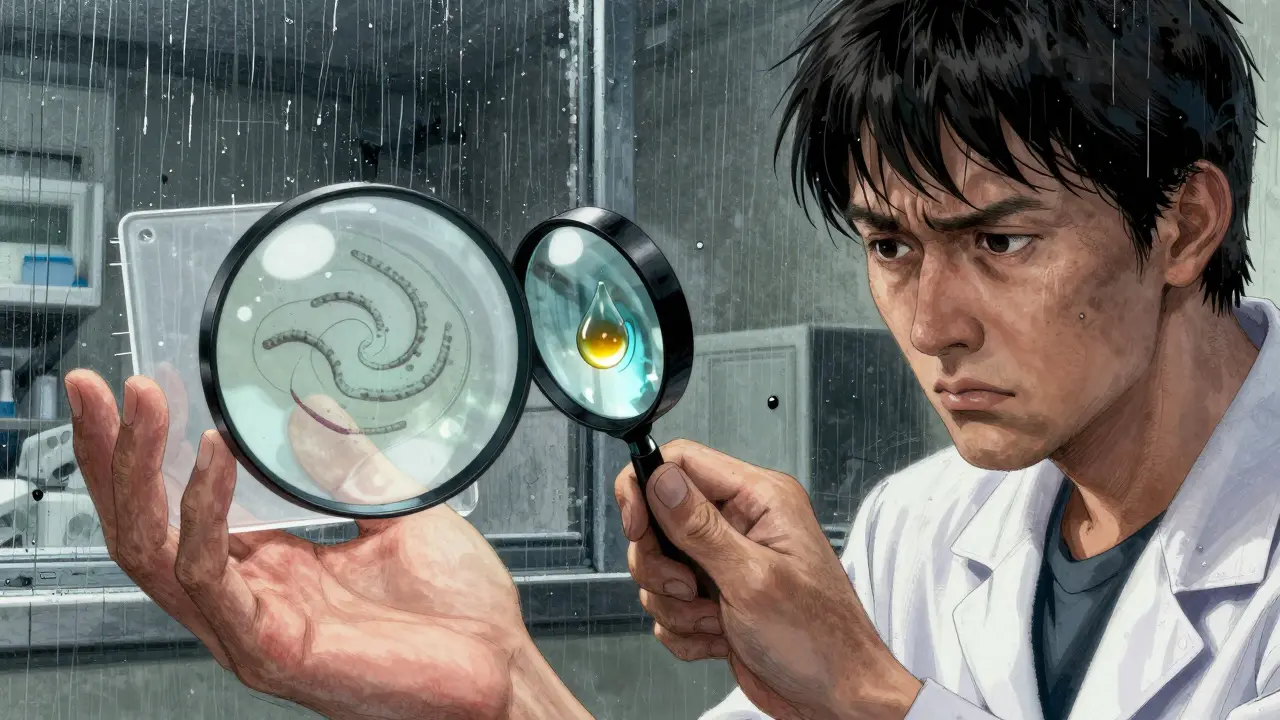
A good dermatologist won’t guess. They’ll test. The first step? A KOH prep. They scrape a bit of nail, mix it with potassium hydroxide, and look under the microscope. If they see fungal threads, it’s confirmed. This test catches 70 to 80% of cases. If it’s negative but they still suspect fungus? They send it for a fungal culture. That takes weeks, but it’s 95% accurate. It tells you exactly what fungus you’re dealing with. For psoriasis? They look for the classic signs: pitting, oil spots, salmon patches. Sometimes they use the NAPSI score-a system that rates severity across four parts of the nail. Each quadrant gets a score from 0 to 8. Add them up, and you get a number that shows how bad it is. Newer tools are helping too. Reflectance confocal microscopy-a non-invasive imaging tool-can now tell the difference with 92% accuracy by looking at the nail structure under the surface. And in 2024, researchers started testing nail microbiomes. Psoriasis nails have more Staphylococcus and less Cutibacterium. Fungal nails? Loaded with Trichophyton DNA. This could mean a simple swab might replace invasive biopsies in the near future.What Actually Works to Treat Them
Treatments are not interchangeable. And time matters. For fungal infections, the gold standard is terbinafine. Taken orally for 12 weeks, it clears the infection in 78% of cases. Topical treatments like efinaconazole (Jublia) work too, but they take 9 to 12 months because nails grow so slowly-only 0.1mm per day. You need patience. And you need to keep your feet dry. Humidity above 40% helps fungus thrive. For nail psoriasis, topical steroids or corticosteroid injections under the nail can help. But the real game-changers are biologics. Drugs like secukinumab (Cosentyx) or ixekizumab target the immune system’s overactive signals. In clinical trials, 65% of patients saw major improvement in their nails after 24 weeks. That’s not a miracle. It’s science. And here’s something most people don’t know: psoriasis can make you more prone to fungal infections. Up to 30% of nail psoriasis patients end up with a secondary fungal infection. Why? The damaged nail bed is an open door. That’s why doctors now check for fungus even when they suspect psoriasis.What Not to Do
Don’t self-treat with antifungals if you have psoriasis. It won’t help. It might make your nails worse. Don’t ignore a single discolored nail. If it’s not improving in 3 months, get it checked. Don’t assume it’s just aging. Nail changes aren’t normal. They’re symptoms. And don’t wait for your doctor to notice. Bring photos. Take one every month. Same light, same angle. Show the progression. That’s how you get accurate care.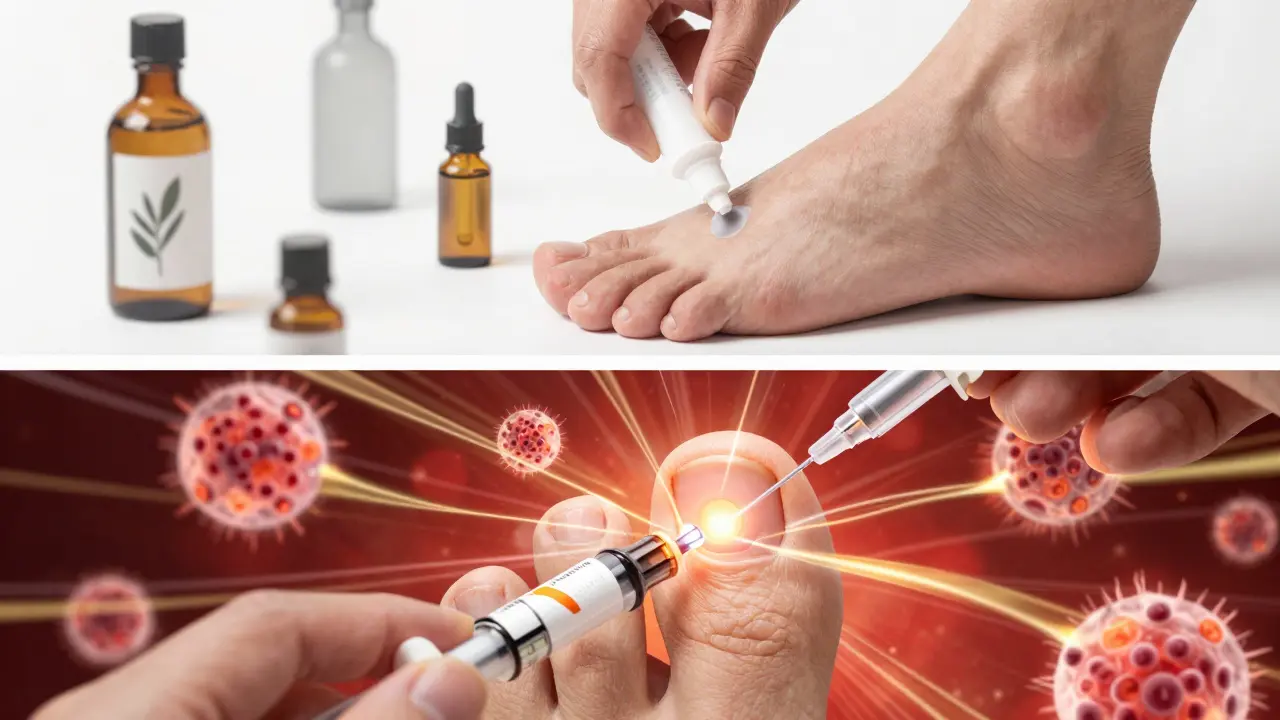
The Cost of Getting It Wrong
Misdiagnosis isn’t just frustrating. It’s expensive. In the U.S. alone, unnecessary treatments for misdiagnosed nail disorders cost about $850 million a year. That’s antifungals prescribed to psoriasis patients. Steroids given to fungal cases. Lab tests repeated. Appointments wasted. And then there’s the emotional toll. One patient on MyPsoriasisTeam wrote: “After 8 months of antifungals that did nothing, my nails got worse. I developed painful separation. I felt like I was going crazy.” Another said: “My dermatologist said it was psoriasis. I got steroid shots. My nail crumbled. Turns out it was fungus.” These aren’t outliers. They’re the norm.What You Can Do Today
If you’re worried about your nails:- Take a clear photo of each affected nail. Do it monthly.
- Check for pitting. Look for odor. See if it’s one nail or several.
- Ask yourself: Do I have psoriasis on my skin? Have I had it before?
- Don’t buy antifungal creams online without a diagnosis.
- Go to a dermatologist-not a podiatrist, not a general practitioner. Nail disorders are dermatology’s specialty.
Stephen Craig
January 6, 2026 AT 07:51Nails are just the tip of the iceberg. What we see on the surface is rarely what’s happening underneath. The body doesn’t lie-it just speaks in symbols. A yellow nail isn’t dirt or fungus. It’s a whisper from your immune system, begging you to listen.
Most people treat symptoms. The real work is asking why.
It’s not about the nail. It’s about the person behind it.
Connor Hale
January 8, 2026 AT 00:02Been there. Thought it was fungus. Took antifungals for six months. Nothing. Then my dermatologist spotted the pitting-tiny pinpricks I didn’t even notice. Turned out to be psoriasis. Changed everything. Don’t guess. Get tested.
Roshan Aryal
January 9, 2026 AT 23:00Western medicine loves to overcomplicate things. You want to know what causes nail changes? Poor diet. Toxins. Stress. Not some fancy lab test. Your grandpa didn’t need a KOH prep-he just ate garlic and kept his feet dry. Now we’re paying $850 million to diagnose what our ancestors fixed with soap and time.
And don’t get me started on biologics. You’re paying for a chemical leash to control your own body. Pathetic.
Jack Wernet
January 11, 2026 AT 20:48This is one of the clearest, most clinically accurate summaries I’ve encountered on this topic. The distinction between onychomycosis and nail psoriasis is not merely academic-it is profoundly practical. Misdiagnosis leads to unnecessary suffering, financial burden, and erosion of patient trust in medical systems. Thank you for elevating the conversation with precision and compassion.
For those reading: consult a board-certified dermatologist. Not a podiatrist. Not a pharmacist. A dermatologist.
Charlotte N
January 12, 2026 AT 03:23So... like... if it's not fungus... and it's not psoriasis... what else could it be? I mean, I've got this one nail that's kinda yellow and thick and I'm scared to ask my doctor because I don't want to be that person who's like "oh my god my nail" but also I don't want to ignore it and then lose the nail??
Also I think I might have psoriasis on my elbow but I'm not sure because it's kinda dry and I just thought it was winter??
Help.
Joseph Snow
January 12, 2026 AT 16:07Let me guess-the real agenda here is to sell more biologics. Big Pharma doesn’t want you to know that antifungals work fine for most cases. They just need to rebrand psoriasis as something ‘immune’ so they can charge $10,000 a shot.
And who funded this ‘research’? The same labs that patent the drugs. KOH prep? Culture? NAPSI score? All distractions. The truth? Your body’s trying to tell you something. Stop listening to doctors. Start listening to yourself.
melissa cucic
January 13, 2026 AT 09:55I’ve spent the last two years trying to figure out what’s wrong with my nails-first it was fungus, then psoriasis, then a possible fungal infection secondary to psoriasis, then a reaction to my new laundry detergent. I’m not exaggerating when I say I’ve tried everything: tea tree oil, vinegar soaks, laser treatments, steroid injections, turmeric paste, and even a crystal healer who said my ‘root chakra’ was blocked.
Turns out? It was a combination of psoriasis and a mild fungal infection. The dermatologist did a culture and a confocal scan. It took three visits. But now I’m finally getting better.
It’s not glamorous. It’s not viral. But it’s real. And it’s worth the effort.
Akshaya Gandra _ Student - EastCaryMS
January 13, 2026 AT 13:12thiis is sooo helpful!! i have this one nail that looks weird and i thought it was just me being gross but now i realize it might be psoriasis?? i have eczema on my hands too so maybe its related??
also can someone explain what a koH prep is?? i googled it and it sounds like a kpop group lmao
Jacob Milano
January 14, 2026 AT 00:27I’ve seen this happen too many times. A guy comes in with a thick nail, says he’s been soaking it in vinegar for a year. He’s convinced it’s fungus. I look closer-pitting, salmon patch, no smell. Psoriasis. He’s devastated. Not because it’s bad, but because he wasted a year on something that didn’t work.
That’s the real tragedy here. Not the disease. The wasted time. The lost confidence. The shame.
Don’t be that guy. Get checked. Your nails are telling you something. Listen.
Aaron Mercado
January 14, 2026 AT 18:00EVERYTHING you’ve been told about nails is a lie. The medical system wants you to believe this is a ‘minor’ issue. But think about it-why do they push antifungals first? Because it’s cheap. Because it’s easy. Because they don’t want to admit they don’t know what’s really going on.
And then they hit you with biologics-$20,000 a year, with side effects that could kill you-and call it ‘progress’.
I’m not saying don’t treat it. I’m saying: question everything. Who profits? Who benefits? And why are you still waiting for a doctor to tell you what your own eyes can see?
saurabh singh
January 15, 2026 AT 00:51Bro, I’m from India, and we’ve been treating nail issues with neem oil and turmeric for centuries. No lab tests. No prescriptions. Just home remedies. And guess what? It works.
But now everyone’s obsessed with Western medicine like it’s magic. You don’t need a $500 scan to know if your nail is infected. Smell it. Look at it. Feel it.
And if you have psoriasis? Cut out sugar. Drink warm water. Sleep early. Your body knows how to heal. You just stopped listening.
Dee Humprey
January 15, 2026 AT 12:55Just took a photo of my nails today. Looked at the one I’ve been ignoring-tiny pits, no smell, started at the cuticle. I cried. Not because it’s bad. Because I finally understood.
I’ve had psoriasis for 12 years. Never knew my nails were part of it.
Thank you for this. I’m booking a dermatologist tomorrow. And I’m not letting fear win again.
💙
John Wilmerding
January 17, 2026 AT 00:10It is of paramount importance to underscore the clinical necessity of differential diagnosis in the context of nail pathology. The conflation of onychomycosis with nail psoriasis represents a significant diagnostic error, with measurable consequences for therapeutic efficacy and patient outcomes. The integration of non-invasive imaging modalities, such as reflectance confocal microscopy, into routine dermatologic practice is not merely an advancement-it is an imperative.
Furthermore, the economic burden of misdiagnosis, as quantified in the United States, constitutes a systemic failure in primary care triage and specialist referral protocols. This is not a patient problem. It is a healthcare infrastructure problem.
Allen Ye
January 18, 2026 AT 21:55Let’s go deeper. Why do we even call it a ‘nail disorder’? That term implies it’s an isolated flaw, a cosmetic glitch. But nails are extensions of the skin, yes-but they’re also mirrors. They reflect circulation, immunity, nutrition, stress, even emotional suppression.
Think about it: your nails grow slowly. One millimeter per month. That means every visible change took months to develop. The yellowing? The thickening? The pitting? They didn’t appear overnight. They were whispered for a year before you noticed.
So when you ignore your nails, you’re ignoring the slow, persistent voice of your body. And we’ve trained ourselves to silence that voice. We’re told it’s ‘just a nail.’ But what if it’s not?
What if your nail is the last thing your body can show you before the system collapses? What if it’s the final warning before your immune system turns on your joints? Your gut? Your brain?
Maybe the real question isn’t ‘Is it fungus or psoriasis?’
Maybe it’s: ‘What else is my body trying to tell me that I’m too busy to hear?’