Every year, thousands of people accidentally take too much medicine-not because they meant to, but because they got confused. A pill organizer seems like a simple fix: a little box with compartments for morning, noon, night, and each day of the week. But if you don’t use it right, it can become a dangerous tool. In fact, a 2022 study in the Journal of the American Geriatrics Society found that improper use of pill organizers increases the risk of overdose by 23% in older adults. That’s not a typo. The very thing meant to keep you safe can hurt you if you skip the basics.
Know What Can and Can’t Go in Your Pill Organizer
Not all pills belong in a pill box. Some medications are sensitive to moisture, heat, or air. If you toss them into a plastic organizer, they can break down and lose effectiveness-or even become harmful.
Do not put these in a pill organizer:
- Liquid medications (they leak and mix)
- Chewable or dissolvable pills (they stick together or crumble)
- Soft gel capsules (they melt or stick to the plastic)
- Medications that need refrigeration (like insulin or certain antibiotics)
- Any pill labeled "as needed" (PRN)-like painkillers or anxiety meds
The last one is especially dangerous. Putting a PRN painkiller like oxycodone or ibuprofen into your daily compartments means you might take it twice-once as part of your routine, and again because you think you need it. That’s how overdoses happen. Memorial Sloan Kettering Cancer Center says 38% of all pill organizer overdoses come from mixing scheduled and as-needed meds. Keep PRN pills in their original bottle, clearly labeled, and only grab them when you truly need them.
Fill One Medication at a Time
It’s tempting to dump all your pills into the organizer at once. You’ve got your bottles laid out, your coffee’s hot, and you’re on a roll. But that’s when mistakes happen.
The safest method? One pill type at a time. Here’s how:
- Wash your hands with soap for 20 seconds. Clean hands prevent contamination.
- Grab one medication bottle. Don’t open the next one until you’re done with this one.
- Read the label. Check the name, dose, and instructions. Compare it to your current medication list.
- Fill only the compartments that match your prescription. If you take 10 mg in the morning and 5 mg at night, don’t just guess-count them.
- Close the bottle. Put it back in its spot. Then move to the next medication.
This might take 15 to 20 minutes. It’s not fast. But it cuts double-dosing errors by 63%, according to Dr. Jane Smith, Chief Pharmacist at Memorial Sloan Kettering. If you’re filling for a week, do it on the same day each week-Sunday mornings work well for most people. Routine prevents gaps.
Always Keep Original Bottles Nearby
Your pill organizer is a helper, not a replacement. Never throw away your original pill bottles. They’re your safety net.
Why? Because:
- Labels have the exact drug name, strength, and expiration date.
- They show how many pills you should have left.
- They’re your backup if you’re unsure what’s in a compartment.
WebMD reports that 28% of medication errors happen when people refill organizers using old bottle labels instead of current prescriptions. Maybe your doctor changed your dose last month, but you’re still filling based on the old label. That’s how you end up with 20 mg when you should only have 10.
Keep your bottles on the counter while you fill your organizer. Open each one, read the label, then match it to your organizer. After you’re done, put the bottles in a visible spot-like next to your coffee maker or toothbrush. That way, you’ll see them every day and remember to double-check.
Never Store Your Organizer in the Bathroom
It’s convenient. You brush your teeth, wash your face, and take your pills all in one place. But bathrooms are the worst place to store pills.
Steam from showers raises humidity. Heat from hot water and dryers raises temperature. Moisture makes pills stick, crumble, or degrade. A 2022 study from Hero Health showed that pills stored in high-humidity environments (like bathrooms) lose potency 47% faster than those kept in a cool, dry place.
Store your organizer in a bedroom drawer, on a kitchen counter away from the sink, or in a cabinet in a cool room. Keep it below 86°F (30°C) and away from direct sunlight. If you live in a humid climate like Dunedin, this is even more important.
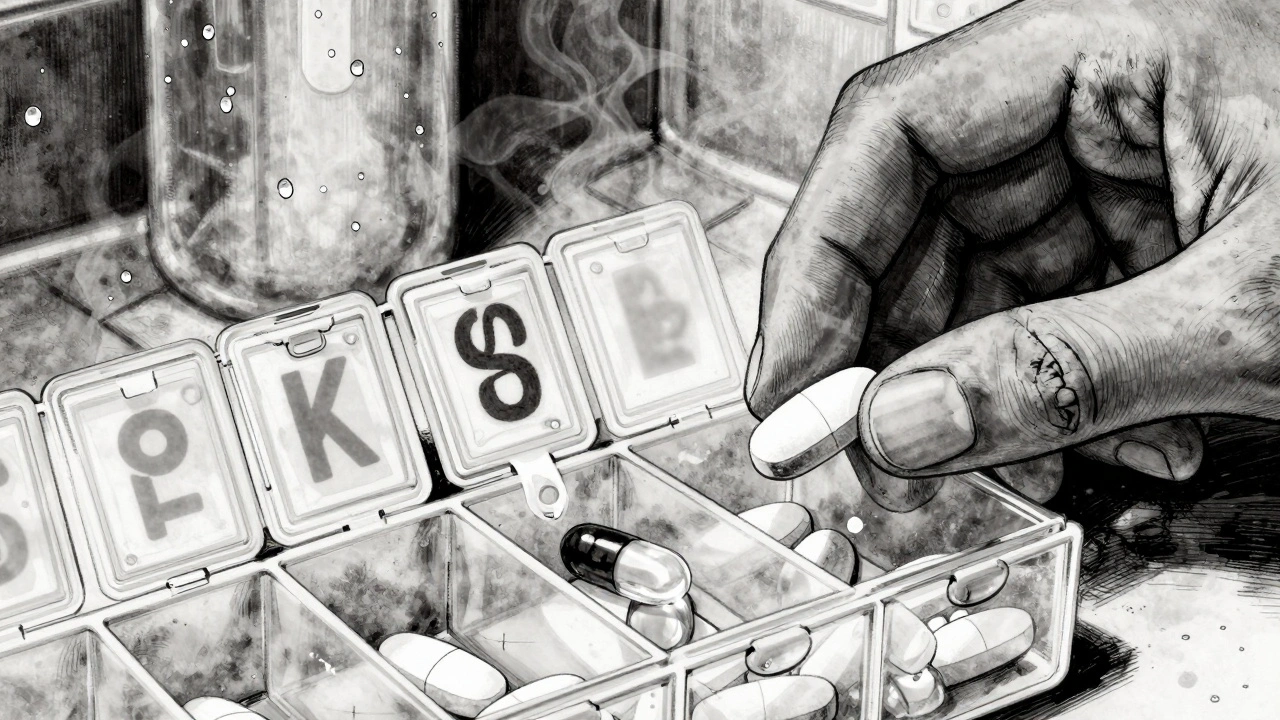
Use Visual Checks Before Taking Each Dose
You’ve filled your organizer. You’ve stored it safely. But the moment you reach for a pill, pause.
Before you swallow anything, look at the compartment. Ask yourself:
- Is this the right day?
- Is this the right time of day?
- Do these pills look like what’s on my bottle?
Memorial Sloan Kettering found that 31% of accidental overdoses happen because people don’t verify what’s in the organizer before taking it. You might think you know what’s there. But pills can look similar-especially generics. A white oval might be lisinopril one week and hydrochlorothiazide the next. If you don’t check, you might take the wrong one.
If you have trouble telling pills apart, use a pill splitter with color-coded inserts, or keep a separate organizer for look-alike medications. Some people even take a photo of each filled compartment on their phone as a visual record.
Track Your Fills and Watch for Patterns
Keep a simple log. Just a notebook or a note on your phone. Write down:
- Date you filled the organizer
- What you filled (medication name and dose)
- Any issues you noticed (e.g., pill stuck, label faded)
This isn’t just for you. If you visit your pharmacist or doctor, this log helps them spot problems fast. Maybe you’ve been taking two doses of the same pill because the label was unclear. Maybe your blood pressure meds are running out too fast. Your log turns guesswork into data.
Central Pharmacy MI recommends keeping this log for at least three months. That’s enough time to see patterns. If you notice you’re always missing the Wednesday evening dose, maybe your alarm isn’t loud enough. If you’re always confused about your thyroid pill, maybe it’s time to ask your pharmacist about a different brand or form.
Get Help from Your Pharmacist
You don’t have to do this alone. In 2023, 68% of U.S. pharmacies started offering free organizer filling services with pharmacist verification. That means you walk in with your bottles, and a pharmacist fills your organizer for you-checking each pill against your current prescription.
This cuts errors by 52%, according to
Pharmacy Times. If you’re on four or more medications, Medicare now covers smart pill organizers under Part D. Ask your pharmacist if you qualify. Even if you don’t, most pharmacies will still help you fill your organizer for free. It’s part of their job.

Upgrade to a Smart Organizer If You Need It
If you forget doses often, or if someone else manages your meds, a smart organizer might be worth it. These devices have alarms, app alerts, and even sensors that detect when a compartment is opened.
Hero Health’s latest model (version 3.2.1, released October 2023) sends an alert if someone opens the same compartment twice within four hours. That’s a red flag for possible double-dosing. Some models even sync with family members’ phones so caregivers know if a dose was missed.
They cost between $25 and $100. But if they prevent one hospital visit, they pay for themselves. The American Society of Health-System Pharmacists predicts that by 2027, nearly half of all pill organizers sold will be smart devices with automated verification.
What to Do If You Think You’ve Overdosed
If you’ve taken too much medicine-whether you think you did or not-don’t wait. Call your doctor or poison control right away. In New Zealand, dial 0800 764 766 (Poison Control). In the U.S., call 1-800-222-1222.
Don’t try to figure it out on your own. Even small mistakes can be serious. Taking two blood pressure pills instead of one can drop your pressure dangerously low. Taking extra acetaminophen can damage your liver.
If you’re helping someone else and they’re confused, drowsy, or acting strangely, call for help immediately. Time matters.
Final Reminder: Your Organizer Is a Tool, Not a Cure
A pill organizer doesn’t fix poor communication with your doctor. It doesn’t replace knowing what each pill is for. It doesn’t make up for skipping appointments or not reading labels.
But when used correctly, it’s one of the most effective tools we have to prevent accidental overdose. Studies show that people who use organizers properly have 32% fewer missed doses and 18% less accidental double-dosing.
The key isn’t the box. It’s the habit. Wash your hands. Check the label. Fill one at a time. Keep the bottles. Don’t trust your memory. And never, ever put PRN meds in it.
Your safety isn’t about being perfect. It’s about being careful, one pill at a time.
 Dec, 2 2025
Sara Larson
December 4, 2025 AT 14:48This is so helpful!! 🙌 I used to dump all my meds in one box and wonder why I felt weird after lunch. Now I keep my PRN pills in the original bottle next to my coffee maker-game changer. Also, filling one at a time? Took me 20 mins but I didn’t mix up my blood pressure meds once this week. Love this guide.
PS: Sunday morning fill ritual now. My cat even waits by the box like it’s her job. 😺
Josh Bilskemper
December 5, 2025 AT 18:40Most of this is common sense but you clearly needed a 2000 word lecture to figure it out. The bathroom thing? Everyone knows that. And why are you still using plastic organizers? Get a desiccant-lined one if you’re that concerned. Also PRN meds shouldn’t even be in a box-duh. This reads like a brochure for a pharmacy chain.
Storz Vonderheide
December 7, 2025 AT 12:53As someone who helps my mom manage her meds across three countries, this is gold. I’ve seen people in Nigeria use pill organizers with no labels, just colors-and it’s terrifying. The point about keeping original bottles nearby? That’s universal. In Lagos, we even write the drug name in big marker on masking tape and stick it to the organizer. Simple. Effective.
Also, smart organizers? My cousin in Toronto got one with a voice reminder. She says it sounds like her late husband telling her to take her pills. Makes her cry but she takes them. That’s the real win.
Thank you for writing this with heart.
dan koz
December 9, 2025 AT 07:12Yo, I’m from Nigeria and I’ve seen people use pill organizers like snack boxes. One guy took his insulin out and put it in a plastic box in his pocket. He died last year. This isn’t just about confusion-it’s about survival. Always keep bottles. Always check. Never trust your memory. And if you’re helping someone, sit with them while they fill it. Don’t just do it for them. They need to see it. That’s how you build safety, not just compliance.
Kevin Estrada
December 9, 2025 AT 15:34Okay but WHY is everyone acting like this is new info?? I’ve been using a smart organizer since 2021 and my mom’s been screaming at me for not putting her anxiety meds in the box and I’m like MOM IT’S OXYCODONE YOU’RE GONNA OD AND THEN I’LL BE ON THE NEWS AND IT’LL SAY ‘SON FAILED TO PREVENT MOTHER’S DEATH’ AND THEN I’LL HAVE TO MOVE TO A DIFFERENT COUNTRY AND CHANGE MY NAME AND I’M NOT READY FOR THAT!!
Also I put my organizer in the fridge because I read online that cold makes pills last longer and now it’s sticky and I’m scared to open it. HELP.
Katey Korzenietz
December 10, 2025 AT 01:41WTF is this? You mean to tell me people don’t know not to put PRN meds in organizers? That’s not ignorance-that’s negligence. My grandmother died because of this. And now you want me to read a whole essay on how to not kill yourself? This should be mandatory in schools. Or at least on the back of every prescription bottle. I’m done.
Ethan McIvor
December 11, 2025 AT 15:33There’s something deeply human about the ritual of filling a pill organizer. It’s not just medicine-it’s care, repetition, memory. Every time I open that little box, I’m reminded that I’m still here, still trying. I used to hate doing it. Now I do it while listening to my late wife’s favorite jazz record. It’s quiet. It’s sacred. And honestly? I think she’s still watching.
Thanks for reminding us that safety isn’t about perfection. It’s about showing up, one pill at a time.
Mindy Bilotta
December 12, 2025 AT 01:31Just a quick tip-use a permanent marker to write the day and time on the bottom of each compartment if your organizer doesn’t have labels. I did this for my dad and he stopped mixing up his morning and night pills. Also, if you have trouble seeing small print? Get a magnifying pill sorter. They’re like $8 on Amazon. Life saver.
Brian Perry
December 13, 2025 AT 06:31So I tried the smart organizer. It beeped at me at 3am. I thought I was being robbed. Then I realized it was my meds. Then I screamed. Then my dog barked. Then my neighbor called the cops. Then I had to explain why I was holding a plastic box with pills and crying in my bathrobe. Worth it? Maybe. Did I survive? Barely. But I haven’t missed a dose since. So… yeah. Still alive. Kinda.