How to Recognize Overdose in Pets from Human Medications
 Dec, 23 2025
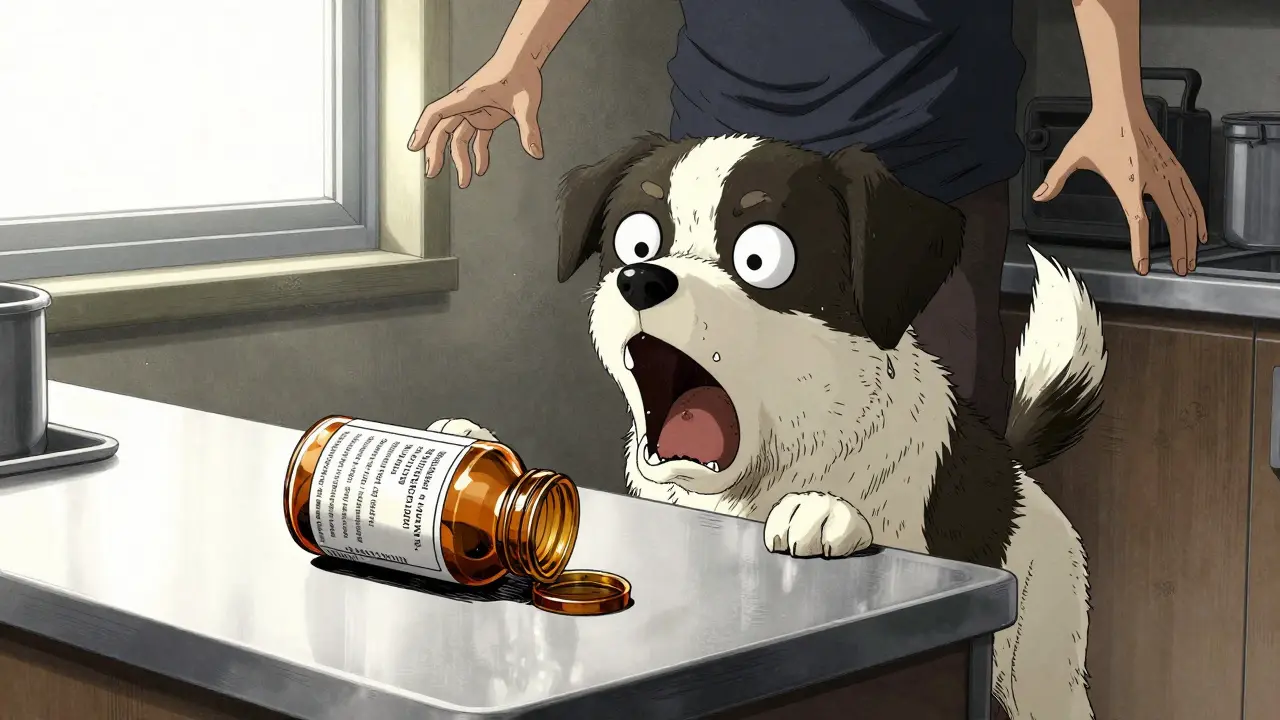
Every year, over 150,000 pets in the U.S. end up in emergency vet clinics because they ate human medication. Most of these cases aren’t from accidental spills or open bottles left on counters-they’re from well-meaning owners who didn’t realize how dangerous a single pill can be. Your dog sniffs your Advil. Your cat licks residue off your Xanax bottle. You think, It’s just one pill. But for pets, one pill can be a death sentence.
Why Human Medications Are So Dangerous for Pets
Pets don’t process drugs the same way humans do. Their livers, kidneys, and enzymes break down medications differently-or sometimes not at all. A dose that’s safe for you can be lethal for your dog or cat. Cats, in particular, are incredibly vulnerable. They lack a key liver enzyme called glucuronyl transferase, which means they can’t break down acetaminophen (Tylenol) or certain antidepressants like Effexor. Even a tiny amount can cause fatal liver failure or oxygen deprivation. Dogs aren’t much safer. Their bodies handle NSAIDs like ibuprofen poorly. While you might take 200mg for a headache, your 50-pound dog could suffer kidney failure from just one tablet. And stimulants like Adderall? A single capsule can send their heart rate soaring past 220 beats per minute. Normal? Around 100.Top Medications That Cause Overdose in Pets
Not all human drugs are equally dangerous. Some are far more lethal than others. Here’s what you need to watch out for:- NSAIDs (ibuprofen, naproxen): The #1 cause of pet poisonings. Causes vomiting, black tarry stools, and acute kidney failure. Dogs can die within 72 hours if untreated.
- Acetaminophen (Tylenol): Deadly to cats-even one 325mg tablet. Causes brown gums, trouble breathing, and liver damage. Dogs can tolerate more, but over 150mg/kg, liver necrosis kicks in.
- Antidepressants (SSRIs like Prozac, SNRIs like Effexor): Lead to serotonin syndrome: fever, tremors, seizures, agitation. Effexor is especially dangerous for cats; one extended-release capsule can be fatal.
- ADD/ADHD meds (Adderall, Concerta): Stimulants that spike heart rate, body temperature, and blood pressure. Symptoms show up in under an hour. Dogs can develop 107°F fevers and seizures.
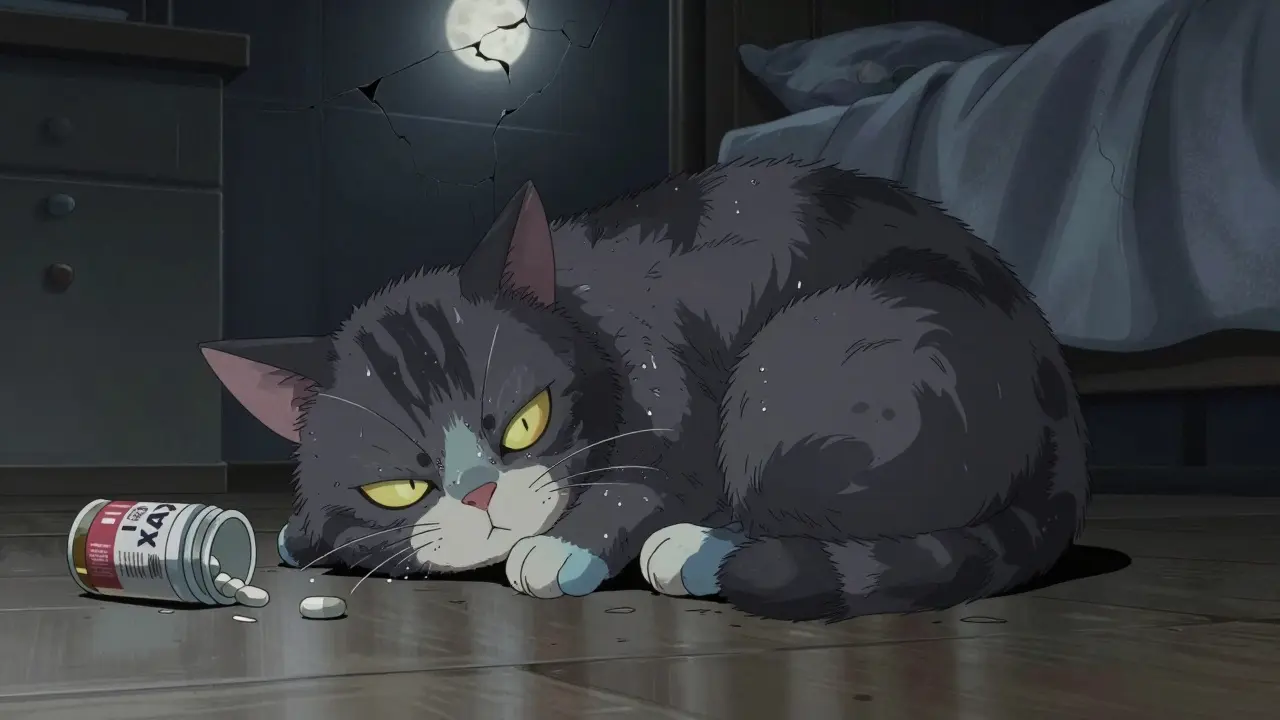
- Benzodiazepines (Xanax, Ambien): Paradoxically cause agitation in 52% of dogs instead of sedation. In cats, they trigger liver failure with ALT levels over 1,200 U/L (normal is under 100).
According to Pet Poison Helpline, NSAIDs account for nearly 28% of all pet medication poisonings. Antidepressants come in second at 17%. But it’s not just the numbers-it’s how fast things go wrong.
How to Spot the Signs of Overdose
Time matters. The sooner you act, the better the chance your pet survives. Most successful treatments happen within two hours of ingestion. Here’s what to look for, grouped by medication type:For NSAIDs (Ibuprofen, Naproxen)
- Vomiting (92% of cases)
- Black, tarry stools (melena-68% of cases)
- Lethargy, loss of appetite
- Increased thirst and urination (early kidney warning)
These symptoms usually show up within 1-6 hours. By 24-72 hours, kidney damage becomes irreversible. BUN levels above 120 mg/dL (normal: 10-25) mean severe failure.
For Acetaminophen (Tylenol)
- Brown or blue-tinged gums (methemoglobinemia)
- Swelling in face or paws
- Difficulty breathing
- Dark urine
In cats, this happens within 1-4 hours. In dogs, liver damage takes 24-72 hours. But the brown gums? That’s a red flag you can’t ignore. It means their blood can’t carry oxygen anymore.
For Antidepressants (Prozac, Effexor, Lexapro)
- High fever (103-106°F)
- Tremors or muscle rigidity
- Restlessness, pacing, vocalizing
- Seizures (78% of untreated cases)
This is serotonin syndrome. It starts within minutes to 12 hours. Effexor is especially dangerous because of its slow-release coating-cats will chew the whole pill, thinking it’s candy.
For ADD/ADHD Medications (Adderall, Concerta)
- Extreme restlessness or hyperactivity
- Heart rate over 220 bpm
- Body temperature above 105°F
- Dilated pupils
- Tremors or seizures
These hit fast. Symptoms appear in 15-60 minutes. Dogs may appear manic, panting, drooling, and uncoordinated. Their pupils will be wide and fixed. This isn’t excitement-it’s a medical emergency.
For Benzodiazepines (Xanax, Ambien)
- Agitation, aggression (instead of calmness)
- Wobbling, loss of coordination
- Slowed breathing
- Yellowing of eyes or gums (in cats-liver failure)
Over half of dogs don’t get sleepy-they get crazy. Cats? They get liver failure. If your cat suddenly starts bumping into walls or crying nonstop after you took your Xanax, don’t wait.
What to Do If You Suspect an Overdose
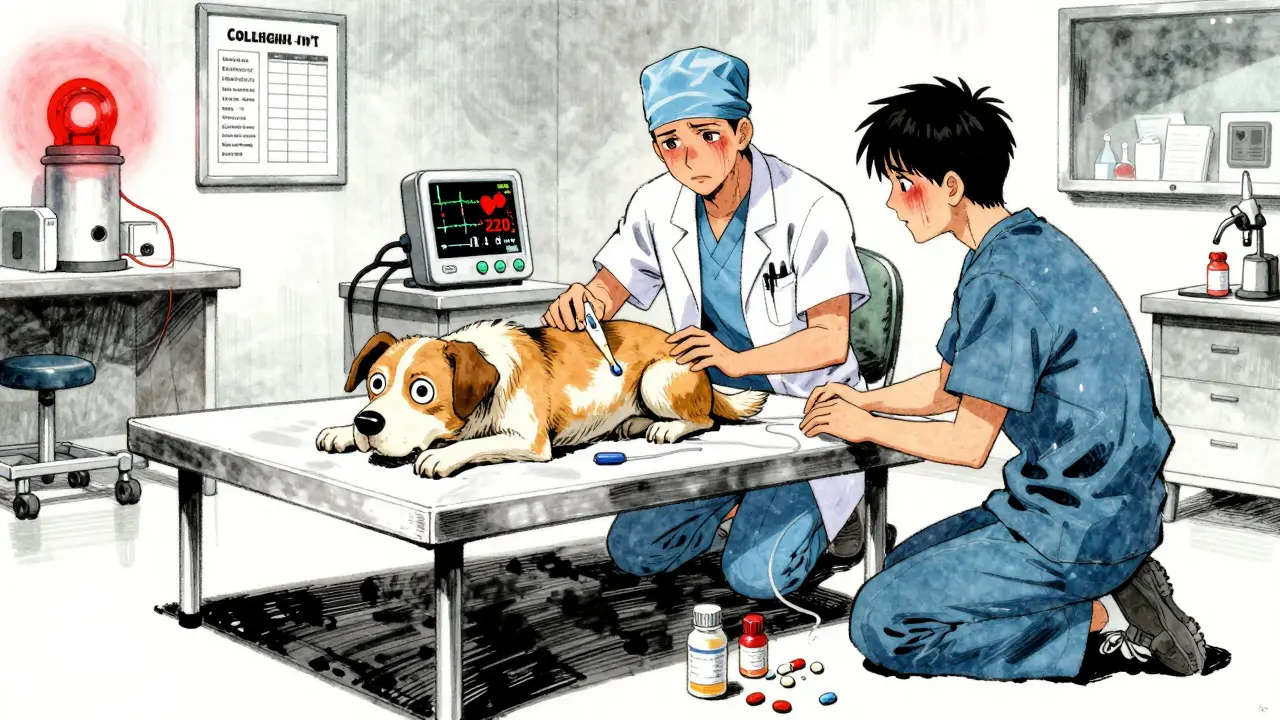
Don’t wait for symptoms to get worse. Don’t try to make your pet vomit at home unless instructed by a vet. Don’t Google it for 20 minutes. Follow this 5-minute action plan:- Check for clues: Are there pill fragments? Empty bottle? Smell of medication on their breath?
- Take their temperature: Use a rectal thermometer. Above 103.5°F? That’s a red flag for stimulants or SSRIs.
- Look at their gums: Are they pink? Brown? Blue? Brown means acetaminophen poisoning.
- Check their pupils: Dilated and fixed? Likely an ADHD drug.
- Call immediately: Contact Pet Poison Helpline (1-800-213-6680) or ASPCA Poison Control. They’ll tell you if it’s an emergency and what to do next.
These hotlines are staffed 24/7 by veterinary toxicologists. The average response time is under a minute. They’ll ask what the medication is, how much was taken, and your pet’s weight. Have that info ready.
Why Most Owners Miss the Signs
A PetMD survey of 1,247 pet owners found 68% misinterpreted early symptoms. People thought:- Agitation from SSRIs was just “excitement” (42% of cases)
- Tremors from stimulants were “shivering from cold” (37% of cases)
- Black stools were “diet-related”
- Brown gums were “just dirty”
One Reddit user described their dog acting “hyper after eating my Adderall” and thought it was just a good day. By the time they got to the vet, the dog’s temperature was 105.6°F. He survived-because they got there fast. Others weren’t so lucky.
Delayed recognition is the #1 reason pets die. In one case, a cat ate Tylenol. Owners thought it was a respiratory infection. Eighteen hours later, methemoglobin levels hit 50%. Survival rate drops to 12% above 40%.
How to Prevent It
Prevention isn’t hard. It just takes consistency:- Keep all medications in locked cabinets-not on nightstands, counters, or purses.
- Never give your pet human medicine without vet approval. Even “natural” supplements can be toxic.
- Use child-proof caps. They’re not pet-proof, but they help.
- Be extra careful with extended-release pills (XR, ER). They release poison slowly, making symptoms harder to link to ingestion.
- Download the ASPCA Poison Control app. It has a symptom checker and quick access to emergency numbers.
Some pet insurance plans now cover poisoning emergencies. If you don’t have it, consider it. The average cost to treat a medication overdose? $1,200-$5,000. Preventing it costs nothing.
What’s Changing in 2025
New tools are emerging. In July 2023, the American College of Veterinary Emergency and Critical Care launched an AI-powered app that analyzes symptoms and matches them to likely toxins. Beta testing showed 89% accuracy. The ASPCA is rolling out species-specific checkers in 2024-cat-focused first, then dogs. Veterinary clinics are also training staff better. Banfield Pet Hospital trained all 1,022 locations in 2023. Misdiagnosis rates dropped from 38% to 12% in six months. But the biggest change? More people are talking about it. Pet owners are sharing stories. Vets are educating. And that’s saving lives.Can I give my dog baby aspirin for pain?
No. Even low-dose aspirin can cause stomach ulcers and kidney damage in dogs. There are safer, vet-approved pain relievers made specifically for pets. Never assume a human medication is safe just because it’s "baby" or "low-dose."
My cat licked a pill off the floor-should I worry?
Yes. Cats absorb toxins through their mouths and paws. Even a tiny residue can be dangerous, especially with acetaminophen or Effexor. Call your vet or Pet Poison Helpline immediately. Don’t wait for symptoms.
How long does it take for symptoms to show up?
It varies. Stimulants like Adderall show signs in 15-60 minutes. Antidepressants can take 1-12 hours. NSAIDs and acetaminophen may take 1-72 hours. Never assume "no symptoms yet" means "no problem." Some poisons cause damage before symptoms appear.
Can I induce vomiting at home?
Only if a vet or poison control expert tells you to. Some substances cause more damage coming back up-like bleach, petroleum products, or sharp pills. Hydrogen peroxide can also be dangerous if used incorrectly. Always call first.
Is there a way to know if my pet ate something I didn’t see?
If your pet suddenly acts strange-vomiting, trembling, lethargic, or with discolored gums-and you didn’t give them anything, assume poisoning until proven otherwise. Check for open pill bottles, chewed packaging, or unusual smells on their breath. When in doubt, get them checked.
Abby Polhill
December 24, 2025 AT 04:16NSAIDs are the silent killers in most households. I had a beagle who ate a single naproxen tablet because I left my pill bottle on the nightstand. By the time I noticed, his BUN was at 140. We got lucky-he survived with 48 hours of IV fluids and a $3,200 bill. Now I lock everything in a cabinet with a keypad. No exceptions. Even my vitamins.
Pro tip: If you use a pill organizer, keep it in a drawer. Pets are ninja-level scavengers.
Bret Freeman
December 24, 2025 AT 10:52Let me just say this: if you’re the kind of person who thinks ‘it’s just one pill’ and then wonders why your dog is vomiting black sludge, you don’t deserve a pet. This isn’t a ‘oops’ moment-it’s negligence dressed up as love. You wouldn’t let your kid eat your Adderall. Why treat your dog like a lab rat with a tail?
I’ve seen three dogs die from this. All because their owners ‘didn’t think it was a big deal.’ Spoiler: it is. Big. Deal.
Lindsey Kidd
December 25, 2025 AT 04:59Thank you for this. 🙏 I’m a vet tech and I see this way too often. Last week, a cat ate a single Effexor XR capsule-just one. Owner thought it was ‘just anxiety meds.’ Cat had seizures by 90 minutes. We saved her, but her liver enzymes were through the roof.
PLEASE keep meds locked up. Even if you think your pet is ‘too smart’ to get into them-they’re not. They’re motivated by smell, not logic. And cats? They’ll lick residue off your fingers after you take your Xanax. Don’t ask me how I know.
Christine Détraz
December 25, 2025 AT 21:10I used to think my cat was just ‘weird’ because she’d sit by the bathroom sink after I took my pills. Now I know she was sniffing for leftovers. I never thought about how a tiny residue on my hand could be lethal. I’ve started washing my hands before touching her. Small change, huge difference.
Also-why do we assume pets are immune to human drugs? We’re not magic. Neither are they.
Ajay Sangani
December 27, 2025 AT 14:49Interesting. In India, most people dont have access to pet insurance, so the cost of treatment is a huge barrier. But the awareness gap is even wider. I once saw a man give his dog paracetamol for fever. He said, 'It works for me, why not for him?'
Education needs to be culturally adapted. Not just 'lock it up' but 'here’s what happens when you don't.' Maybe community vets can run short workshops in local languages.
Pankaj Chaudhary IPS
December 28, 2025 AT 12:13As someone who has worked in public health for over two decades, I can confirm that the root cause here is not ignorance-it is complacency. We prioritize convenience over caution. We treat our pets as extensions of our lifestyle, not as sentient beings with different biochemistry.
The solution is not just awareness-it is institutionalized responsibility. Pet owners should be required to complete a basic toxicology module before adopting. Just like a driver’s license. This is not extreme-it is ethical.
Gray Dedoiko
December 30, 2025 AT 09:26My dog once ate a single Advil. We got to the vet in 40 minutes. They pumped his stomach and gave him activated charcoal. Cost $800. He’s fine now.
But honestly? I still feel awful. I didn’t even realize the bottle was open. I just assumed he wouldn’t touch it. That’s the problem-we assume too much.
Now I keep everything in the bedroom closet, behind a latch. It’s annoying. But he’s alive.
Aurora Daisy
January 1, 2026 AT 01:13Oh, so now we’re blaming pet owners for being too careless? Let’s not forget the pharmaceutical companies who design pills to look like candy. Those little blue Xanax tabs? Designed to be easy to swallow. Guess what? So are cats. And dogs. And toddlers.
Stop making it about ‘responsible owners’ and start making it about ‘responsible drug design.’ Maybe then we won’t need this whole list.
Paula Villete
January 1, 2026 AT 07:08Typo in the post: ‘107°F fevers’-should be ‘107°F’ not ‘107F’. Just saying. 😏
But seriously-this is one of the most important things I’ve read this year. I used to think my cat was just ‘sensitive’ when she acted weird after I took my antidepressants. Turns out, she was having serotonin syndrome. I didn’t even know that was a thing.
Now I take my meds in the bathroom with the door locked. And I wash my hands like I’m in an operating room. Worth it.
Georgia Brach
January 1, 2026 AT 17:41Let’s be real: 90% of these cases are preventable. But the fact that this post even needs to exist is a symptom of a deeper societal failure. We live in a culture that treats animals as disposable accessories. We buy them like gadgets, then forget they have metabolisms.
Also, the AI app mentioned? It’s not ‘cutting-edge’-it’s a band-aid. We need mandatory vet education for all pet owners. Not ‘download an app.’ We need laws.
And no, ‘child-proof caps’ aren’t enough. Dogs can open those. I’ve seen it.
Isaac Bonillo Alcaina
January 3, 2026 AT 04:29My ex gave her cat Tylenol for a ‘cold.’ Said she ‘read it was safe in small doses.’ Cat died in 14 hours. She cried for a week. Then got another cat. And left her pills on the counter again.
There’s no such thing as a ‘good person’ who does this. There’s only negligence. And it kills.
I don’t judge. I just wish more people had the emotional bandwidth to care before the funeral.
Bhargav Patel
January 3, 2026 AT 15:39It is fascinating to observe the biological divergence between human and canine metabolism. The absence of glucuronyl transferase in felines is a remarkable evolutionary adaptation-yet one that renders them exquisitely vulnerable to modern pharmacology.
One might argue that the human species, having engineered such potent chemical compounds, bears a moral obligation to understand the ecological impact of their use-even on non-human species. This is not merely veterinary science; it is bioethics.
Steven Mayer
January 3, 2026 AT 19:46Effexor is the silent assassin. I’ve seen it twice. No vomiting. No tremors. Just… lethargy. Then coma. Then death. No warning signs until it’s too late. The extended-release coating delays toxicity by 6–12 hours. By then, the liver is already necrotic.
My cat licked residue off my coffee mug after I took mine. I didn’t know. She died. Now I use a separate mug. And I rinse it three times. And I don’t touch her for 15 minutes after taking it.
It’s not paranoia. It’s survival.
Charles Barry
January 4, 2026 AT 00:37Who’s really behind this? The vet industry? The pet insurance companies? They profit from these emergencies. They push ‘awareness’ so you’ll panic-buy $400 emergency treatments instead of just… not giving your pet human drugs.
And why are we only talking about NSAIDs and antidepressants? What about your coffee? Your nicotine patch? Your weed gummies? Cats die from THC. Dogs die from xylitol. But no one makes a post about that.
This is fear-mongering disguised as education. And I’m not buying it.
Austin LeBlanc
January 4, 2026 AT 23:55My neighbor’s dog ate a whole bottle of Adderall. He was running in circles, panting like a freight train, pupils like saucers. They rushed him to the ER. Vet said if they’d waited another 20 minutes, he’d have had a stroke.
Now the neighbor’s got a sign on her door: ‘NO MEDS IN THIS HOUSE.’ And she’s not even a pet owner anymore. She gave her dog away.
Some people just can’t be trusted with both pills and pets.