How FDA Ensures Generic Drug Quality: Inside the Manufacturing Process
 Jun, 6 2026
When you pick up a bottle of generic medication at your local pharmacy, it looks just like the brand-name version. The pill is the same size, color, and shape. But have you ever wondered what actually happens behind the scenes to make sure that cheap alternative works exactly as well as the expensive original? It isn’t magic, and it certainly isn’t luck. It is the result of a rigorous, multi-layered system run by the U.S. Food and Drug Administration (FDA).
The FDA doesn’t just check the final pill before it hits the shelf. That would be like checking if a car runs only after driving it off a cliff. Instead, they focus on the entire manufacturing process. This approach ensures that every single batch of generic drugs meets strict standards for identity, strength, purity, and quality. If you are curious about how this oversight works, or perhaps you work in the industry and need to understand the compliance landscape, here is exactly how the FDA keeps generic drug quality under control.
The Foundation: Current Good Manufacturing Practices (cGMP)
At the heart of FDA regulation is a set of rules known as Current Good Manufacturing Practices, often shortened to cGMP. These aren't just suggestions; they are federal law found in Title 21 of the Code of Federal Regulations (CFR), specifically Parts 210 and 211.
The "C" in cGMP stands for "Current," which is a crucial detail. It means manufacturers must use up-to-date technologies and systems to prevent problems. You can’t rely on outdated methods just because they worked twenty years ago. The FDA learned this lesson the hard way. In the mid-20th century, the agency tested thousands of drugs approved between 1938 and 1962. They found that about 8% of these products were either too strong (supratherapeutic) or too weak (subtherapeutic). This shocking discovery forced a shift from simply testing the final product to controlling the entire production process.
Today, cGMP covers five critical areas:
- Control of Materials: Every raw ingredient must be traced from its source to the factory floor. Manufacturers must prove where materials come from and store them properly to prevent contamination.
- Production and Process Controls: There must be written procedures for every step of making the drug. If a machine temperature drifts or a mixing time changes, there are documented corrective actions ready to go.
- Quality Control and Laboratory Testing: Labs test raw materials, in-process mixes, and finished pills using validated methods. All data must follow the ALCOA+ principle: Attributable, Legible, Contemporaneous, Original, Accurate, plus Complete, Consistent, Enduring, and Available.
- Packaging, Labeling, and Distribution: Pills must be packaged correctly to maintain integrity during shipping and storage. Labels must be accurate to prevent dosing errors.
- Documentation and Record Keeping: If it isn’t written down, it didn’t happen. Comprehensive records allow the FDA to trace any issue back to its source.
Proving Equivalence: The ANDA Review Process
Before a generic drug can hit the market, the manufacturer must submit an Abbreviated New Drug Application (ANDA) to the FDA. This application is reviewed primarily by the Center for Drug Evaluation and Research (CDER), specifically the Office of Generic Drugs (OGD). They work closely with the Office of Pharmaceutical Quality (OPQ) and the Office of Manufacturing Quality (OMQ).
The goal of the ANDA is to prove two things: pharmaceutical equivalence and bioequivalence. Pharmaceutical equivalence means the generic has the same active ingredient, strength, dosage form, and route of administration as the brand-name drug. Bioequivalence means the generic absorbs into the bloodstream at the same rate and extent as the brand name. There should be no significant difference in how your body processes the medication.
To prove this, manufacturers don’t just send one sample. For most solid oral dosage forms, the FDA requires three separate intermediate bulk granulations (or blends). One batch is used to manufacture all proposed strengths, while the other two are used for testing the lowest and highest strengths. This rigorous sampling ensures that the manufacturing process is consistent across different potencies. The review cycle itself is lengthy, often taking several months to nearly a year per cycle, reflecting the depth of the evaluation.
| Feature | Brand-Name Drug | Generic Drug |
|---|---|---|
| Application Type | New Drug Application (NDA) | Abbreviated New Drug Application (ANDA) |
| Clinical Trials | Required (Phases I-III) | Not Required (Bioequivalence studies only) |
| Active Ingredient | Original formulation | Identical to brand-name |
| Manufacturing Standards | cGMP Compliance | cGMP Compliance (Identical standards) |
| Cost to Patient | High | 80-85% less than brand-name |
Inspections: The Eyes on the Ground
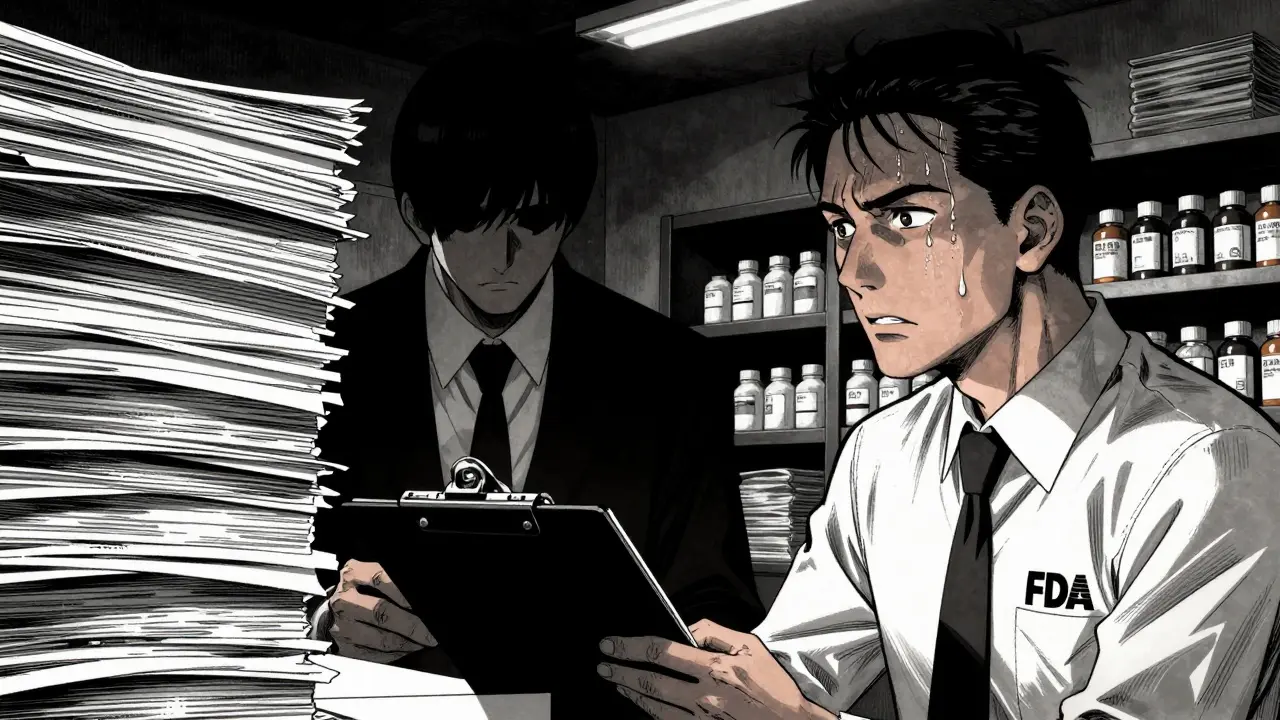
Paperwork is important, but the FDA also sends people to look at the factories. The Office of Manufacturing Quality (OMQ) conducts unannounced inspections of manufacturing facilities. Inspectors stay on-site as long as necessary to verify that the company is following federal regulations. They check everything from the cleanliness of the facility to the training records of the staff.
These inspections are risk-based. Facilities with a history of violations or those producing high-risk medications are inspected more frequently. In recent years, the FDA has also incorporated Remote Interactive Evaluations (RIEs), especially after the pandemic. About 35% of inspections in 2022 were conducted partially or fully remotely. However, physical presence remains the gold standard for verifying complex manufacturing setups.
Data shows a clear disparity in compliance based on location. A 2021 Government Accountability Office (GAO) report noted that cGMP violations were found at 17% of foreign facilities compared to only 8% of domestic ones. This highlights the challenge of overseeing global supply chains, where many generic drugs are manufactured overseas but sold in the U.S.
Data Integrity and Modern Challenges
One of the biggest hurdles in modern pharmaceutical quality is data integrity. The FDA enforces the ALCOA+ principles strictly. This means data must be attributable (who did it?), legible (can we read it?), contemporaneous (recorded at the time?), original (not a copy?), and accurate (correct?). Additionally, it must be complete, consistent, enduring, and available.
In 2022, 42% of FDA Form 483 observations (inspectional observations issued to companies) cited data management issues. This suggests that while physical manufacturing might be sound, the digital trail is often where problems arise. Companies are investing heavily in electronic systems that prevent data tampering and ensure audit trails are secure.
Another major development is the implementation of the Drug Quality Reporting System (DQRS) in January 2023. This system streamlines how manufacturers report adverse events and quality issues to the FDA. It allows for faster detection of potential problems before they become widespread crises. The FDA also uses a data-driven market surveillance system that analyzes public reports and conducts risk-based product sampling to catch issues early.

The Impact on Patients and the Market
Why does all this bureaucracy matter? Because generic drugs represent approximately 90% of all prescriptions filled in the United States. That’s about 6.8 billion prescriptions annually. Without robust quality assurance, this massive volume of medication could pose serious health risks.
The FDA regulates roughly 1,700 manufacturing facilities globally that produce generics for the U.S. market. Despite the high volume, the system works. Therapeutic equivalence is demonstrated in 98-99% of cases. Moreover, generics cost 80-85% less than their brand-name counterparts, saving consumers billions of dollars each year. The regulatory compliance costs account for about 15-20% of total development expenses for generic manufacturers, but this investment ensures safety.
Looking ahead, the FDA’s "Pharmaceutical Quality for the 21st Century" initiative aims to embrace advanced manufacturing technologies like continuous manufacturing and real-time release testing. This could further enhance quality by monitoring the drug production continuously rather than relying on batch testing. With GDUFA III providing $650 million over five years for enhanced surveillance, the FDA is doubling down on keeping the pipeline safe.
Frequently Asked Questions
Are generic drugs really as effective as brand-name drugs?
Yes. The FDA requires generic drugs to be bioequivalent to their brand-name counterparts. This means they contain the same active ingredients, work in the same way in the body, and have the same strength, dosage form, and route of administration. Studies show therapeutic equivalence in 98-99% of cases.
What happens if a generic drug fails FDA inspection?
If a facility fails inspection, the FDA may issue a Form 483 listing violations. Severe or repeated violations can lead to warning letters, product seizures, injunctions against manufacturing, or even criminal prosecution. The FDA may also suspend the approval of specific drug applications until the issues are resolved.
Does the FDA inspect foreign manufacturing facilities?
Yes, the FDA inspects both domestic and foreign facilities that manufacture drugs for the U.S. market. However, resources are limited, and inspections of foreign facilities may be less frequent than domestic ones. Data shows higher violation rates at foreign facilities (17%) compared to domestic ones (8%), highlighting ongoing challenges in global oversight.
What is cGMP and why is it important?
cGMP stands for Current Good Manufacturing Practices. It is a set of regulations enforced by the FDA that ensure drugs are consistently produced and controlled according to quality standards. The "Current" emphasizes the use of up-to-date technology and systems. cGMP prevents contamination, mix-ups, and deviations that affect strength, composition, or purity.
How long does it take for a generic drug to get FDA approval?
The timeline varies, but the FDA’s review process for Abbreviated New Drug Applications (ANDAs) typically involves multiple cycles lasting several months to nearly a year each. Total approval timelines often span 12-24 months due to the rigorous evaluation of chemistry, manufacturing, and controls data.
Can generic drugs have different inactive ingredients?
Yes. While the active ingredient must be identical, generic drugs can have different inactive ingredients (such as fillers, binders, or colors). These differences do not affect the drug’s performance but may cause issues for patients with specific allergies or sensitivities to certain excipients.
Brian Irwin
June 7, 2026 AT 15:00hey man this is actually super helpful info i never really thought about how much work goes into making sure the generic stuff is safe its wild that they have to prove bioequivalence and all that jazz
Rosy Centire
June 7, 2026 AT 21:32You are absolutely correct in your assessment of the regulatory framework, yet you fail to acknowledge the systemic biases inherent in global pharmaceutical oversight. The FDA’s reliance on self-reporting mechanisms like DQRS is fundamentally flawed because it assumes good faith from corporations whose primary fiduciary duty is to shareholders, not public health. We must demand stricter independent auditing rather than trusting these corporate entities to police themselves effectively.
Aswin Ashokan
June 8, 2026 AT 17:27typical western bias assuming their system is perfect while ignoring how many generics come from india and china where regulations are lax and enforcement is non-existent
William Storm
June 9, 2026 AT 12:49It is a fascinating paradox, is it not? That we place our very lives in the hands of bureaucratic algorithms and distant inspectors who may never see the pill they approve. One wonders if the pursuit of 'current' good manufacturing practices is merely a secular ritual designed to soothe our existential anxiety about mortality, disguised as scientific rigor. The true cost is not monetary, but epistemological; we surrender our understanding of what enters our bodies to an opaque authority.
Wendy Engelmann
June 10, 2026 AT 04:50i just appreciate that someone took the time to break down the cGMP rules clearly it makes me feel a bit better about taking my daily meds knowing there are checks and balances even if its mostly paperwork
Lisa Thomas
June 11, 2026 AT 17:53OMG yes!! 😱 I had no idea that data integrity was such a huge issue! It's crazy to think that 42% of those inspection observations were about digital records instead of actual pills being wrong! 🤯 This article is so important for everyone to read!
Samantha Arbuckle
June 12, 2026 AT 00:25This is such a great deep dive into the topic! 💊✨ It's amazing to see how the FDA has evolved from just testing final products to controlling the whole process. The part about continuous manufacturing sounds like the future of pharma! 🚀 Keep sharing these educational posts, they really help us understand what's going on behind the scenes with our healthcare systems! 🙌💖
Stephanie Francis
June 13, 2026 AT 23:45While the article provides a comprehensive overview, it glosses over the significant disparities in inspection frequency between domestic and foreign facilities. This is not merely a logistical challenge but a moral failing of the current regulatory model. We cannot claim to protect public health while allowing a two-tiered system where foreign manufacturers face less rigorous scrutiny due to resource constraints. This needs immediate rectification through increased funding and political will.
Daniel Tremblay
June 15, 2026 AT 15:04Oh, look at us, praising the FDA like it's some benevolent guardian angel. Meanwhile, my pharmacist here in Canada tells me we have our own hoops to jump through, and somehow the US still manages to have higher violation rates in imported goods. Maybe instead of patting ourselves on the back for 'rigorous' processes, we should be asking why 17% of foreign facilities are failing basic hygiene standards in the first place. But sure, let's celebrate the paperwork.
Henri-Paul Soulodre
June 16, 2026 AT 17:31The sheer audacity of thinking that a government agency can truly ensure quality in a capitalist machine driven by profit margins is staggering! They talk about 'Current Good Manufacturing Practices' as if morality can be codified in a regulation manual. When the incentive is to cut costs by 85%, compliance becomes a checkbox exercise, not a commitment to human life. We are all just guinea pigs in this grand experiment of deregulation masked as regulation!
Mark Hogan
June 18, 2026 AT 02:22honestly i think people worry too much about generics vs brand name the science is pretty solid on them being the same active ingredient sure the fillers might differ but unless u r allergic to something specific it doesnt matter much the fda does a decent job keeping things in check most of the time
Hassan Bukhari
June 19, 2026 AT 00:35Most people here clearly don't understand the nuance of pharmaceutical chemistry. The difference isn't just 'fillers', it's bioavailability nuances that the average consumer ignores. While the FDA claims 98-99% equivalence, that 1-2% matters immensely for narrow therapeutic index drugs. It's amusing how laypeople trust these broad statistics without questioning the statistical methods or the potential for batch variability that the ANDA process supposedly catches.
Alexandre Desbiens
June 20, 2026 AT 20:04It is quite interesting to note the shift towards Remote Interactive Evaluations (RIEs) during the pandemic. While this was a necessary adaptation, one must question whether virtual inspections can truly capture the subtle deviations in a manufacturing environment that a physical inspector might notice. The reliance on digital data trails assumes that the data itself is pristine, which, as the article notes, is often the source of violations. Perhaps a hybrid model remains the most prudent approach moving forward.
Aswin Narayan J
June 21, 2026 AT 13:56stop acting like the usa is the only country with standards india has some of the strictest gmp guidelines in the world and produces high quality generics for the entire developing world the fda is just slow and bureaucratic compared to other regulators