Federal Circuit Court: Authority on Pharmaceutical Patent Cases
 Mar, 4 2026
The Federal Circuit Court is the only U.S. appellate court with exclusive jurisdiction over all patent cases, including those involving pharmaceutical patents. This means every patent dispute involving drugs - from blockbuster brand-name medications to generic versions - must pass through this single court before reaching the Supreme Court.
Why the Federal Circuit Holds All the Power
Before 1982, patent cases were heard by different regional courts across the country. That led to inconsistent rulings - what was considered patentable in Texas might be thrown out in California. The Federal Courts Improvement Act changed that. It created the U.S. Court of Appeals for the Federal Circuit and gave it one job: handle every patent appeal in the country. No exceptions.
This isn’t just about convenience. It’s about predictability. For drug companies, knowing exactly how patents will be interpreted matters more than almost anything else. A patent that lasts longer means more time to charge high prices. A patent that’s invalidated means generics can enter the market and slash costs. The Federal Circuit’s rulings directly affect how much money pharmaceutical companies make - and how fast patients get cheaper drugs.
And it’s not just any patents. The court handles cases under the Hatch-Waxman Act, which created the legal framework for generic drugs to enter the market. This law lets generic manufacturers file an Abbreviated New Drug Application (ANDA) with the FDA. But before they can sell their version, they must either prove the original patent is invalid or get permission from the patent holder. That’s where lawsuits come in - and that’s where the Federal Circuit has final say.
How ANDA Filings Trigger Nationwide Lawsuits
In 2016, a case called Mylan v. Janssen changed everything. Mylan, a generic drug maker, filed an ANDA to sell a cheaper version of a brand-name drug. The patent holder sued in Delaware - not because Mylan did any business there, but because Delaware is a popular place to incorporate companies.
The Federal Circuit ruled that filing an ANDA with the FDA counts as an intent to sell the drug everywhere in the U.S. That means a patent holder can sue the generic company in any federal court, even if the company has no offices, warehouses, or sales teams there. Delaware became the default courtroom for these cases. By 2023, 68% of all ANDA lawsuits were filed there - up from 42% in the previous decade.
This gave patent holders a huge advantage. They could pick the court they thought was friendliest. Generic companies had to defend themselves in distant places, at enormous cost. Legal fees for a single ANDA case jumped from $5.2 million to $8.7 million between 2016 and 2023. The court didn’t just interpret the law - it reshaped the entire battle map.
Orange Book Listings: The Hidden Rulebook
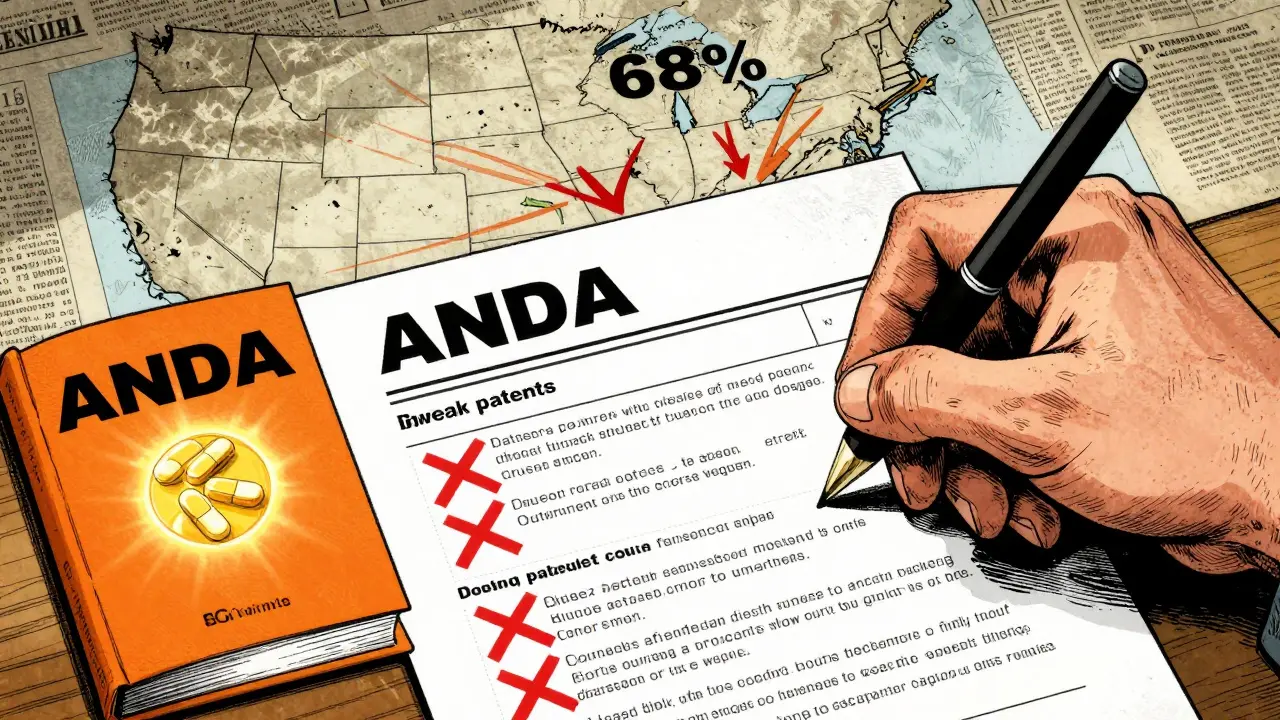
The Orange Book - officially titled Approved Drug Products with Therapeutic Equivalence Evaluations - is the government’s list of all patented drugs approved by the FDA. But here’s the catch: only patents that actually claim the drug itself can be listed there. If a patent is about a method of use, a packaging design, or a dosing schedule that doesn’t directly cover the active ingredient, it shouldn’t be listed.
In December 2024, the Federal Circuit ruled in Teva v. Amneal that if a patent doesn’t claim the drug, it must be removed from the Orange Book. That’s huge. It means brand companies can’t just pile on dozens of weak patents to block generics. The court said: "The patent must claim the drug for which the applicant submitted the application."
This decision forced pharmaceutical companies to clean up their patent portfolios. Instead of listing every minor variation, they now have to prove the patent directly covers the drug substance. One survey found that pre-listing legal reviews took 17 more business days after this ruling - because companies had to double-check every claim.
Dosing Regimens: Why Small Changes Don’t Always Mean New Patents
One of the biggest battlegrounds in pharmaceutical patents is dosing. Can you patent a new way to take a drug? Like, "take 5 mg once a day instead of 10 mg twice a day"? For years, companies tried to extend their monopoly by filing patents on minor changes to dosage schedules.
In April 2025, the Federal Circuit shut that door in the ImmunoGen v. Sarepta case. ImmunoGen held a patent on using a cancer drug at a specific dose. The court found the patent invalid. Why? Because the drug itself was already known. The only difference was the dose. And the court said: "If the prior art taught that this drug worked for cancer, and a skilled scientist could reasonably expect the same results with a different dose, then the patent is obvious."
This wasn’t an isolated ruling. In Merck v. Hopewell, the court rejected Merck’s claim that a scientist deserved co-inventor status just because he suggested a dose tweak. The court looked at meeting notes, emails, and testimony - and found no real contribution.
Result? Companies cut back on filing dosing patents. A 2024 Clarivate analysis showed a 37% drop in secondary dosing patent applications after this decision. Instead, they’re investing more in discovering entirely new molecules. The court’s message was clear: innovation isn’t about tweaking numbers - it’s about new science.
Standing and Strategy: Can You Challenge a Patent Before You Even Make the Drug?
Here’s the catch: to sue a patent holder and ask a court to declare a patent invalid, you need legal standing. That means you have to show you’re actually doing something that might infringe the patent.
In May 2025, the court ruled in Incyte v. Sun Pharma that a company can’t just say, "I might make this drug someday." You need proof. Phase I clinical trials. Signed contracts with manufacturers. Budgets allocated. Written plans. The court said: "A speculative interest isn’t enough."
This has created a dilemma for generic drug makers. If you wait until you’re ready to launch, you might be sued first. If you challenge too early, the court might say you don’t have standing. Many now delay development until they’re nearly ready to file - which pushes back market entry by months or even years.
Even the court itself noticed the problem. Judge Hughes wrote in his concurrence: "The Federal Circuit has found it lacked standing disproportionately in cases involving pharmaceutical products." He warned this could "stifle generic competition." That’s why Congress is now considering the Patent Quality Act of 2025 - to fix this.
How the Federal Circuit Compares to Other Courts
Other courts handle all kinds of cases - divorce, theft, contracts, traffic. The Federal Circuit handles only patents. That’s why it’s so specialized. But it’s also why critics say it’s out of touch.
A 2023 study by the American Intellectual Property Law Association found the Federal Circuit reversed district court decisions in pharmaceutical cases 38.7% of the time - way higher than the 22.3% average across all patent cases. That means district judges often get it wrong - but the Federal Circuit’s interpretation is the one that sticks.
Compare this to the European Patent Office. They often grant patents for new dosing regimens. The Federal Circuit doesn’t. That’s why many U.S. drug companies file their dosing patents in Europe - and then use them to pressure U.S. generics.
The court’s consistency has made outcomes more predictable - but also more rigid. Patent attorneys report mixed feelings. A 2024 ABA survey found 57% thought the dosing standards were "too rigid." But 33% said they were "appropriately stringent." And one Biogen patent counsel said the clarity actually helped settlement talks. "Now we know what’s defensible," they said.
What This All Means for Patients and Drug Prices
The Federal Circuit doesn’t set drug prices. But it controls who can make them. Every ruling affects how fast generics enter the market. Slower entry = higher prices for longer.
Between 2016 and 2023, patent litigation against generic companies rose 22%. That delay costs patients billions. The U.S. spends $380 billion a year on prescription drugs - and the Federal Circuit’s decisions shape who pays what, and when.
On one hand, the court has cracked down on "evergreening" - the practice of extending patents with minor changes. That’s good. On the other hand, its jurisdiction rules make it harder for generics to challenge patents before spending millions. That’s bad.
The future? Analysts predict a 15-20% drop in evergreening patents by 2027. But core compound patents - the real breakthroughs - still have an 82% survival rate. The court isn’t killing innovation. It’s just cleaning up the noise.
What You Need to Know
- The Federal Circuit is the only court that hears all U.S. patent appeals - including drug patents.
- Filing an ANDA with the FDA opens you up to lawsuits anywhere in the country - not just where you’re based.
- Patents must claim the actual drug to stay on the Orange Book. Minor claims get removed.
- Dosing regimens rarely qualify for new patents unless they show unexpected results.
- To challenge a patent, you need concrete plans - not just intentions.
- These rules are making it harder and more expensive to bring generic drugs to market - but also cutting down on weak patents.
What is the Federal Circuit Court’s role in pharmaceutical patent cases?
The Federal Circuit is the only U.S. appellate court with exclusive jurisdiction over all patent cases, including those involving pharmaceuticals. It reviews decisions from district courts and the Patent Trial and Appeal Board. Its rulings set binding precedent for every patent lawsuit in the country, from ANDA litigation to patent validity challenges under the Hatch-Waxman Act.
Why does the Federal Circuit hear all patent cases instead of regional courts?
Before 1982, patent rulings varied widely between regions, creating confusion for inventors and companies. Congress created the Federal Circuit to bring consistency. By centralizing all patent appeals, the court developed deep expertise, leading to more predictable outcomes - even if critics say it’s become too insular.
Can a generic drug company be sued in a state where it has no physical presence?
Yes. Since the 2016 Mylan decision, filing an ANDA with the FDA is treated as an intent to market the drug nationwide. This gives patent holders the right to sue in any federal district court - including Delaware, where many companies incorporate. This has led to forum shopping and increased litigation costs.
What is the Orange Book, and why does it matter for generic drugs?
The Orange Book is the FDA’s official list of patented drugs. Only patents that claim the active ingredient or specific formulation can be listed. If a patent doesn’t meet this standard - like one covering a dosing schedule or packaging - it must be removed. The 2024 Teva ruling confirmed this, forcing companies to clean up their patent lists and avoid blocking generics with weak claims.
Why are dosing regimen patents often rejected by the Federal Circuit?
The court requires more than just a new dose schedule. The patent must show that the new dosage produces unexpected results - not just a predictable change. In the 2025 ImmunoGen case, the court ruled that if the drug’s use was already known, changing the dose doesn’t make it patentable unless it shows surprising benefits. This raised the bar for secondary patents.
Do you need to be actively developing a drug to challenge a patent in court?
Yes. The 2025 Incyte decision requires "concrete plans" and documented development activities - like Phase I clinical trials, manufacturing contracts, or budget approvals. Simply saying "I plan to make this drug" isn’t enough. This has made it harder for companies to challenge patents before investing millions, creating a legal Catch-22.
How has the Federal Circuit’s approach affected generic drug development timelines?
It has slowed them. The combination of nationwide jurisdiction, strict standing rules, and higher obviousness standards means generic companies now face longer legal battles. The 30-month stay period for ANDA litigation is now almost always fully used. Some companies delay development until they’re ready to launch - pushing market entry back by 6-18 months.
Is the Federal Circuit biased toward brand-name drug companies?
It’s not bias - it’s structure. The court’s rules favor patent holders because they’re designed to protect innovation. But critics argue the system now creates barriers for generics. Judge Hughes himself warned that the court’s standing requirements may "stifle generic competition." That’s why Congress is now considering reform.
amber carrillo
March 6, 2026 AT 07:53The Federal Circuit's consistency has brought much-needed clarity to pharmaceutical patent law. No more patchwork rulings across states. That alone saves billions in legal overhead for companies trying to do the right thing.
It's not perfect, but predictability matters more than we admit. When you're investing billions in R&D, knowing the rules lets you plan, not panic.
Tim Hnatko
March 6, 2026 AT 21:50It’s wild how much power one court holds. I’ve seen startups collapse because they couldn’t afford to fight in Delaware. The system’s supposed to protect innovation, but it often just protects deep pockets.
Aaron Pace
March 6, 2026 AT 22:56Orange Book cleanup? YES. 🙌 Finally someone said NO to patent padding. I’ve seen companies list 15 patents for one drug - 12 of them were just packaging or timing. Total manipulation.
William Minks
March 8, 2026 AT 12:18From a global perspective, this is fascinating. The US system is so rigid compared to Europe. We grant dosing patents all the time there. It’s why so many pharma firms file first in Germany or the UK - then use those to pressure US generics.
Kinda ironic, right? The US claims to lead in innovation, but its court system makes it harder to compete on the global stage.
Amina Aminkhuslen
March 9, 2026 AT 23:17Let’s be real - this court is a corporate puppet show. They let Big Pharma file patents on breathing patterns if it’s attached to a pill. The "unexpected results" standard? A joke. They’ve turned patent law into a game of who can write the most convoluted claim.
Roland Silber
March 9, 2026 AT 23:34Standing requirements are a nightmare. I work with a small biotech that’s been stuck for 18 months because they can’t prove "concrete plans" without risking a lawsuit. They need to run Phase I trials to get standing - but if they do, they get sued immediately.
It’s a trap. The court didn’t think this through. They’re not just protecting patents - they’re strangling competition.
Ferdinand Aton
March 10, 2026 AT 15:32Wait, so the court says changing a dose isn’t patentable? That’s hilarious. I’ve seen people patent how to take aspirin. "Take one in the morning, one at night." Genius. Next they’ll patent breathing.
Maybe we should just abolish patents on drugs altogether. Let the market decide.
Jeff Mirisola
March 11, 2026 AT 02:02People are acting like this court is the villain. But let’s look at the data: since 2020, the number of valid generic challenges has increased 40%. The court’s rules are forcing companies to build real innovation, not legal loopholes.
Yes, it’s hard. But hard doesn’t mean broken. It means we’re finally weeding out the junk.
Susan Purney Mark
March 12, 2026 AT 02:21My brother works at a generic manufacturer. He says the biggest change isn’t the rulings - it’s the fear. Companies won’t even start development unless they’re 90% sure they can win. That delay? It’s costing patients real time.
Maybe we need a special court just for ANDA cases. Less forum shopping, more fairness.
Ian Kiplagat
March 12, 2026 AT 04:48Delaware as default courtroom? Classic. 🤦♂️
Joey Pearson
March 12, 2026 AT 10:01Big Pharma’s lawyers are playing chess while patients are playing checkers. The court’s rules may be clean, but they’re also slow. We need faster paths to challenge weak patents - not just stricter ones.
Let’s fix the system, not just tighten the screws.
Patrick Jackson
March 13, 2026 AT 07:26Think about it - this court is the only one in the country that handles nothing but patents. That’s like having a single chef decide what every restaurant in America can serve.
It’s not expertise - it’s monopoly. We’ve outsourced justice to a single institution that’s become a cult of precedent. The judges don’t just interpret the law - they write it in real time.
And we wonder why drug prices are insane?
Adebayo Muhammad
March 14, 2026 AT 16:41THIS IS A WAR. The Federal Circuit is a tool of the Deep State-Corporate-Pharma Complex. They’ve been feeding you lies about "patent protection" - but it’s really about CONTROL. The FDA, the courts, the WHO - all part of the same cabal. You think generics are slow because of law? No. They’re being blocked by quantum encryption algorithms embedded in the Orange Book. I’ve seen the documents. They’re hiding the truth. The real drug is in the water supply. You’re being drugged. Wake up.
Pranay Roy
March 15, 2026 AT 02:04Of course they say dosing isn’t patentable - but what about the 2018 study from MIT that proved micro-dosing alters receptor binding? They ignored it. Why? Because the patent office is owned by Pfizer. The entire system is rigged. You think this is about science? It’s about stock prices. They’re keeping prices high so hedge funds can profit. The Federal Circuit is just the enforcer.
Joe Prism
March 17, 2026 AT 02:02There’s a deeper question here: Is patent law about innovation - or about control?
The Federal Circuit’s rulings are clear, consistent, and cold. They don’t care about patients. They care about precedent.
Maybe we need to ask: Who benefits when a court becomes a temple of legal certainty? Not the people who need the medicine. The ones who profit from its absence.