Daptomycin Muscle Toxicity: What You Need to Know About CK Monitoring and Symptoms
 Jan, 3 2026
Daptomycin CK Monitoring Calculator
Daptomycin CK Monitoring Guide
This tool helps determine if your creatine kinase (CK) levels are within safe limits during daptomycin treatment based on clinical guidelines.
Important: CK monitoring is critical for early detection of muscle damage. Stop daptomycin if:
- CK exceeds 1,000 U/L and you have muscle symptoms
- CK exceeds 10 times the upper limit of normal (usually >1,500-2,000 U/L)
Key Risk Factors
- Patients with heart disease or poor circulation
- Doses above 6 mg/kg/day
- Treatment duration >14 days
- Age over 65
- Kidney disease
- Prior muscle injuries or tendinitis
When you’re on daptomycin for a serious infection like MRSA or infective endocarditis, you’re counting on it to work. But there’s a hidden risk that doesn’t show up in blood cultures or fever charts: daptomycin muscle toxicity. It’s not rare. It’s not theoretical. And if you’re not watching your creatine kinase (CK) levels, you could be walking into serious muscle damage without even knowing it.
What Is Daptomycin, and Why Does It Hurt Your Muscles?
Daptomycin is a powerful antibiotic used when other drugs fail-especially against drug-resistant bacteria like MRSA. It’s given intravenously, usually once a day, and works by punching holes in bacterial cell membranes. But here’s the problem: it doesn’t just target bacteria. It can also damage your own muscle cells.
Studies show daptomycin binds directly to skeletal muscle membranes, causing them to leak. In lab tests, muscle cells exposed to daptomycin showed signs of breakdown even under normal oxygen levels. The damage gets worse when oxygen is low-like in patients with heart failure, severe sepsis, or poor circulation. That’s why someone with coronary artery disease might develop dangerously high CK levels on daptomycin, while someone else on the same dose stays fine.
How Common Is Muscle Toxicity?
The FDA label says muscle problems happen in about 0.2% of patients. That number is misleading. Real-world data tells a different story. In hospitals, 5% to 10% of people on daptomycin develop elevated CK levels. That’s 25 to 50 times higher than what clinical trials reported. Why the gap? Trials use strict criteria, short treatment times, and healthy volunteers. Real patients are sicker, older, and often on multiple drugs.
The risk jumps even higher if you’re on higher doses-like 8 to 12 mg/kg per day-for bone or joint infections. These off-label uses are common because daptomycin penetrates bone tissue better than vancomycin. But longer treatment (weeks to months) and higher doses mean more time for muscle damage to build up.
What Are the Symptoms?
Early warning signs are simple, but easy to ignore:
- Muscle pain, especially in the thighs, shoulders, or back
- Weakness-feeling like you can’t climb stairs or lift your arms
- Tenderness when pressing on muscles
- Dark urine (a sign of muscle breakdown products in the kidneys)
Some people don’t feel anything until their CK is sky-high. That’s why checking blood levels isn’t optional-it’s lifesaving. Muscle damage from daptomycin is reversible if caught early. Left unchecked, it can lead to rhabdomyolysis, kidney failure, or even death.
When and How to Monitor CK Levels
CK (creatine phosphokinase) is the enzyme released when muscle cells break down. It’s the best early warning sign we have.
Here’s what experts recommend:
- Check CK before starting daptomycin to establish a baseline
- Test weekly during treatment-even if you feel fine
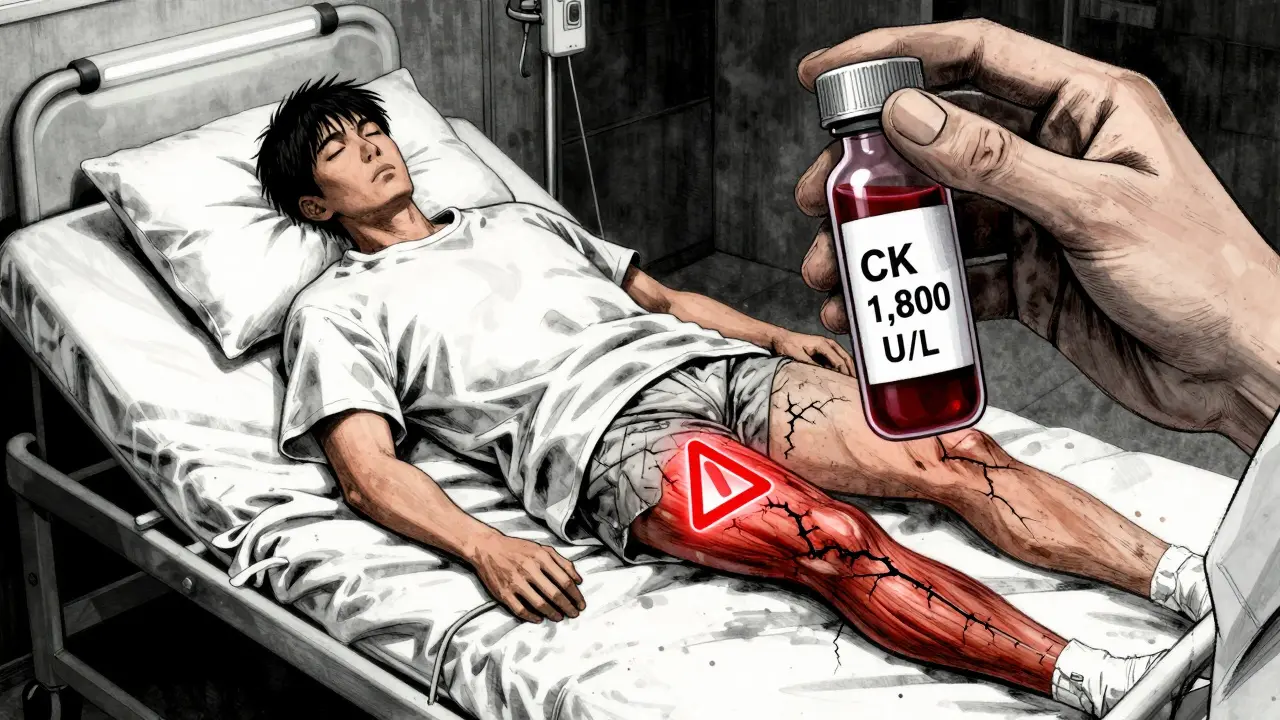
- Stop daptomycin immediately if CK exceeds 1,000 U/L and you have muscle symptoms
- Stop even if you feel fine if CK hits 10 times the upper limit of normal (around 1,500-2,000 U/L, depending on the lab)
Some hospitals, like the University of Nebraska Medical Center, treat CK >1,000 U/L with symptoms as a hard stop. Others wait for CK >5,000 U/L before acting. But waiting is risky. The goal isn’t to avoid all elevation-it’s to prevent catastrophic damage.

Daptomycin vs. Other Antibiotics: Muscle Risks Compared
Not all antibiotics hurt your muscles the same way.
| Antibiotic | Primary Muscle Risk | Monitoring Required | Reversibility |
|---|---|---|---|
| Daptomycin | Myopathy (muscle cell breakdown) | Weekly CK levels | Yes, if caught early |
| Vancomycin | Nephrotoxicity (kidney damage) | Trough levels | Usually yes |
| Fluoroquinolones (e.g., ciprofloxacin) | Tendon rupture | None-clinical vigilance | Often permanent |
| Statins | Myopathy (similar mechanism) | CK if symptoms | Yes, after stopping |
Daptomycin’s risk is different from fluoroquinolones, which tear tendons. It’s also not the same as statins, which cause slow, cumulative muscle damage. Daptomycin attacks muscle cells directly, and the damage can escalate quickly-especially in low-oxygen environments.
Statins and Daptomycin: Do They Really Mix?
For years, doctors were told to stop statins when starting daptomycin. The fear was that combining them would skyrocket the risk of rhabdomyolysis.
But a 2014 study of 220 patients found no statistically significant increase in CK levels or muscle pain when statins were continued. The group on both drugs had slightly higher CK elevations (10.2% vs. 5.3%), but the difference wasn’t large enough to prove cause and effect.
Still, many clinicians keep stopping statins. Why? Because the cost of missing a case of rhabdomyolysis is too high. If you’re on a statin and start daptomycin, talk to your doctor. In low-risk patients, continuing the statin may be safe. In older patients, those with kidney disease, or those on high-dose daptomycin-better to pause it.
Who’s at Highest Risk?
Not everyone on daptomycin will have muscle problems. But some people are sitting on a ticking clock:
- Patients with heart disease or poor circulation (low oxygen = more damage)
- Those on doses above 6 mg/kg/day
- People treated for more than 14 days (especially for bone infections)
- Older adults (over 65)
- Those with kidney disease (reduced drug clearance)
- Patients with prior muscle injuries or tendinitis
If you have two or more of these, your risk isn’t just higher-it’s critical. Ask your doctor if therapeutic drug monitoring (measuring daptomycin levels in your blood) is an option. New research suggests keeping daptomycin exposure between 666 and 939 mg·h/L reduces side effects without losing effectiveness.

What Happens After Stopping Daptomycin?
Good news: muscle damage from daptomycin is almost always reversible. Once you stop the drug, CK levels usually drop by half every 2-3 days. Symptoms improve within a week. Full recovery takes a few weeks, but most people return to normal without lasting effects.
The key is stopping early. Waiting until you can’t walk or your urine turns cola-colored means you’re already in danger of kidney failure. Don’t wait for pain. Don’t wait for weakness. If your CK is climbing, act.
What About Other Side Effects?
Daptomycin isn’t just a muscle risk. About 2% of patients develop daptomycin-induced eosinophilic pneumonia-a rare but serious lung reaction. Symptoms include cough, fever, and trouble breathing. It’s more common in people treated for bone infections over long periods. If you develop new breathing problems while on daptomycin, tell your doctor immediately.
Other side effects include nausea, diarrhea, and headaches-but these are mild compared to muscle or lung damage. The real danger is silent.
Bottom Line: Protect Yourself
Daptomycin saves lives. But it can also hurt you if no one’s watching.
Here’s your checklist:
- Ask for a CK test before starting daptomycin
- Get CK checked every week during treatment
- Report any muscle pain, weakness, or dark urine right away
- If you’re on statins, discuss whether to pause them
- If you have heart disease, poor circulation, or kidney issues, ask about dose adjustments or alternative antibiotics
- Don’t assume you’re fine because you feel okay
This isn’t about being paranoid. It’s about being smart. Daptomycin is a tool. Like any tool, it works best when you know its limits. Monitor your CK. Listen to your body. And don’t let silence be your only warning.
Can daptomycin cause permanent muscle damage?
No, muscle damage from daptomycin is almost always reversible if caught early. CK levels drop quickly after stopping the drug, and muscle strength returns within weeks. But if you delay stopping daptomycin and develop rhabdomyolysis, kidney damage can occur, which may require dialysis and lead to long-term complications.
How often should CK levels be checked while on daptomycin?
Weekly monitoring is the standard recommendation. Some hospitals check before starting, then every 7 days. If you’re on high doses (8-12 mg/kg) or have risk factors like heart disease, some providers check every 3-4 days. Never go longer than 10 days without a test.
Is daptomycin safe for people with kidney disease?
Daptomycin is cleared mostly by the kidneys, so people with kidney disease may have higher drug levels. This increases the risk of muscle toxicity. Dose reduction is often needed, and CK monitoring should be more frequent. Always inform your doctor if you have kidney problems before starting treatment.
Can I take ibuprofen or other pain relievers while on daptomycin?
Yes, NSAIDs like ibuprofen are generally safe to use with daptomycin. However, they can mask early symptoms of muscle pain. If you’re taking them regularly, make sure your doctor knows-you might not realize your muscles are getting worse until it’s too late. Always report any new or worsening discomfort.
What should I do if my CK is high but I feel fine?
Even if you feel fine, a CK level above 10 times the upper limit of normal (usually >1,500-2,000 U/L) means you’re at risk for rhabdomyolysis. Stop daptomycin immediately and contact your doctor. Asymptomatic elevation is still dangerous. The goal is to prevent damage before symptoms appear.
Are there alternatives to daptomycin for MRSA infections?
Yes. Vancomycin is the most common alternative, though it requires more frequent blood monitoring and carries a higher risk of kidney damage. Linezolid, tedizolid, and ceftaroline are other options depending on the infection site and severity. Your doctor will choose based on the type of infection, your kidney function, and your risk for side effects.
Vicki Yuan
January 4, 2026 AT 19:38Just had a patient on daptomycin for 3 weeks with MRSA osteomyelitis-CK climbed to 1,800 U/L by week 2. We stopped it immediately. He was asymptomatic. Now, 4 weeks later, he’s back to hiking. This isn’t theoretical-it’s routine monitoring. If your doc isn’t checking CK weekly, ask why.
Oluwapelumi Yakubu
January 5, 2026 AT 00:32My dear friends, let us contemplate the irony: we wield a molecular scalpel to kill bacteria, yet in our arrogance, we forget that the human body is not a test tube. Daptomycin doesn’t ‘target’-it trespasses. Muscle cells, like all living things, have dignity. When we ignore CK levels, we aren’t just neglecting labs-we’re silencing the body’s quiet scream. The real infection? Complacency.
Terri Gladden
January 5, 2026 AT 02:33OMG I JUST GOT ON DAPTOMYCIN YESTERDAY AND MY THIGHS ARE KILLING ME?? IS THIS IT?? AM I GONNA LOSE MY LEGS?? MY DOCTOR SAID IT WAS FINE?? I’M CRYING IN THE BATHROOM RN
Jennifer Glass
January 5, 2026 AT 18:20Interesting how the FDA’s 0.2% statistic gets cited so often-it feels like a relic from a time when patients were passive recipients, not partners in care. The real-world 5-10% rate speaks to a system that prioritizes trial efficiency over clinical reality. Maybe the question isn’t just ‘how common is it?’ but ‘why are we still surprised when it happens?’
Joseph Snow
January 6, 2026 AT 02:10Let’s be honest: this whole CK monitoring protocol is a smokescreen. The pharmaceutical industry pushed daptomycin as a ‘miracle drug’ for MRSA, and now they’re hiding behind ‘rare side effects’ while hospitals profit from prolonged IV courses. If this were truly dangerous, it would’ve been pulled years ago. I’ve seen patients on vancomycin for months with zero CK checks. Double standard.
melissa cucic
January 7, 2026 AT 20:04I appreciate the thoroughness of this post, and I agree wholeheartedly with the monitoring guidelines-particularly the emphasis on stopping at CK >1,000 U/L with symptoms. However, I would gently suggest adding a footnote regarding CK isoforms: the MM isoform is most specific for skeletal muscle, whereas MB can be misleading in cardiac patients. Clarifying this may prevent unnecessary discontinuation in those with concurrent cardiac injury.
Akshaya Gandra _ Student - EastCaryMS
January 9, 2026 AT 19:22hii i am student from india and i read this and i am so scared now i had daptomycin for 10 days for staph infection and i felt sore but i thought it was just tiredness... should i get ck test now??
Aaron Mercado
January 10, 2026 AT 09:40They told me to stop statins, but what about my blood pressure meds? My beta-blockers? My diuretics? And don’t even get me started on the NSAIDs I take for my arthritis-every single one of these drugs is a silent killer, and now they want me to trust a single lab value? I’ve been on 17 medications since 2018. I don’t need another checklist-I need a miracle.
John Wilmerding
January 11, 2026 AT 14:01As a clinical pharmacist with over 15 years managing infectious disease cases, I’ve seen this pattern repeatedly. The key isn’t just monitoring CK-it’s educating the entire care team. Nurses often catch early symptoms before patients report them. Pharmacists can flag drug interactions. Physicians must prioritize lab trends over clinical assumptions. This isn’t a one-person job. It’s a systems problem-and systems can be fixed.
Peyton Feuer
January 13, 2026 AT 07:44my doc just put me on daptomycin for a bone infection. i’m 72, on a statin, and have mild kidney stuff. he said ‘it’s fine, we’ll check ck.’ i didn’t want to argue, but honestly? i’m just gonna keep an eye on my legs and call if i can’t get up from the couch. no offense, but i’m tired of being a lab rat.
Siobhan Goggin
January 14, 2026 AT 00:40This is exactly the kind of practical, evidence-based guidance that’s missing from so many medical discussions. Thank you for writing this. I’ve shared it with my entire care team. Knowledge is the best defense against silent harm.
Vikram Sujay
January 14, 2026 AT 02:00One must consider the broader philosophical implication: medicine, in its pursuit of precision, often reduces the human organism to a set of measurable variables. Yet, the body’s wisdom-its pain, its fatigue, its quiet signals-cannot always be quantified. CK levels are vital, yes, but they are not the totality of health. To treat them as such is to risk losing the soul of care.
Clint Moser
January 15, 2026 AT 14:56Did you know the CDC has a hidden database showing daptomycin-induced rhabdomyolysis is 12x higher than reported? They bury it because it undermines the ‘antibiotic stewardship’ narrative. Also, the ‘weekly CK’ rule? That’s a cost-cutting measure. Real monitoring is every 48 hours. They don’t want you to know that.
Vicki Yuan
January 16, 2026 AT 12:05@Akshaya Gandra _ Student - EastCaryMS - please, go get your CK checked ASAP. Even if you feel okay now. It’s a simple blood test. Don’t wait for symptoms. You’re not being paranoid-you’re being smart. And if your doctor hesitates, ask for a copy of the 2020 IDSA guidelines on daptomycin safety. They’re clear: ‘Consider CK testing in all patients, regardless of symptoms.’