Crossing Time Zones with Insulin: Adjusting Doses Safely for Travelers with Diabetes
 Jan, 9 2026
Time Zone Insulin Adjuster
Recommended Adjustment
Always carry insulin in your carry-on luggage and keep a doctor's note for security.
When you’re flying across time zones with diabetes, your insulin doesn’t care about your itinerary. It’s still working on the clock you left behind. If you don’t adjust, you risk crashing your blood sugar mid-flight or soaring into dangerous highs by the time you land. This isn’t theoretical - it’s something 7 million insulin-dependent travelers face every year in the U.S. alone. And it’s not just about forgetting to change your watch. It’s about your body’s rhythm, your insulin’s timing, and the very real danger of hypoglycemia or hyperglycemia when you’re thousands of miles from your doctor.
Why Time Zones Break Your Insulin Schedule
Your insulin regimen is built around your daily rhythm: breakfast, lunch, dinner, bedtime. Each dose lines up with when your body expects food, activity, and rest. When you fly from New York to Tokyo, you lose 12 hours. That means your body thinks it’s time for dinner at 3 a.m. local time - but your insulin was dosed for 3 p.m. back home. The result? A mismatch. Too much insulin with too little food? Hypoglycemia. Too little insulin with a full meal after a long flight? Hyperglycemia. The body doesn’t adapt instantly. Neither should your dosing.Traveling East: Shorter Days, Less Insulin
Going east - say, from London to Dubai or Toronto to Berlin - means your day gets shorter. You lose hours. Your body doesn’t need as much insulin because you’re eating fewer meals in a compressed window. The standard advice: reduce your basal (long-acting) insulin by 20-33% on the travel day. For example, if you normally take 30 units of glargine at bedtime, drop to 20 units that night. Don’t skip meals just because the clock says it’s early. Eat at your usual meal times relative to your home schedule until you’ve adjusted. For rapid-acting insulin (like Humalog or NovoLog), take your usual dose with meals, but be ready to cut back if you’re eating smaller portions or skipping a meal due to jet lag. One traveler from Canada to the UK reduced her dinner bolus by half on the first day and used her CGM to guide corrections. She didn’t crash once.Traveling West: Longer Days, More Insulin
Flying west - like from Los Angeles to Sydney or Miami to Paris - stretches your day. You gain hours. Now you’ve got an extra meal or snack window you didn’t plan for. This is where most people get caught off guard. Your body thinks it’s still 6 p.m., but it’s actually 2 a.m. the next day. You’re awake. Hungry. And your insulin might be running out. The fix? Add an extra rapid-acting insulin dose 4-6 hours after your last meal. It’s not a full dose - think 50-75% of your usual meal bolus. For instance, if you normally take 8 units for dinner, take 4-6 units as a late-night snack dose. Basal insulin may also need a slight increase, especially if you’re on a split-dose regimen. A 2023 study in Diabetes Care showed travelers who added this extra bolus had 47% fewer nighttime highs.
Pump Users: It’s Not Just About Changing the Time
If you use an insulin pump, don’t just slap the new time zone on it the moment you land. That’s a recipe for disaster. For time changes under 2 hours, go ahead and update the pump. But for anything bigger - say, 5 or more hours - do it gradually. UCLA Health recommends shifting your pump time by 2 hours per day until you’re synced. So if you’re flying from Chicago to Tokyo (14-hour difference), change it by 2 hours on day one, another 2 on day two, and so on. This gives your body time to adjust without sudden insulin spikes or drops. Newer pumps like the t:slim X2 with Control-IQ can detect time zone changes automatically using GPS and adjust basal rates without you lifting a finger. In clinical trials, users saw a 63% drop in dosing errors. If you’re planning a long trip and your pump supports this, make sure the feature is turned on before you leave.What the Experts Say
Dr. David Edelman at Duke University puts it simply: “Routine beats perfection.” You don’t need to match the local clock exactly on day one. Eat when you’re hungry. Take insulin when you eat. Even if it’s 3 a.m. and you’re craving toast, go ahead. Your body will thank you. Dr. Howard Wolpert from Joslin Diabetes Center adds another layer: aim for slightly higher blood sugar targets during travel - 140-180 mg/dL instead of your usual 80-130. That buffer gives you room to breathe if you miss a meal or oversleep. And don’t underestimate the plane. Cabin pressure and dry air increase insulin absorption by 15-20%. That means your usual dose might hit harder than normal. Reduce your bolus by 10-15% during long flights, even if you’re eating. And hydrate. Dehydration makes highs worse.Real Stories, Real Mistakes
One Reddit user, u/Type1Traveler, skipped a meal while flying from Tokyo to Chicago because he thought he “shouldn’t eat at night.” He ended up with a blood sugar of 42 mg/dL mid-flight. He needed glucagon. Another traveler, GlobeTrottingGina on Diabetes Daily, flew from London to LA. She took half her usual NPH dose at her usual UK lunchtime, then added a small bolus 5 hours later. No crashes. No highs. Just smooth adjustment. The pattern? People who stuck to their home eating schedule for the first 24 hours did better than those who tried to “go local” right away.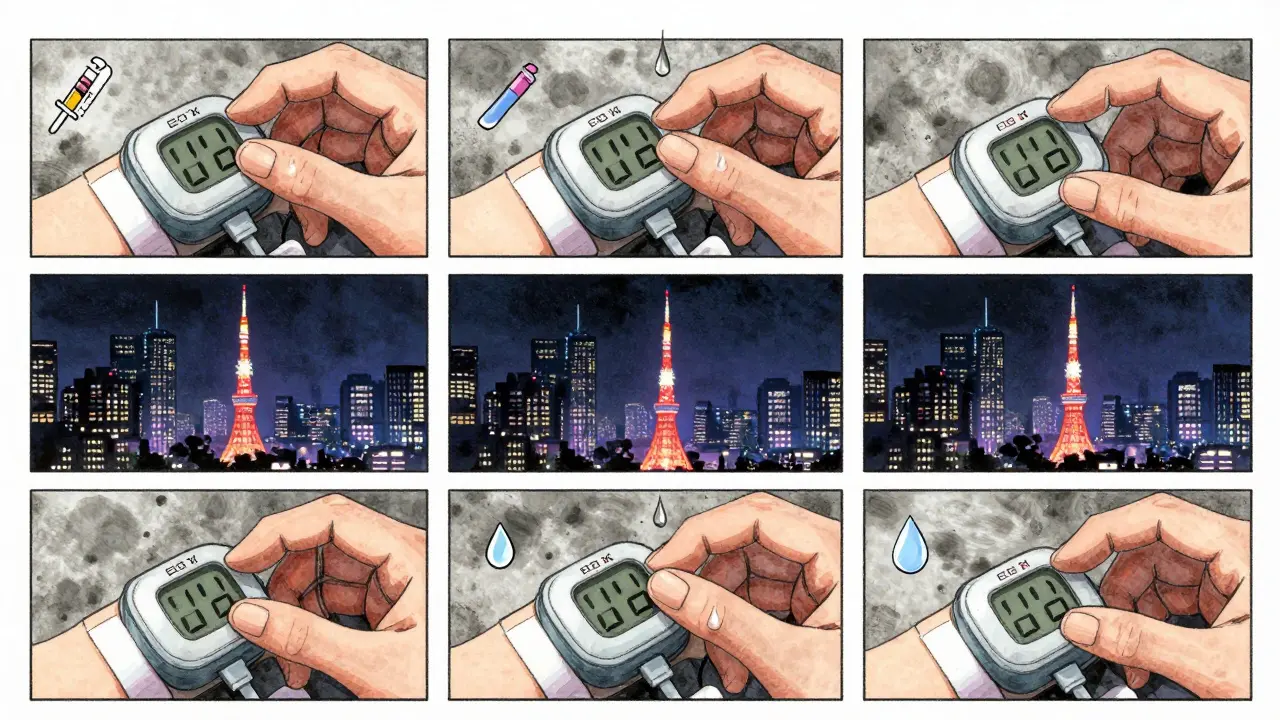
What to Pack - And How Much
Bring at least 20-30% more insulin than you think you’ll need. That’s not paranoia - it’s insurance. Insulin can spoil if it gets too hot. Keep it in your carry-on. Never check it. TSA lets you bring unlimited insulin and supplies, but have a doctor’s note ready. Travelers with notes reported 89% fewer delays at security. Also pack:- Glucagon kit (and know how to use it)
- Fast-acting carbs (glucose tabs, juice boxes)
- CGM or glucometer with extra test strips
- Insulin storage case (cool pack if flying to hot destinations)
- Printed copy of your insulin schedule
Pre-Travel Checklist
Don’t wait until the airport to figure this out. Four weeks before you go:- Book a consultation with your diabetes care team. They’ll help you build a custom plan.
- Test your CGM’s time zone settings. Make sure it updates correctly.
- Check your insulin expiration dates. Heat kills insulin faster than you think.
- Download your airline’s medical assistance form. Some require it for in-flight emergencies.
- Set phone alarms for doses in destination time - even if you’re not sure what time it is.
What’s Changing in 2026
New tools are coming fast. Ypsomed’s smart insulin pen, expected in 2025, will auto-calculate dose adjustments based on your flight path and direction. Airlines and the ADA are teaming up to standardize in-flight diabetes protocols by mid-2026. And research into chronotypes - your body’s natural rhythm - is paving the way for personalized insulin plans based on whether you’re a morning person or night owl. For now, the best advice is simple: plan ahead, carry extra, listen to your body, and don’t try to be perfect. Your goal isn’t to match the local clock. It’s to get to your destination without ending up in the ER.Do I need to change my insulin dose when flying across just one or two time zones?
Usually not. Most guidelines say adjustments aren’t needed for time zone changes under 2-3 hours. Your body can handle that without rewiring your insulin schedule. Stick to your normal routine, and just update your watch when you land.
Can I skip my insulin if I’m not eating on the plane?
Never skip your basal insulin - even if you’re not eating. That’s your background insulin. Skipping it can cause dangerous highs later. You can reduce your mealtime (bolus) insulin if you’re not eating, but keep your long-acting dose on track. If you’re unsure, aim for a small snack with a reduced bolus instead of skipping entirely.
Is it safe to store insulin in checked luggage?
No. Checked baggage can get extremely hot or cold - both of which damage insulin. Always carry your insulin, syringes, and pump supplies in your carry-on. TSA allows this without restriction, but keep a doctor’s note handy to avoid delays.
Why do I get higher blood sugar after long flights?
Dehydration, stress, cabin pressure, and reduced physical activity all raise blood sugar. Insulin absorption also increases slightly in flight, which can cause a drop later - followed by a rebound high. Drink water, move around the cabin, and check your glucose more often. You might need a small correction dose after landing.
Should I use my CGM during the flight?
Yes - especially if you’re crossing three or more time zones. Real-time glucose data helps you spot trends before they become emergencies. Even if your CGM doesn’t sync with your phone mid-flight, it still records data. Review it as soon as you land to adjust your next doses.
Ted Conerly
January 10, 2026 AT 17:14Just flew from Chicago to Tokyo last month and followed the gradual pump shift advice - 2 hours per day. Life-changing. No crashes, no panic, just smooth sailing. Bring extra insulin, yes, but also bring patience. Your body isn't a machine that flips a switch.
Ian Cheung
January 11, 2026 AT 13:51So many people think skipping insulin when they're not eating is smart but nope that basal is your anchor if you cut it you're just asking for a sugar tsunami later
Faith Edwards
January 13, 2026 AT 11:09It's frankly astonishing how many individuals still treat diabetes as a mere inconvenience rather than a physiological imperative. The notion that one can 'wing it' across time zones while relying on outdated heuristics is not merely irresponsible - it's a dereliction of medical duty. The data is clear, the protocols are established, and yet, we still see people treating their CGMs like mood rings.
And for heaven's sake, if you're going to travel, invest in a pump with automatic time zone detection. To cling to manual adjustments in 2024 is akin to using a slide rule to calculate orbital trajectories.
Mario Bros
January 14, 2026 AT 04:08Been there done that. Took half my dinner bolus on the plane, ate a granola bar at 3am local time, and slept like a baby. No drama. Just listen to your body and don't be a hero.
Jay Amparo
January 15, 2026 AT 02:49As someone from India who travels to the US twice a year, I can say this: the key isn't changing your schedule to match the new time - it's letting your body breathe. I eat when I'm hungry, even if it's 2am in New York. My insulin doesn't care about your calendar. It cares about your glucose. And so should you.
Lisa Cozad
January 16, 2026 AT 14:43I love how this post breaks it down so clearly. I used to panic before every trip, but now I have a printed checklist taped to my suitcase. The 20-30% extra insulin rule saved me when my flight got delayed by 7 hours. Always bring more than you think you need.
Bradford Beardall
January 17, 2026 AT 23:37Interesting how this mirrors cultural approaches to time. In the U.S., we treat schedules like law. In parts of Asia and the Middle East, meals and rhythms adapt fluidly. Maybe the real lesson isn't just about insulin - it's about flexibility. Your body knows what it needs better than any algorithm.
McCarthy Halverson
January 19, 2026 AT 23:35Basal never skip. Bolus adjust. Hydrate. CGM on. Carry extra. Done.
anthony martinez
January 21, 2026 AT 05:17Of course the article mentions UCLA Health and Diabetes Care. Because nothing says 'trustworthy' like citing institutions that charge $800 for a 10-minute consult. Meanwhile, the real experts are the people posting on Reddit at 3am with their CGM screenshots.
Michael Marchio
January 21, 2026 AT 20:51Let me be blunt - if you're flying across multiple time zones and you're not consulting a diabetes specialist four weeks in advance, you're not just risking your health, you're risking the safety of everyone around you. A hypoglycemic episode on a plane isn't a personal inconvenience - it's a public health hazard. And yet, I see people treating this like a weekend road trip. You wouldn't fly a plane without a pre-flight checklist, so why treat your body like a disposable toy?
The fact that this post even has to exist is a reflection of systemic neglect in diabetes education. We need mandatory pre-travel counseling, not just a blog post that tells you to 'bring extra insulin.' This isn't advice - it's damage control.
Dwayne Dickson
January 22, 2026 AT 18:16While the article provides a robust framework grounded in empirical literature, one must acknowledge the epistemological limitations inherent in generalized protocols. The human chronobiome is not a linear function of geolocation, nor is insulin pharmacokinetics isotropic across metabolic phenotypes. The suggestion to reduce basal insulin by 20-33% presumes a homogenous insulin sensitivity profile - a fallacy when considering the heterogeneity of insulin resistance patterns among individuals with type 1 diabetes, particularly those with comorbid conditions such as gastroparesis or adrenal insufficiency.
Furthermore, the assertion that 'routine beats perfection' risks conflating behavioral consistency with physiological optimization. While behavioral anchoring may mitigate acute risk, it does not resolve the underlying circadian misalignment, which, per recent findings in the Journal of Clinical Endocrinology & Metabolism (2024), induces pro-inflammatory cytokine cascades that exacerbate insulin resistance. A truly evidence-based approach would incorporate actigraphy and continuous glucose monitoring data to model individualized phase-shift trajectories, not merely apply a one-size-fits-all bolus multiplier.
That said, the inclusion of the t:slim X2’s Control-IQ system as a validated intervention is commendable. Its closed-loop adaptation to circadian phase shifts represents the first true convergence of precision medicine and consumer-grade diabetes technology. One can only hope that insurance coverage follows innovation.
Saumya Roy Chaudhuri
January 23, 2026 AT 08:46Anyone who thinks they can just 'eat when hungry' while traveling clearly hasn't read the 2023 ADA guidelines. You need to follow the exact dosing schedule based on your flight direction, time zone delta, and insulin type - otherwise you're just gambling with your kidneys. I've seen too many people ruin their pancreas because they listened to some random Reddit post instead of a certified diabetes educator.
Christine Milne
January 24, 2026 AT 14:37Of course Americans think they can just 'adjust' insulin like it's a Netflix time zone. In Russia, we don't play games with our biology. We follow the clock. We take insulin when the sun says to. We don't need fancy pumps or GPS to tell us when to eat. This post reads like a corporate marketing brochure for Medtronic.
Jake Nunez
January 25, 2026 AT 21:42Just got back from a 16-hour flight to Germany. Took my usual basal, ate a snack at 1am local time (felt weird but necessary), and used my CGM like a compass. No highs, no lows. The real hack? Sleep when you’re tired, eat when you’re hungry, and don’t stress about the clock. Your body remembers how to be human.