Cataracts: What Causes Lens Clouding and How Surgery Restores Vision
 Dec, 18 2025
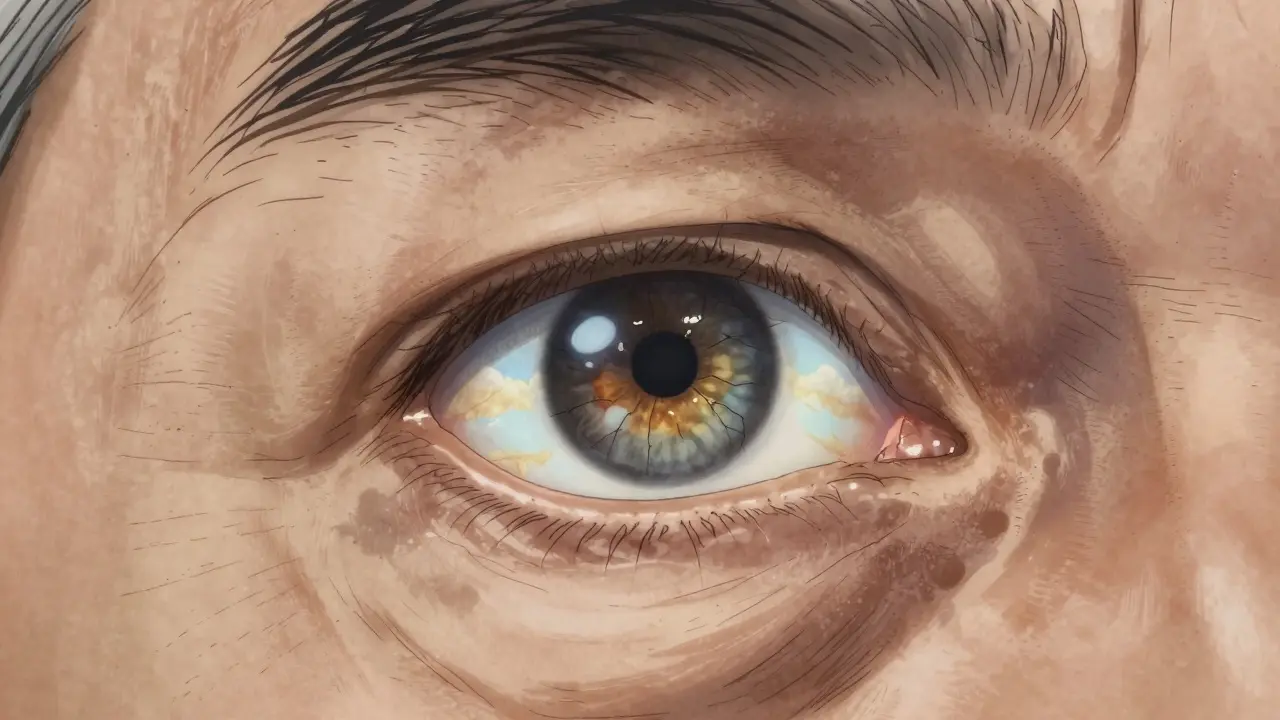
By the time you’re 65, there’s a better than 50% chance you’ll develop cataracts. It’s not a disease you catch-it’s something your eyes do as they age. The clear lens inside your eye slowly turns cloudy, like a fogged-up window. Colors fade. Glare from headlights or sunlight becomes blinding. Reading becomes a struggle, even with glasses. For millions, this isn’t just inconvenience-it’s loss of independence.
What Exactly Happens in the Eye?
Your eye’s lens is made mostly of water and protein. Over time, those proteins start to clump together. They don’t dissolve. They don’t go away. They just build up, scattering light instead of focusing it. That’s what causes the blur. It’s not a film over the eye. It’s not dirt. It’s the lens itself changing from the inside out. This process is slow. Most people don’t notice it at first. You might think you just need new glasses. But if your prescription keeps changing without improvement, or if you’re seeing halos around lights at night, that’s a red flag. Cataracts don’t hurt. They don’t itch. They just steal clarity, one day at a time.Why Does This Happen?
Aging is the biggest reason. More than 24 million Americans over 40 have cataracts. But it’s not just about getting older. Sun exposure, smoking, diabetes, and long-term steroid use can speed it up. Even a history of eye injury raises the risk. Genetics play a role too-if your parents had early cataracts, you might too. The good news? It’s not inevitable. Wearing UV-blocking sunglasses and quitting smoking can delay it. But once the clouding starts, nothing you put in your eye-eye drops, supplements, vitamins-will clear it. The only proven fix is surgery.How Is It Treated Today?
Cataract surgery is the most common surgery in the U.S., with nearly 4 million procedures done each year. It’s quick, safe, and done as an outpatient. You walk in, you walk out the same day. The standard method is called phacoemulsification. A tiny probe, smaller than a pencil tip, goes into your eye through a 2.5mm incision. It uses ultrasound to break up the cloudy lens into bits, then gently sucks them out. The old lens is gone. In its place, a new artificial lens-called an intraocular lens or IOL-is folded and inserted. Once inside, it unfolds and settles into the same spot where your natural lens used to be. It takes about 15 minutes per eye. Local numbing drops do the job. No needles in the eyeball. No hospital stay. Most people feel only slight pressure, nothing painful.What Kind of Lens Do You Get?
Not all IOLs are the same. The most common is the monofocal lens. It gives you sharp distance vision-good for driving, watching TV, recognizing faces. But you’ll still need reading glasses for close work. That’s normal. It’s not a failure. It’s how it’s designed. Premium lenses change the game. Multifocal IOLs let you see at multiple distances without glasses. Toric IOLs fix astigmatism at the same time. Trifocal lenses, like Alcon’s PanOptix or Zeiss’s AT LISA tri, offer clear vision at near, intermediate (like computer screens), and far. These aren’t covered by Medicare or basic insurance. Out-of-pocket costs range from $2,500 to $4,500 per eye. You don’t have to pay extra for a good result. A basic monofocal lens still restores 90% of vision in most people. The choice comes down to lifestyle. Do you read a lot? Work on a computer? Hate wearing glasses? That’s what guides the decision.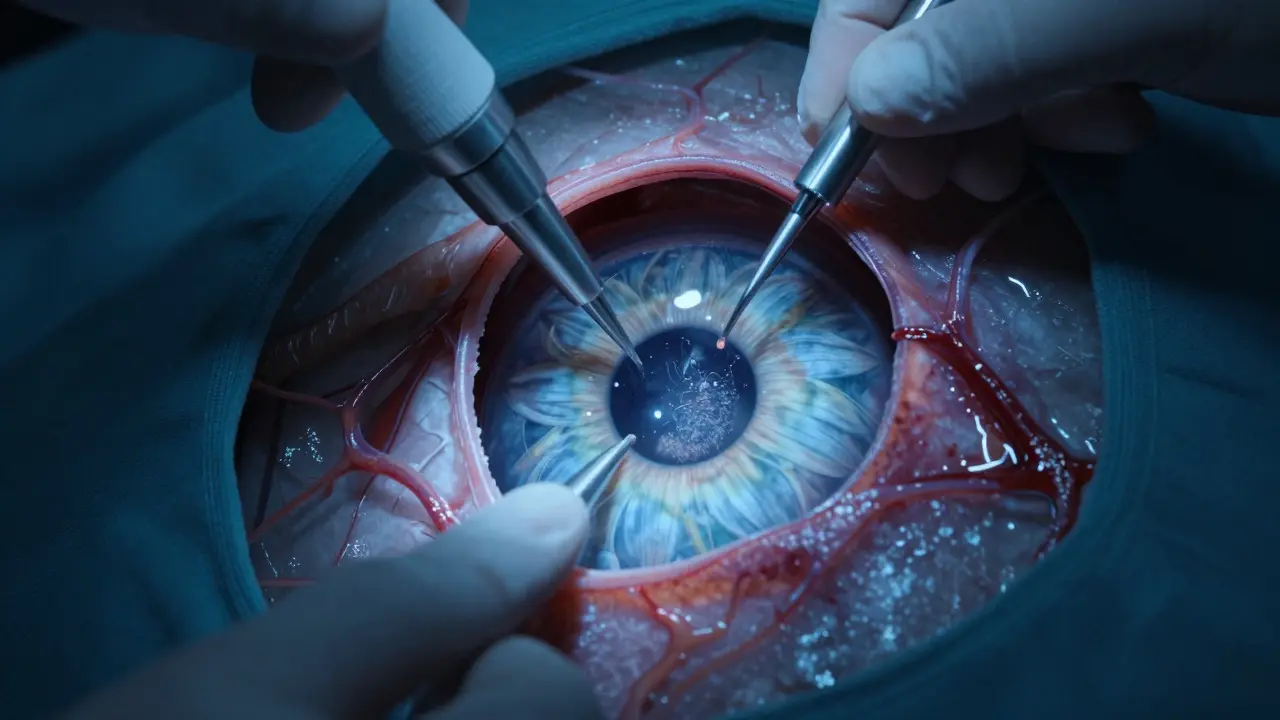
What Happens Right After Surgery?
You’ll leave with a clear shield over your eye. Your vision will be blurry-sometimes very blurry. That’s normal. Your brain hasn’t adjusted yet. The eye is healing. You might feel a scratchy, gritty sensation. Mild discomfort is common. Some people say their eye feels sticky or watery. None of this means something went wrong. You’ll get a prescription for eye drops. Antibiotics to prevent infection. Steroids to reduce swelling. You’ll use them four times a day for the first week, then taper off over the next few weeks. Missing doses increases risk. Don’t skip them. You can’t drive the day of surgery. Not even to the corner store. Your vision will be too unpredictable. Wait for your doctor’s green light-usually within 24 to 48 hours.Recovery Timeline: What to Expect
Most people notice better vision within 1 to 3 days. Colors look brighter. Contrast improves. Text on signs becomes readable without squinting. But full recovery? That takes longer. Some clinics say four weeks. Others say six to eight. The truth? It depends. If your cataract was advanced, or if you have diabetes or glaucoma, healing can take longer. Your brain also needs time to adapt to the new lens. One patient described it like this: “My brain had to relearn depth perception. Things looked flat at first.” Avoid heavy lifting, bending over, or intense exercise for at least two weeks. Don’t get water in your eye. No swimming, no hot tubs, no showering with your eyes open. Rubbing your eye? Absolutely not. Even a light poke can disrupt healing.Can You Still Need Glasses After Surgery?
Yes. And that’s okay. With a standard monofocal IOL, you’ll likely need glasses for reading, computer work, or detailed tasks. That’s the trade-off for clear distance vision. If you want to reduce your dependence on glasses, you need a premium lens. But even then, some people still need thin glasses for fine print or night driving. A 2022 study showed that 89% of people with the Tecnis Symfony lens achieved 20/25 vision or better at all distances. But that’s not 100%. Individual results vary. Your eye’s shape, corneal health, and healing response all matter.
What About Complications?
Cataract surgery is one of the safest procedures in medicine. Success rates are above 95%. But no surgery is perfect. The most common issue is posterior capsule opacification-sometimes called a “secondary cataract.” It’s not a new cataract. It’s just the thin membrane holding the new lens getting cloudy. It happens in 20-30% of patients within five years. The fix? A quick, painless laser treatment called YAG capsulotomy. It takes five minutes. No incision. No recovery time. Vision clears up in hours. Other complications-like infection, retinal detachment, or swelling-are rare, affecting only 2-5% of cases. They’re more likely if you have diabetes, high eye pressure, or a history of eye surgery.Is Vision Therapy Helpful After Surgery?
Most people don’t need it. But for some, it makes a difference. If your brain struggles to adapt to the new lens-especially with multifocal or toric IOLs-vision therapy can help. It’s not about strengthening your eye muscles. It’s about retraining how your brain interprets what your eyes see. Simple exercises like shifting focus between a near object and something far away can improve coordination. Some clinics use computer-based programs to help with contrast sensitivity and depth perception. Patients report less eye strain, better concentration, and fewer headaches after a few sessions. It’s not magic. But if you’re still feeling off after a month, it’s worth asking your eye doctor.What’s Next for Cataract Surgery?
The technology keeps improving. New IOLs are being designed to mimic the natural lens’s ability to focus-called accommodating IOLs. These are still in clinical trials but show promise. Laser-assisted cataract surgery is becoming more common. Instead of a blade, a computer-guided laser makes the incisions. It’s more precise. But it’s also more expensive and not always covered by insurance. The big driver? Aging populations. By 2030, nearly 70 million Americans will be over 65. The global market for cataract devices is expected to hit $6.3 billion by 2027. But the core hasn’t changed. Remove the cloud. Replace it with clarity. Restore the ability to see the world as it is.When Should You Act?
You don’t need surgery just because you have a cataract. You need it when it starts interfering with your life. Can you still read the newspaper? Drive safely at night? See your grandchildren’s face without squinting? If the answer is no, it’s time to talk to an ophthalmologist. Waiting too long can make surgery harder. Advanced cataracts are denser, take longer to remove, and carry slightly higher risks. But you also don’t need to rush. There’s no deadline. Just listen to your vision. The goal isn’t perfect 20/20. It’s freedom. Freedom to see your garden bloom. To read a book without a lamp. To drive home without fear. To look into someone’s eyes and really see them. That’s what cataract surgery gives back. Not just sight. Life.Can cataracts come back after surgery?
No, cataracts cannot return because the natural lens is removed and replaced. But the thin membrane holding the new lens can become cloudy over time-this is called posterior capsule opacification. It’s not a new cataract. It’s easily fixed with a quick laser treatment called YAG capsulotomy, which takes less than five minutes and restores clear vision immediately.
Is cataract surgery painful?
No. The procedure uses numbing eye drops, so you won’t feel pain. You might feel pressure or a sensation of movement, but not sharp pain. Most patients describe it as surprisingly comfortable. Recovery involves mild discomfort for a day or two, like having sand in your eye, but it’s manageable with rest and prescribed drops.
How long does it take to recover from cataract surgery?
Most people notice better vision within 1-3 days. Full healing takes 4-8 weeks, depending on individual factors like age, overall health, and whether you have conditions like diabetes. You can return to light activities within a few days, but should avoid heavy lifting, swimming, and rubbing your eye for at least two weeks. Vision may continue to improve for up to three months as your brain adapts to the new lens.
Will I still need glasses after cataract surgery?
It depends on the type of lens implanted. A standard monofocal lens corrects distance vision, so you’ll likely need reading glasses for close tasks. Premium lenses like multifocal or toric IOLs can reduce or eliminate the need for glasses, but they cost more and aren’t always covered by insurance. Even with premium lenses, some people still need glasses for fine print or night driving.
Can cataracts be prevented?
You can’t stop aging, but you can slow cataract development. Wear UV-blocking sunglasses, quit smoking, manage blood sugar if you have diabetes, and eat a diet rich in antioxidants like leafy greens and colorful vegetables. These steps won’t prevent cataracts entirely, but they can delay their onset by years.
Is cataract surgery covered by insurance?
Basic cataract surgery with a standard monofocal intraocular lens is typically covered by Medicare and most private insurance plans. However, premium lenses-like multifocal, toric, or trifocal IOLs-that reduce dependence on glasses are considered elective upgrades and are not covered. These cost $2,500-$4,500 per eye out-of-pocket.
What are the risks of cataract surgery?
Cataract surgery is very safe, with a 99.5% success rate. The most common risk is posterior capsule opacification, which affects 20-30% of patients but is easily treated. Serious complications like infection, retinal detachment, or swelling are rare, occurring in only 2-5% of cases. Risks increase slightly if you have diabetes, glaucoma, or a history of eye trauma.
Can you have cataract surgery if you have other eye conditions?
Yes, but outcomes vary. If you have glaucoma, macular degeneration, or diabetic retinopathy, cataract surgery can still improve your vision-but it may not restore it fully. Your eye doctor will assess whether the cataract is the main cause of your vision loss or if other conditions are limiting results. In some cases, treating the cataract first helps better evaluate and manage the other condition.
Sajith Shams
December 19, 2025 AT 17:21Let me break this down for you people who think cataracts are just a normal part of aging. They’re not. It’s the result of decades of UV exposure without protection and poor diet. I’ve seen it in my clinic in Delhi-people who never wore sunglasses and ate nothing but fried food and white rice. Their lenses turn to fog by 55. It’s preventable. Stop blaming genetics. Blame your lifestyle.
And don’t get me started on those premium lenses. If you can’t afford them, you shouldn’t be getting surgery at all. You’re just delaying the inevitable. Basic monofocal is fine. Stop being greedy.
shivam seo
December 21, 2025 AT 16:46Bro. I got my cataract surgery last year. Zero pain. Zero drama. Walked out with a shield on my eye and a coffee in my hand. Two days later I was reading street signs like a hawk. The only thing that sucked? The eye drops. Four times a day? Like clockwork. Missed one once. Felt like my eyeball was trying to escape.
But here’s the kicker-my vision’s better than it was at 25. I can see the texture on my cat’s fur. That’s wild.
Andrew Kelly
December 21, 2025 AT 21:39Let’s be honest-this entire industry is a cash grab disguised as medicine. The FDA approves these lenses with minimal long-term data. The ‘premium’ IOLs? They’re marketed like iPhones. ‘Oh, this one has infrared night vision!’ No. It just lets you read a menu without glasses. Meanwhile, Medicare pays for the basic lens and leaves you to pay $4,000 extra for the privilege of not needing readers.
And who’s pushing this? Pharma reps. Eye doctors who get kickbacks. And you-buying into it because you’re scared of growing old. Wake up. You don’t need a $9,000 lens to see your grandchildren. You need a pair of $15 reading glasses and a little patience.
bhushan telavane
December 23, 2025 AT 13:53In India, we call cataracts ‘andha kala’-the blindness of age. But in villages, people still work in fields past 70 with no surgery. They adapt. They use hats, they wait for morning light, they memorize paths. Surgery is a luxury. Not everyone can afford it. But if you can? Do it. Don’t wait until you can’t see your child’s face. That’s not wisdom. That’s pride.
And yes, UV sunglasses matter. My dad wore one every day since 1985. He’s 82. Still reads the newspaper without glasses. Not because of luck. Because he respected his eyes.
Mahammad Muradov
December 24, 2025 AT 20:32Anyone who says cataract surgery is ‘safe’ is lying to themselves. I know a man who lost 30% of his peripheral vision after the procedure. The doctor said ‘it’s rare.’ But rare doesn’t mean impossible. And now he can’t drive. Can’t walk alone at night. He’s 68. His life is smaller now. Not better.
And those ‘premium’ lenses? They cause glare, halos, ghost images. People don’t tell you that. They just say ‘you’ll see better.’ But better for what? For scrolling TikTok? For reading text messages? Is that really worth risking your vision?
And don’t even get me started on YAG laser. They call it ‘painless.’ But what if the laser hits the retina? What if the pressure spikes? No one talks about that. They just sell you the dream.
Connie Zehner
December 25, 2025 AT 07:50OMG I JUST HAD MY SURGERY LAST WEEK AND I CRIED WHEN I SAW MY DOG’S EYES AGAIN 😭😭😭 I DIDN’T REALIZE HOW MUCH I’D MISSED THE LITTLE THINGS-THE WAY THE LIGHT HIT HER FUR, THE TWINKLE IN HER EYES, THE WAY SHE WINKED AT ME WHEN I WALKED IN THE ROOM. I’M ON MY 3RD WEEK OF DROPS AND MY EYE STILL FEELS WEIRD BUT IT’S WORTH IT. I’M SO GRATEFUL. THANK YOU FOR SHARING THIS. I FEEL SEEN. 😊❤️
Also-did anyone else get the ‘floating dots’ after? My doctor said it’s normal but I’m still scared. Is it gonna go away? 😫
holly Sinclair
December 26, 2025 AT 05:47There’s a deeper philosophical layer here that rarely gets discussed. The lens isn’t just a biological structure-it’s a metaphor for perception. We think we see the world clearly, but over time, our experiences, biases, and fears cloud our vision. Cataracts are a physical manifestation of that. We don’t notice the blur until it’s severe. We blame the world for being dim, when the problem is internal.
Surgery doesn’t just replace a lens-it forces us to relearn how to see. To trust our eyes again. To accept that clarity isn’t permanent. That even after the procedure, we’ll still be filtering reality through layers of memory, trauma, and expectation. The real surgery isn’t in the eye. It’s in the mind.
And maybe that’s why so many people feel ‘off’ after surgery-not because of the lens, but because they’re suddenly confronted with a world they’ve been avoiding for years. Brighter. Sharper. More demanding. And they’re not ready for it.
Monte Pareek
December 27, 2025 AT 10:47You’re all overthinking this. Here’s the truth: if your vision is messing with your life, get it fixed. No guilt. No shame. No conspiracy. Just action.
I’m an ER nurse. I’ve seen people wait until they can’t read the clock. Until they can’t find the toilet. Until they fall because they thought the step was still there. That’s not aging. That’s negligence.
Yes, the surgery isn’t perfect. Yes, you might still need glasses. But you’ll still see better than you did before. That’s not a luxury. That’s dignity.
And if you’re scared? Talk to someone who’s been through it. Not some random Reddit guy. A real patient. I’ve got a list. DM me.
And for god’s sake-wear your sunglasses. It’s not optional. It’s armor.
Alex Curran
December 28, 2025 AT 11:29Just had my second eye done last month. First eye was 2022. The difference? Night driving used to be terrifying. Now I see the lane markings like they’re painted yesterday. The halos? Gone. The glare? Reduced by 80%. I didn’t even know I’d been squinting for 10 years.
Monofocal lens. No extras. No regrets. My optometrist said my corneas healed like a champ. No complications. Just clarity.
One thing no one says: the first week feels like you’re wearing dirty glasses. Then suddenly-it clicks. Like a camera refocusing. Your brain just… adjusts. It’s weird but beautiful.
Edington Renwick
December 28, 2025 AT 23:38Everyone’s acting like this is some miracle cure. Let me tell you about my neighbor. Got the surgery. Thought she was golden. Then she started seeing double. Then she developed chronic dry eye. Then she needed a second surgery to fix the lens alignment. Now she’s on drops 24/7 and still can’t read without a magnifier.
They don’t tell you this stuff. They just show you the before-and-after photos of the model patients. The rest of us? We’re just collateral damage.
Don’t rush. Don’t trust the hype. Your vision is sacred. Don’t trade it for a marketing slogan.
Allison Pannabekcer
December 29, 2025 AT 15:38I want to say something kind to everyone who’s scared.
You’re not alone. I was terrified. I thought I’d go blind. I thought I’d lose my independence. I cried the night before surgery.
But I went. I did it. And the next morning, I saw my granddaughter’s freckles for the first time. I didn’t know she had them. I’d been missing them for years.
If you’re hesitating, I get it. But don’t let fear steal more than the cataract already has. You don’t have to be perfect. You don’t have to get the fancy lens. You just have to say yes to seeing again.
And if you’re reading this and you’re still scared? Text me. I’ll walk you through it. No judgment. No sales pitch. Just a human who’s been there.