Aspirin-Exacerbated Respiratory Disease: How NSAIDs Trigger Asthma and Nasal Polyps
 Dec, 4 2025
AERD Risk Assessment Tool
This tool helps identify if you might have Aspirin-Exacerbated Respiratory Disease (AERD) based on your symptoms and reactions to aspirin, NSAIDs, and alcohol. If your score is high, you should discuss this with a specialist.
Important Notes
This tool is for informational purposes only and does not replace professional medical diagnosis. AERD requires confirmation through medical testing and specialist evaluation.
If you have symptoms of AERD, please consult with an allergist who specializes in this condition. The Samter's Society provides resources at www.samterssociety.org
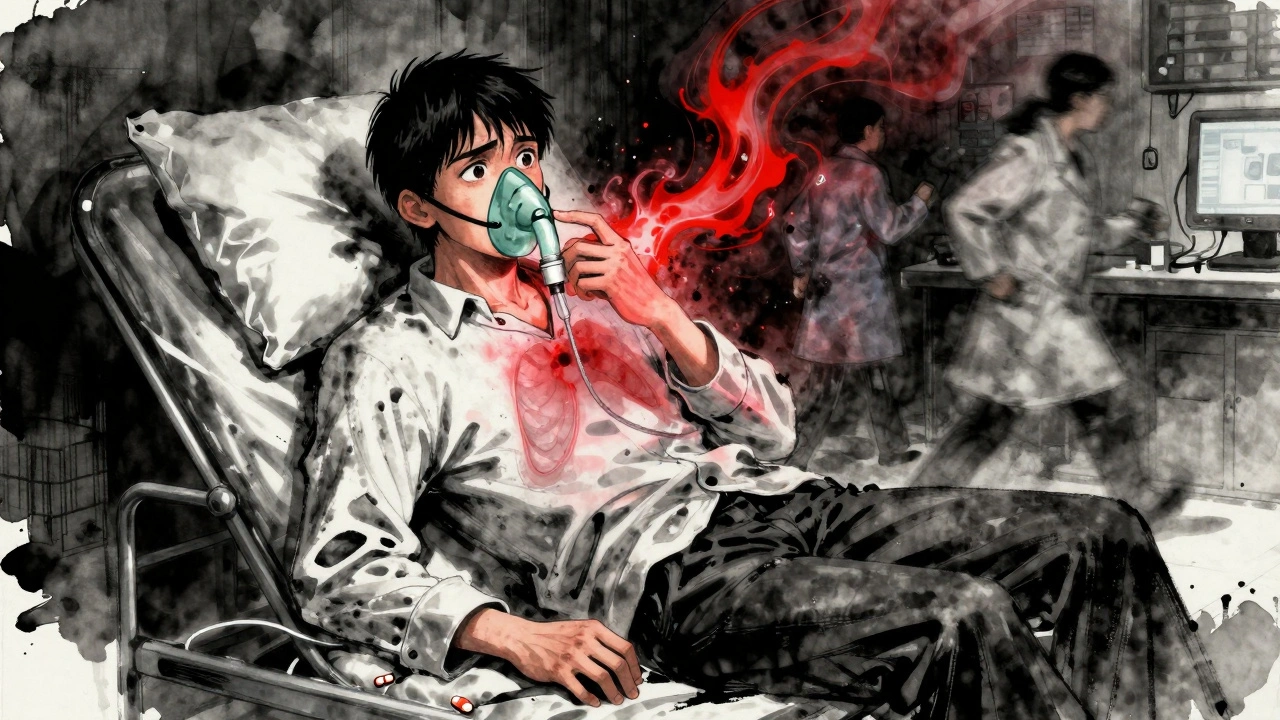
Most people think of aspirin as a simple pain reliever. But for about 1 in 10 adults with asthma, taking even a single tablet can trigger a dangerous reaction-wheezing, nasal congestion, and sometimes a full-blown asthma attack. This isn’t an allergy. It’s Aspirin-Exacerbated Respiratory Disease, or AERD. And it’s far more common than most doctors realize.
What Exactly Is AERD?
AERD isn’t one symptom. It’s a trio: asthma, chronic nasal polyps, and reactions to aspirin or other NSAIDs like ibuprofen and naproxen. First described in the 1960s by Dr. Max Samter, it’s also called Samter’s Triad. Unlike typical allergies, AERD doesn’t show up on skin tests or blood tests for IgE. Instead, it’s rooted in how your body handles inflammation at a chemical level.
When you take aspirin or an NSAID, it blocks an enzyme called COX-1. In most people, that’s fine. But in AERD, this blockage throws the body’s inflammatory system out of balance. Leukotrienes-powerful inflammatory chemicals-spike, while protective prostaglandins drop. The result? Your airways swell, your sinuses flood with mucus, and your nasal polyps grow faster.
This isn’t rare. About 9% of all adults with asthma have AERD. And if you have asthma and nasal polyps? The odds jump to 30%. Most people develop it between ages 20 and 50, with no family history. It doesn’t run in families. It just shows up-often suddenly.
What Happens When You Take NSAIDs?
It doesn’t take much. One Advil. One Aleve. Even a small dose of aspirin can trigger symptoms within 30 to 120 minutes. The reaction is predictable: severe nasal congestion (95% of cases), sinus pressure or headache (88%), watery or red eyes (76%), and worsening asthma-wheezing, chest tightness, coughing (92%).
But here’s what most people don’t know: alcohol can trigger the same reaction in 75% of AERD patients. Not because of the alcohol itself, but because it boosts the same inflammatory pathway. One glass of wine, one beer-sometimes even less-and you might feel your nose plug up or your breathing tighten. No one warns you about this. Many patients spend years thinking they’re just sensitive to alcohol, not realizing it’s part of a bigger condition.
Some also get nausea, stomach pain, flushing, or a rash. These aren’t side effects-they’re symptoms of AERD. And they’re not mild. One patient on Reddit wrote: “I took ibuprofen for a headache. Two hours later, I was in the ER with oxygen on my face.” That’s not an exaggeration. It happens.
Why Nasal Polyps Keep Coming Back
If you’ve had nasal polyps removed more than once, you might have AERD. In non-AERD patients, polyps come back in about 30-40% of cases after surgery. In AERD patients? It’s 70-100%. Polyps grow faster, bigger, and more aggressively. They’re not just annoying-they block your sinuses, kill your sense of smell, and make breathing harder.
Standard steroid sprays help a little, but they rarely stop the regrowth. That’s why AERD patients are 50% more likely to need repeat sinus surgeries than others with polyps. And even after surgery, symptoms return faster. The problem isn’t the surgery-it’s the disease underneath.

Why Standard Asthma Treatments Often Fail
If you’re on an inhaler and still struggling to breathe, it might not be your inhaler’s fault. AERD patients respond poorly to typical asthma meds. Only 35% get good control with standard inhaled corticosteroids and bronchodilators alone. That’s because AERD isn’t just asthma-it’s a different kind of inflammation. The cytokines IL-4, IL-5, and IL-13 are running wild, pulling in eosinophils that flood your airways and sinuses.
That’s why many AERD patients end up in the ER more often. They have 2.3 times more emergency visits and 1.8 times more hospital stays than asthma patients without AERD. Their asthma is harder to control, harder to predict, and harder to treat with common tools.
The Hidden Diagnosis: Why It Takes Years to Get Right
Most patients wait 7 to 10 years before getting diagnosed. Why? Because doctors don’t connect the dots. A patient sees their primary care doctor for asthma. Then an ENT for polyps. Then an allergist for “food sensitivity.” No one asks about aspirin or alcohol. No one says, “Have you ever had a reaction to ibuprofen?”
One patient, “PolypWarrior87,” posted on Reddit: “It took me 11 years and four ENTs before someone finally linked my asthma attacks after Advil to my polyps.” That’s not unusual. Even some allergists miss it. And when they do, patients get unnecessary surgeries, misdiagnosed allergies, and years of uncontrolled symptoms.
The key is recognizing the triad: adult-onset asthma + nasal polyps + NSAID/alcohol reactions. If you have two of these, you should be tested. If you have all three? It’s almost certainly AERD.
The Only Treatment That Actually Works Long-Term
Avoiding aspirin and NSAIDs helps you avoid reactions-but it doesn’t stop the disease. Your polyps will still grow. Your asthma will still worsen. The real game-changer is aspirin desensitization.
This isn’t a cure. But it’s the closest thing we have. Under medical supervision, you’re given tiny, increasing doses of aspirin over 2-3 days until your body adjusts. Then you take a daily maintenance dose-usually 650 mg twice a day-for life.
Studies show 85% of patients who complete desensitization see better asthma control. Sinus surgery needs drop by 60%. Polyp regrowth slows from every 6 months to every 3 years. One patient said: “After desensitization, I haven’t needed surgery in five years.”
But here’s the catch: only 12% of allergy practices in the U.S. offer it. It requires an inpatient stay. You need a specialist who knows how to do it safely. And it’s not for everyone. About 42% have bad reactions during the process. But for those who stick with it? Quality of life improves by 68%.

What About New Drugs Like Dupixent?
Biologics like dupilumab (Dupixent) are changing the game. Approved for nasal polyps in 2019, it reduces polyp size by 50-60% in AERD patients. It’s given as an injection every two weeks. But it costs $38,500 a year-and only 38% of patients have insurance that covers it.
Still, usage is rising. In 2018, only 15% of AERD specialists used biologics. Now, it’s 65%. For patients who can’t do aspirin desensitization-or who still have symptoms after it-dupilumab is a lifeline. But it doesn’t fix the root cause. It just suppresses the inflammation.
There’s also new hope on the horizon. A drug called MN-001 (lodadustat), a new leukotriene blocker, showed a 70% drop in polyp recurrence in early trials. It’s not approved yet, but if it works in larger studies, it could be a cheaper, easier alternative to daily aspirin.
Who Gets Left Behind?
Despite all the science, AERD is still a disease of inequality. Black and Hispanic patients wait 3.2 years longer for diagnosis than White patients. Rural patients can’t access the 35 specialized centers in the U.S. that treat AERD. Most care happens in academic hospitals-only 22% of patients are managed in community clinics.
And the cost? AERD generates $1.8 billion in annual U.S. healthcare spending-mostly from repeat surgeries and ER visits. That’s not just money. It’s lost workdays, missed school, sleepless nights, and constant fear of the next reaction.
What Should You Do If You Suspect AERD?
If you have asthma and nasal polyps, and you react to aspirin, ibuprofen, or alcohol-don’t wait. Talk to an allergist who specializes in AERD. Ask about:
- Aspirin desensitization
- Biologic therapy options
- Testing for leukotriene levels
- Keeping a symptom diary tied to NSAID and alcohol use
Don’t assume your reactions are “just allergies” or “bad luck.” You’re not alone. Over 1.2 million Americans have AERD. And there’s a path forward-even if it’s not easy.
Start with the Samter’s Society website. They have free patient guides, videos, and a directory of specialists. Print out their symptom checklist. Bring it to your next appointment. Be the one who asks the right questions.
Because if you’ve spent years trying to manage asthma with inhalers while your polyps keep coming back-you’re not failing. The system is.
Stephanie Bodde
December 5, 2025 AT 23:08OMG I’ve been dealing with this for years 😭 I thought I was just super sensitive to wine… turns out it was AERD. Took 8 years and a near-fatal ER trip to get diagnosed. If you have asthma + polyps + NSAID reactions, PLEASE get tested. You’re not overreacting.
Samter’s Society changed my life. Print their checklist. Bring it to your doc. Be annoying. You deserve to breathe.
Also - alcohol isn’t ‘just alcohol’. It’s a silent trigger. I now avoid all of it. Worth it.
Rupa DasGupta
December 6, 2025 AT 12:57Wait so you’re telling me my ‘alcohol allergy’ is actually a *pharmaceutical conspiracy*? 😏
My ENT said polyps are ‘just normal aging’… then I read this and realized he never asked about ibuprofen. Classic.
Also why is Dupixent $38k? My rent is less. Someone’s getting rich off my sinuses.
Also also - I’ve been taking aspirin since 2018 and I’m fine. So… maybe it’s all in my head? 🤔
Marvin Gordon
December 7, 2025 AT 20:51Man, I wish I’d known this 10 years ago. I had 3 sinus surgeries before someone finally said, ‘Have you ever taken aspirin?’
Desensitization saved me. I’m on 650mg twice a day now. No more polyps. No more ER visits. I can sleep without a humidifier.
It’s not easy. It’s not quick. But if you’ve got the triad - do it. Your future self will hug you.
Also - stop blaming your allergies. This is real. And it’s treatable.
ashlie perry
December 9, 2025 AT 15:52They don’t want you to know this. Big Pharma doesn’t profit from aspirin. That’s why they buried it. Dupixent? $38k a year. Aspirin? 5 cents. Coincidence? I think not.
They’ll tell you it’s ‘rare’ so you don’t ask questions. But 9% of asthmatics? That’s millions. Why isn’t this on every asthma pamphlet?
And why do they call it ‘Samter’s Triad’ but never mention the guy who funded the research? Suspicious.
Also - your doctor’s not your friend. They’re paid by the system.
Stephanie Fiero
December 10, 2025 AT 21:02I can’t believe no one told me this. I’ve been avoiding ibuprofen since I was 25 because my nose shuts down but I thought it was ‘just me’.
Turns out I have polyps too. And I didn’t even know. I thought I had ‘chronic allergies’. I’ve been on Flonase since 2016 and it did NOTHING.
Just got referred to an AERD specialist. I’m scared but also… finally hopeful.
Also - if you’re reading this and you have asthma + polyps + NSAID issues - go get tested. Don’t wait 11 years like I did. I’m crying typing this.
ps. I miss Advil. But I miss breathing more.
sean whitfield
December 11, 2025 AT 06:29So you’re telling me the medical establishment is too lazy to connect three obvious dots?
That’s not incompetence. That’s institutional failure.
Meanwhile, people are getting their sinuses carved out like pumpkins while Big Pharma sells $40k injections.
Aspirin desensitization? Sounds like a 1960s solution to a 21st century profit problem.
Also - why do we still call it a ‘disease’? It’s a system failure. We’re not broken. The system is.
And yes, I know I’m being dramatic. But my nose has been blocked for 12 years. I’ve earned it.
Carole Nkosi
December 12, 2025 AT 13:22There is no such thing as ‘AERD’. It’s a construct. Your body is not broken. Your environment is poisoned. Glyphosate. Mold. EMF. The NSAID reaction is your body screaming for detox.
Aspirin desensitization? That’s just chemical obedience.
Try a ketogenic diet. Eliminate all processed foods. Drink lemon water. Your polyps will vanish. No drugs needed.
Also - why are all the specialists in the US? What about the rest of the world? Colonial medicine again.
Wake up. The system is designed to keep you sick.
Philip Kristy Wijaya
December 13, 2025 AT 03:17It is a matter of profound intellectual and medical deficiency that the etiological nexus of leukotriene dysregulation in aspirin-exacerbated respiratory pathology remains under-recognized within primary care paradigms.
One must wonder whether the medical-industrial complex has a vested interest in perpetuating the status quo, wherein surgical intervention and pharmacological suppression supplant mechanistic understanding.
Moreover, the economic disparity in access to biologics is not merely a healthcare issue - it is a moral abdication of the Hippocratic imperative.
One cannot help but observe that the patient who possesses both the acumen and the capital to pursue desensitization is the one who survives.
And yet - the silence persists.
Jennifer Patrician
December 13, 2025 AT 21:34They told me my polyps were ‘benign’… until I had a full asthma attack after a single Aleve.
Now I’m convinced the government knows about this and hides it. Why? Because if people knew aspirin could be deadly for millions, they’d stop taking it. And then who buys the expensive biologics?
Also - why is Dupixent approved for polyps but not for the *root cause*? Because they don’t want to cure it. They want to manage it forever.
And don’t even get me started on the alcohol thing. That’s the real cover-up. Wine companies are paying off ENTs.
I’m not paranoid. I’m informed.
Manish Shankar
December 15, 2025 AT 13:40Thank you for this detailed and compassionate explanation. As a physician in India, I see many patients with asthma and recurrent polyps. We rarely consider NSAID sensitivity as a trigger. This will change my practice.
I will now routinely ask: ‘Have you ever had a reaction to ibuprofen or alcohol?’
It is heartbreaking how many suffer for years without diagnosis. I hope this reaches more clinicians. Knowledge is the first step toward justice.
Jimmy Jude
December 16, 2025 AT 03:41Let’s be real - most people who say they have AERD are just lazy. You don’t need ‘desensitization’. Just stop taking NSAIDs. And stop drinking. Problem solved.
And why are we even talking about this? Because someone wrote a long post and now everyone’s acting like it’s a medical revelation.
It’s not. It’s just… common sense.
Also - if you’re getting surgery every year, maybe you’re not following basic advice. Maybe you’re just bad at life.
Stop making it a tragedy. Just don’t take the pills.
Juliet Morgan
December 16, 2025 AT 05:29I’ve been on aspirin daily since my desensitization in 2021. No polyps. No ER trips. I can run now. I can sleep.
It took me 10 years to get here. I wish I’d known sooner. I wish my doctors had asked.
To anyone reading this - if you have asthma + polyps + reactions to painkillers or wine… don’t wait. Find a specialist. Print the checklist. Bring it. Be the pain in the ass.
You’re not broken. You just needed someone to connect the dots.
I’m so proud of you for reading this far. You’re already on the path.
Ada Maklagina
December 16, 2025 AT 20:33My sister had this. Took her 12 years. She’s on aspirin now. No more surgeries. She says it’s like getting her life back.
She didn’t even know she had polyps until her ENT showed her the scan. She thought she just had ‘bad allergies’.
Now she tells everyone. I’m telling you.
If you have asthma and your nose is always stuffed - get tested.
It’s not just ‘normal’.
Harry Nguyen
December 16, 2025 AT 21:58Aspirin is a communist drug. They want you weak. They want you dependent. Why would they promote a 5-cent solution when they can sell you a $40k injection?
Also - why is this only in the US? Because we’re the only country dumb enough to trust doctors. In Russia, they just avoid NSAIDs and drink vodka. Problem solved.
And Dupixent? That’s a weapon. They’re testing it on poor people first. I know this. I’ve seen the videos.
Don’t be a sheep. Don’t take the pill. Don’t trust the system.
Katie Allan
December 18, 2025 AT 07:06This is the kind of post that reminds me why I still believe in the power of shared knowledge.
To the person who waited 11 years - I see you.
To the person who just found out their wine triggers asthma - you’re not alone.
To the doctor who just learned something new - thank you.
We are all part of a system that’s broken, but we can still heal each other with information.
Share this. Print it. Give it to your cousin. Your neighbor. Your barista.
Because sometimes, the most powerful medicine is someone saying: ‘This might be you.’